|
|
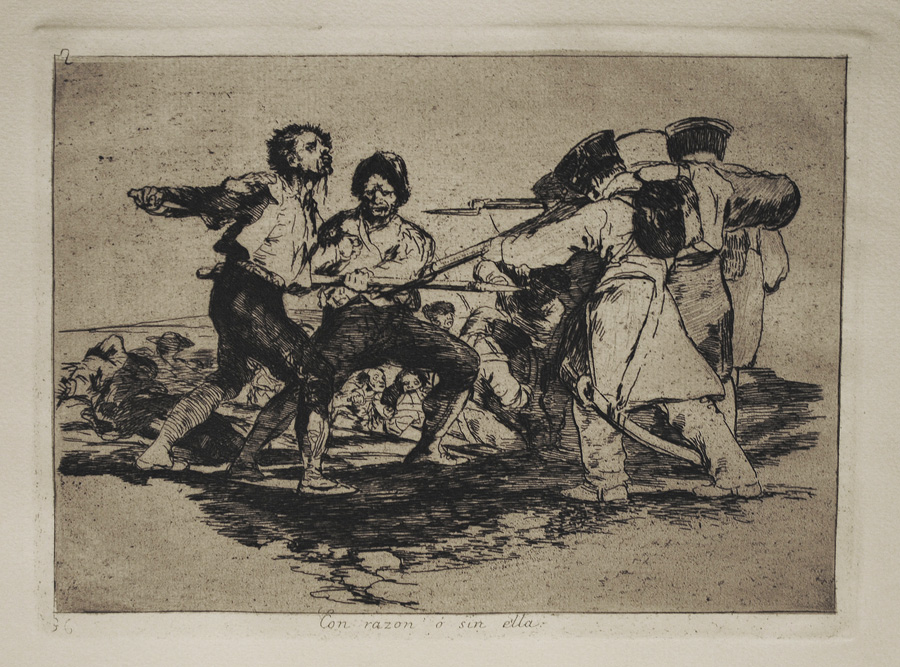
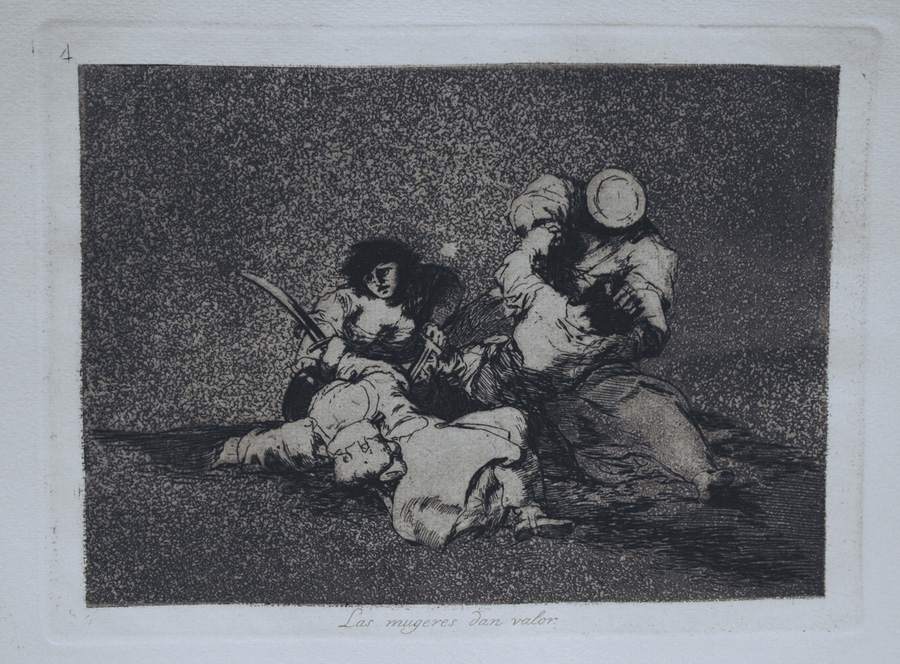
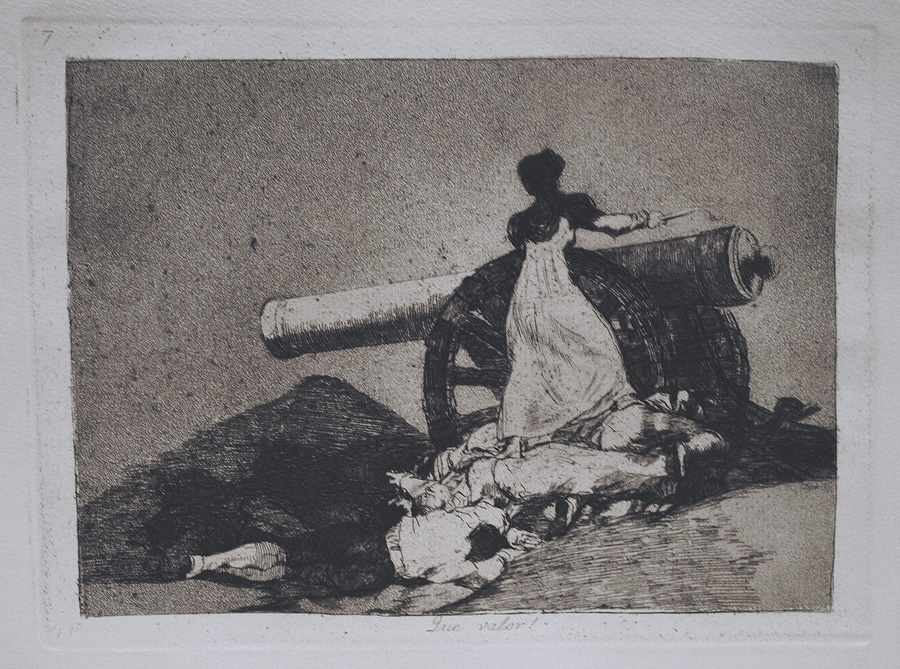
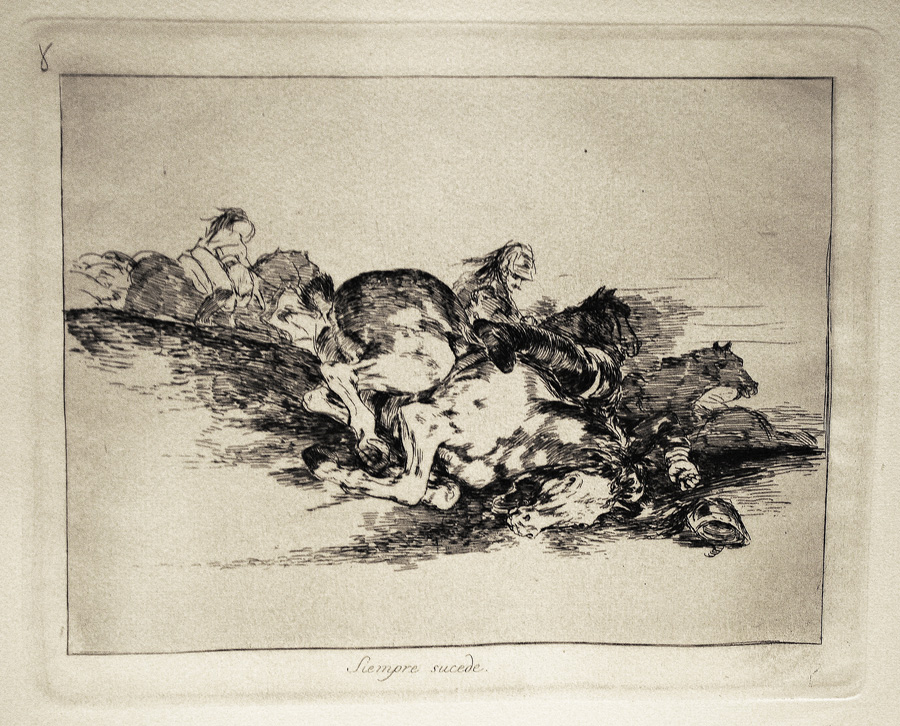
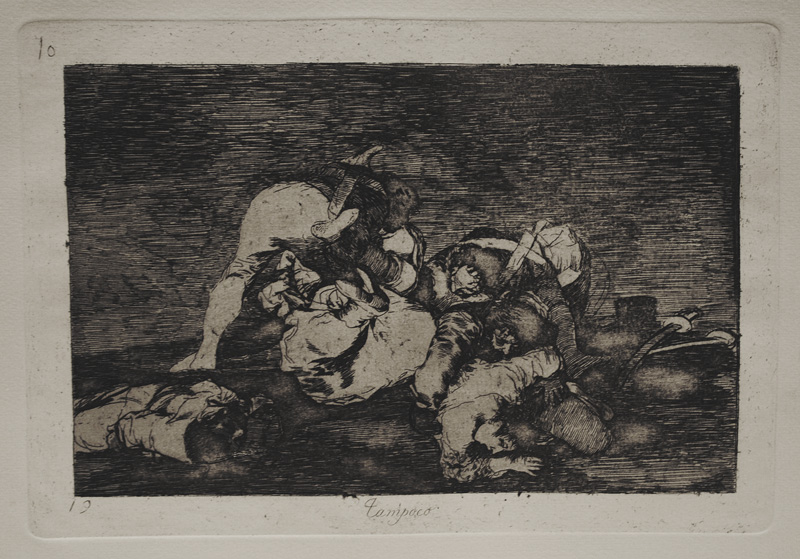
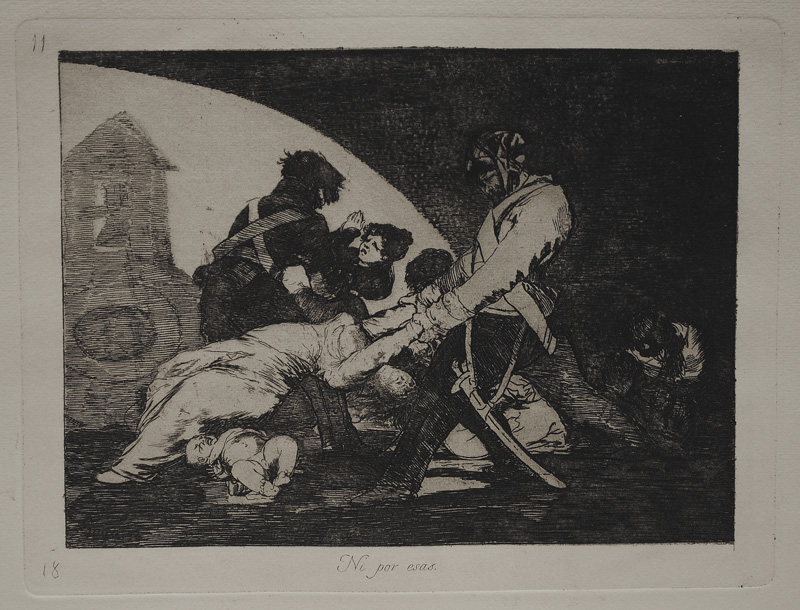
Robert Hughes, whose The Shock of the New introduced America to modern art when it was aired on public television and whose American Visions, a survey of American Art up to the from the Spanish invaders of the southwest and the Pilgrims in New England to Abstract Expressionism and Pop Art, tells us in the opening pages of his Goya (2003) that in the midst of the Vietnam War, which tore America apart for many years, "there was nothing, absolutely nothing, that came near the achievement of Goya's Desasters de la guerra (Disasters of War), those heart-rending prints in which the artist bore witness to the almost unspeakable facts of death in the Spanish uprising against Napoleon, and, in doing so became the first modern visual reporter on warfare" (p. 7). Otto Dix's Krieg, the twentieth-century's witness to the horror of war, almost pales (although it is horrible enough to look at in itself) before Goya's depiction of the early nineteenth century's horrors of war, both civil and uncivil, between atrocities perpetrated on Spaniards by Spaniards and atrocities perpetrated by the French upon the Spanish (and vice-versa). Hughes suggests (p. 273) that "very broadly, the images fall into three groups. Forty-six plates, 2 through 47, describe incidents of guerilla war, the Spanish pueblo against Napoleon's soldiers. Eighteen more, 48 through 65, are concerned with the effects of the great famine that devasted Madrid between 1811 and 1812—a famine that Goya, living in the city, experienced too, and whose effects he saw at first hand. And then there are the Caprichos enfáticos, or 'emphatic caprices'—a run of fifteen allegorical and satirical images rather than journalistic reportage, that attack what one might call the disasters of peace—evoking the shattered hopes of the Spanish liberals and illustrados in the wake of Napoleon's defeat after Fernando VII returned to the throne, abolished the 1512 Constitution, and set in train an iron policy of repression, censorship, inquisitorial tyranny, and royal absolutism."
Select Bibliography: Rogelio Buendia Goya (NY: Arch Cape Press, 1990), Jean-François Chabrun, Goya: His Life and Work (NY: Tudor, 1965), Colta Ives & Susan Alyson Stein Goya in the Metropolitan Museum of Art (NY: Metropolitan Museum of Art, 1995), Raymond Keaveney, Master European Paintings from the National Gallery of Ireland from Mantegna to Goya (Dublin: National Gallery Of Ireland, 1992), Fred Licht, Goya and the Origins of the Modern Temper in Art (NY: Harper & Row, 1983), Park West Gallery. Goya: Sleeping Giant (Southfield MI: Park West Gallery, n.d.), Alfonso E. Perez Sanchez, and Eleanor Sayre, Goya and the Spirit of the Enlightenment (Boston: Museum of Fine Arts, 1989), Maurice Raynal, The Great Centuries of Painting: The Nineteenth Century. New Sources of Emotion from Goya to Gauguin (Geneva: Skira, 1951), Daniuel Catton RIch, ed. The Art of Goya: Paintings, Drawings, and Prints (Chicago: The Art Institute, 1941), Richard Schickel, The World of Goya 1746-1828 (NY: Time-Life Books, 1968), The Royal Academy of Arts in London, Goya and his times (London: Royal Academy, 1963), Janis A. Tomlinson, Goya in the Twilight of the Enlightenment (New Haven: Yale University Press, 1992), Juliet Wilson-Bareau & Manuela B. Mena Marqués, Goya: Truth and Fantasy. The Small Paintings (New Haven: Yale University Press, 1994).
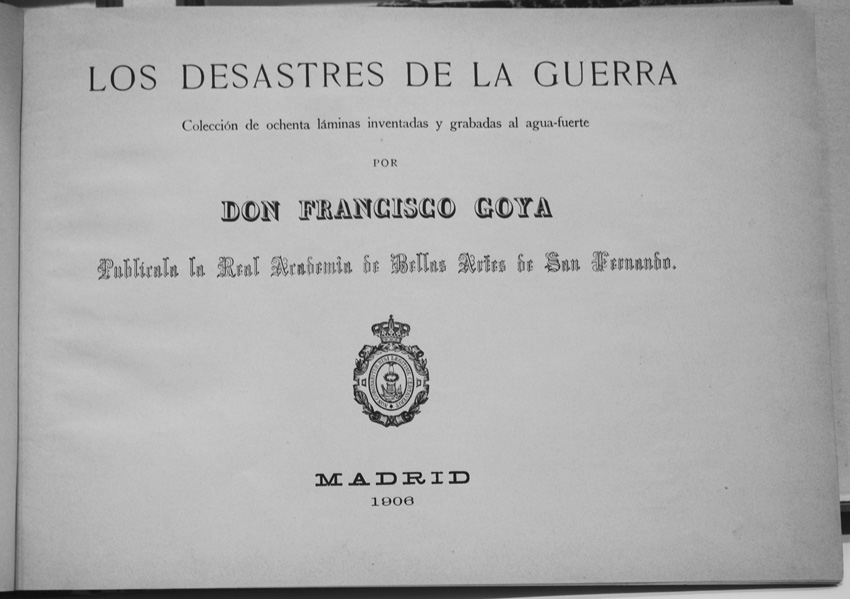
Works on Prints: The standard catalogue raisonnés of Goya's prints by Loys Delteil and Tomás Harris are both out of print but should be available in major libraries and in museums; there is a reprint of the Harris published by Alan Wofsy in 1983 which we have used throughout. We follow Harris in our descriptions of the editions, for which see volume 2, pages 172-176, and the individual prints (pp. 177-304). Los Desastres de la Guerra was not published during Goya's lifetime because he would have been called before the Inquisition, from whence few returned. Harris briefly discusses the 472 trial proofs printed before Goya's death and then summarizes the quality of the various editions. Generally, the first edition published in 1863 for the Real (i.e., Royal) Academia in an edition of 500, is by far the best, though the first 300 or so are of much higher quality than the remaining pieces, where "the tone of the ink is darkened to compensate for the wear of the aquatint" (pp. 173-74). The second edition was published by the Real Academía (as were all later ones) in 1892 in an edition of 100; Harris says that the plates were probably steel-faced before the making of this edition (p. 174). The third edition was published in 1903 in an edition of 100, which Harris describes as "very inferior to the second). The fourth edition was published by the Real Academía in 1906 in an edition of 275. Harris describes it as "excellently printed on very suitable papers" and says that "the impressions are generally a little inferior to those of the second edition but are better than those of the third." The fifth edition, which Harris describes as "inferior to all previous ones" was published by the Real Academía om 1923 in an edition of 100. Harris attributes the problems to over-inking and the very hard quality of the paper. The sixth edition was made in 1930 the for the Real Academía; Harris describes it as "little inferior to the second edition and superior to the third. The seventh and last edition was made in 1937 the for the the Ministerio de Instrucción Publica in 1937, during the Spanish Civil War. Five sets were printed on Old Japan paper, of which three were dedicated to Stalin, Eleanor Roosevelt, and the Republican President, Azana, leaving two sets unaccounted for. 15 sets on Imperial Japan paper were published in a parchment portfolio, and 130 sets on Arches paper were were also published. Harris says, "This edition is remarkably good and the impressions are the best taken from the plates after the second edition. We acquired a complete set of the fourth edition a number of years ago, and most of our impressions are from that edition. We have also had several impressions from the first edition (one of which is still available). We find it close in quality to the impression of the same piece from the fourth edition. We also have one impression from the third edition, which is seriously deficient when compared to the same work from the 4th edition. In 1988 were were fortunate to see an exhibition of all of Goya's prints in the Guttenberg Museum in Mainz (an outing for the faculty of the English Department at the University of Giessen, where I taught for the summer session. They displayed impressions of Los Desastres from the fourth edition. We were also lucky enough to see an exhibition of Los Desastres at the University of Iowa Art Museum several year later (I think; it might have been at Iowa State University). It was also composed of impressions from the fourth edition. These two exhibition, of course, made us feel quite pleased when we acquired our own complete set of Los Desastres in the fourth edition.
The most convenient reproduction of The Disasters of War is the edition published by Dover Books in 1967 with a very short introduction by Philip Hofer of the Department of Graphic Arts at the Harvard University Library. Also likely to be available inexpensively in used condition: Aldous Huxley, ed., The Complete Etchings of Goya (NY: Crown Publishers, 1943; Huxley incorporates Goya's own comments on the Caprichos from a manuscript now in the Prado in Madrid, many of which I have incorporated in my descriptions), ). See Nigel Glendinning, Goya: La Década de los Caprichos. Retratos 1792-1804 (Madrid: Real Academia de Bellas Artes de San Francisco, 1992), Verna Posever Curtis and Selma Reuben Holo, La Tauromaquia: Goya, Picasso and the Bullfight (Milwaukee: Milwaukee Art Museum, 1986), Anthony H. Hull, Goya: Man Among Kings (NY: Hamilton Books, 1987), R. Stanley Johnson, Goya: Los Caprichos (Chicago: R.S. Johnson, 1992; Johnson usefully cites remarks of an early commentator on Goya's Caprichos from a manuscript preserved in the Biblioteca Nacional, Madrid, many of which I have incorporated in my descriptions), Elie Lambert, Goya: L'oeuvre grave (Paris: Alpina, n.d.), Roger Malbert, ed. Disasters of War: Callot, Goya, Dix (London: Cornerhouse Publications, 1998), Alfonso E. Pérez Sánchez, & Julián Gállego, Goya: The Complete Etchings and Engravings (Munich: Prestel-Verlag, 1995), Nicholas Stogdon, Francisco de Goya, Los Caprichos: Twenty Proofs and a New Census (London: N.G. Stogdon, Inc, 1988), Janis A. Tomlinson, Graphic Evolutions: The Print Series of Francesco Goya (NY: Columbia University Press, 1989).
|
|
|