Click image for BBB rating
See our Privacy Policy
cool="cool" width="865" height="7970" border="0" cellpadding="0" cellspacing="0" gridx="16" showgridx="showgridx" usegridx="usegridx" gridy="16" showgridy="showgridy" usegridy="usegridy" bgcolor="#99ccff">
|
 |
|
|
|
|
|
|
Welcome to Spaightwood Galleries, Inc.
120 Main Street, Upton MA 01568-6193
You can follow us on Facebook at http://www.facebook.com/pages/Spaightwood-Galleries-Inc/122951564441757
I blog there regularly and announce special events and special sales.
Contemporary American Art, c. 1960 to 2014, Part I
|
|
|
|
|
|
We are currently showing the second part of a 2-part show of American Art from c. 1960 to the present. Part I opened Saturday, May 17 and ended Labor Day, September 1, 2014. Part II has been on the wall since early September and will end on Sunday, November 9. It will be followed by a large show of Marc Chagall's etchings from 1923-1956 and of his lithographs from 1950 to his death. The show will run from Friday November 21 2014 until Sunday, February 22, 2015.
The first part focused on works by women artists, including Helen Frankenthaler (5), Joan Mitchell (10), Louise Nevelson (11), Louise Bourgeois (2), Nancy Graves (3), Hollis Sigler (2), Lynda Benglis (2), Emmi Whitehorse (4), Pat Steir (8), Suzanne McClelland (2), Elaine de Kooning (2), Judy Pfaff, Jennifer Bartlett (3), Susan Rothenberg (3), Judy Chicago, Betye Saar, Dorothea Tanning (2), Anita Jung (9), and others. Part 2 (beginning the first week of September) will focuses on Robert Motherwell, Jules Olitski, James Brown, Jim Dine, Larry Rivers, James Rosenquist, Andy Warhol, Alex Katz, Ellsworth Kelly, Sam Gilliam, Jack Beal, Richard Diebenkorn, Sam Francis, and others. Both shows share a common group of 31 small-format works by Jasper Johns, Ellsworth Kelly, Barnett Newman, Willem de Kooning, Elaine de Kooning, Claes Oldenburg, Philip Guston, James Brown, Anita Jung, James Rosenquist, and others as well as a group of 10 medium-sized works by Jim Dine, Alex Katz, Larry Rivers, Jane Freilicher, Elaine de Kooning, Emmi Whitehorse, Jaune Quick-to-See Smith, Robert Motherwell, and Lesley Dill.
We had planned to present just one show, but as we started hanging the works, it quickly became clear that that would be impossible: we simply have far too many works to fit on the walls if we try to show works by male and female artists simultaneously. Partly this is a function of our space. As one enters the gallery, there are two about 16 feet long. Before we started running out of space for books and prints, these space had about 7 feet of usable verticle space; after we added additional book shelves and print storage spece, we were down to about 58 inches: enough for 31 vertical 16 x20 inch framed works, so we always reserve this space for smaller pieces. After passing through this space, one sees two walls (one on either side of this entry space), each of which, after we added more spaces to hold print storage boxes, could hold about 5 framed works 20x24, 24x20 or 28x28 (but that's practically frame-to- frame). Moving out to the two long walls, each of which has three spaces about 9 feet wide and 9 feet high (over the bookshelves) and two spaces about 54 inches wide (same height). At either end of the main display area, there are two walls about 9 feet wide and about 15 feet high (no bookshelves or additional print-storage spaces yet). Beyond them, more bookshelves over which are hanging paintings, drawings, and prints by Claude Garache, one of our favorite artists. At the moment, this is feeling like a permanent allocation, but we shall see. At the very back of this space are three paintings by Gerard Titus-Carmel, one of which is 80x80 inches and two of which are only 60x60 inches. Because we had so many works we wanted to include, after hanging the long walls in the main gallery space, and leaning works up against thebookshelves that run the length of the space, we rehung parts of the show to add more pieces and use more of the vertical space we had. To take the virual tour of the larger works, click Gallery Tour 2
Even after all this, however, we had too many works for one show, so although the entry spaces are full of works by both men and women, the long walls (and floors) are pretty much exclusively devoted to works by men. This will, of course, reverse starting in September, when we see how many of our 24 Motherwells, 8 Olitskis, 7 James Browns, 5 Jim Dines, 5 Warhols, 4 Lichtensteins, 4 Rivers, 4 Rosenquists, 4 William Weeges, 2 Pearlsteins, 2 Beals, and assorted works by other artists (including Christo, Sam Francis, Jack Youngerman, Ellsworth Kelly, Frank Stella, and a Sam GIlliam monoprint/collage) we can fit up on the walls. Also on display: Richard Lindner, Mel Ramos, Philip Pearlstein, Lester Johnson, Allen Jones, Allan D'Arcangelo, Richard Kulicke, Alan Shields, Charles Arnoldi, and others.
|
|
|
|
 |
|
|
|
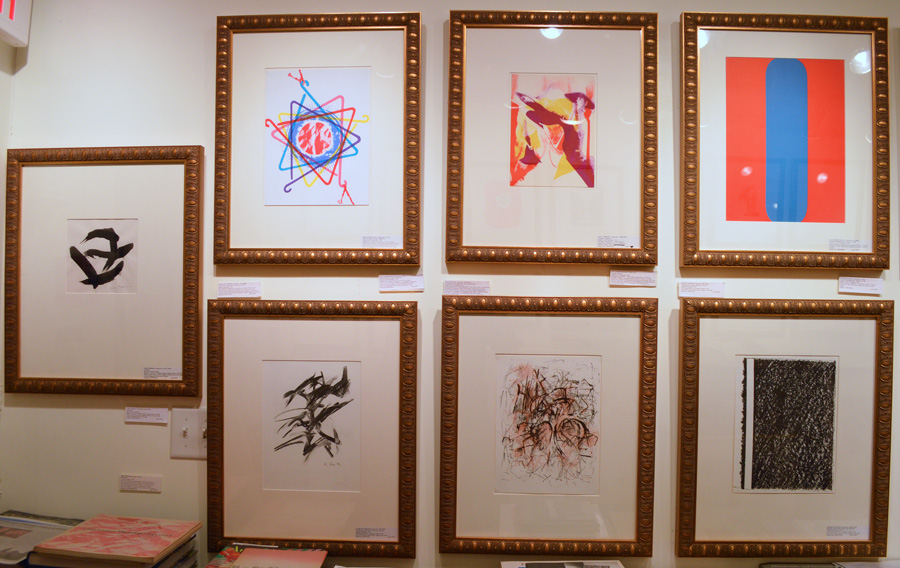
At left: Sara Freeeman (American, no biographical information), Untitled. Original composition in ink and brush. Signed in pencil lower right. I have failed to find any information about the artist. Image size: 140x160mm. Price: Please call or email for current pricing information.
TOP ROW: James Rosenquist (American, b. 1933), Auto tire, dinner triangle (Glenn 95). Original color lithograph, 1955. 38 signed & numbered impressions +8 TPs on Arches. There is also an edition of unknown size published unsigned in a special issue of the deluxe art review, XXe Siecle, from which our impression comes. Printed by Mourlot, Paris. Image size: 254x187mm. Price: Please call or email for current pricing information.
Paul Jenkins (American, 1898-1976), L'Atelier Mourlot, 1964. 150 signed impressions + 1000 unsigned impressions on arches for "L'Atelier Mourlot" (as presented at the Redfern Gallery in London). Jenkins was a pioneer in pouring paint ontop canvas and letting chance and judgment debate the composition. He also supplied the paintings shown in "An Unmarried Woman" (Jill Claybough & Alan Bates, 1977). Image size: 254x187mm. Price: Please call or email for current pricing information.
Ellsworth Kelly (American, b. 1923). Untitled (Red/Blue/Red) (Axsom, p. 178). Original 2-color lithograph, 1964. Edition unknown (c. 1500 as published in the deluxe art review, Derrière le Miroir. These images were based upon based upon collages for a show at Galerie Maeght. IMage size: 380x280mm. Price: Please call or email for current pricing information.
Elaine de Kooning (american, b.
BOTTOM ROW: Elaine de Kooning (American, 1920-1988), On the way to San Remo. Original lithograph for a memorial volume published by The Museum of Modern Art to commemorate Frank O'Hara, the poet and MoMA curator whose sudden death was memorialized by the artists he worked with by creating images to accompany In Memory of My Feelings: A Selection of Poems by Frank O'Hara. Published as a collection of unbound sheets combining poetry and images. The edition consisted of 2500 numbered volumes (ours are from 352/2500) and it was chosen for inclusion in From Manet to Hockney: Modern Artiasrs' Illustrated Books in 1985 and illustrates 3 of the lithographs by Willem de Kooning, Roy Lictenstein, and Philip Guston. For a better photograph of the work, please click here. Image size: 303x227mm. Price: Please call or email for current pricing information.
Joan Mitchell (American, 1926-1992), Meditations in an Emergency. Original color lithogaph, 1967. Published in In Memory of My Feelings, 1967. For a better photograph of the work, please click here. Image size: 303x227mm. Price: Please call or email for current pricing information.
Barnet Newman, Sleeping on the Wing. Original lithogaph, 1967. Published in In Memory of My Feelings, 1967. Image size: 303x227mm. Price: Please call or email for current pricing information.
|
|
|
|
 |
|
|
|
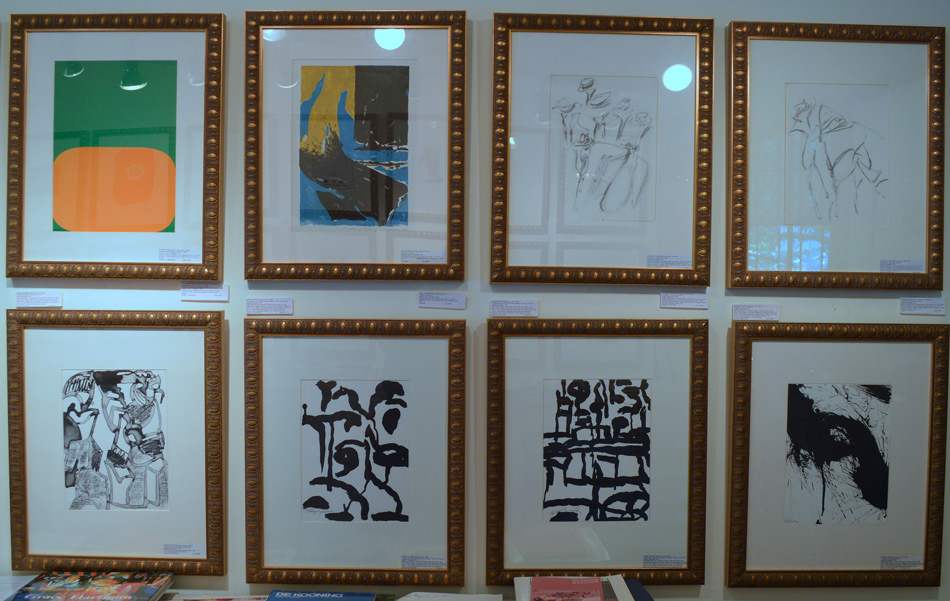
This is a fairly narrow area (onlyabout 10 feet wide) that never gets any natural light illumination and depends upon flood lights on both sides of the space for illumination. Since the lights are all on one circuit, the effects of reflections are especially bad when photographing each wall, though, happily, not much of a problem when one is looking at indvidual works.
TOP ROW: Ellsworth Kelly (American, b. 1923). Untitled (Green/Orange) (Axsom, p. 178). Original 2-color lithograph, 1964. Edition unknown (c. 1500 as published in the deluxe art review, Derrière le Miroir. These images were based upon collages for a show at Galerie Maeght. IMage size: 380x280mm. Price: Please call or email for current pricing information.
Adja Yunkers (Russia 1900-1983 US), Summer in Venice I. Original color lithograph, 1966. 250 impressions signed lower right by the artist and date '66 for the Cleveland Print Club ( + 10 HCs) The stamp of the Cleveland Print Club is on the verso.Yunkers' work is in the collections of the Bibliotheque Nationale, Paris; the Brooklyn Museum; the Corcoran Gallery in Washington D.C.; the Fine Arts Museum of San Francisco, the Hamburg Kunsthalle, theV&A (London), and many others. Image size: 338x280mm. Price: Please call or email for current pricing information.
Willem de Kooning (Netherlands 1904-1997 America), Untitled I (V&A, pp. 318-319) . Original lithograph, 1967. 2500 impressions for a memorial tribute to the poet and art critic, Frank O'Hara. For a better photograph of the work, please click here. Thre is a full-page illustration in Carol Hogben & Rowan Watson, eds., From Manet to Hockney: Modern Artists' Illustrated Books (London: Victoria and Albert Museum, 1985), p. 319. Image size: 303x227mm. Price: Please call or email for current pricing information.,
Willem de Kooning (Netherlands 1904-1997 America), Untitled I (V&A, pp. 318-319). Original lithograph, 1967. 2500 impressions for a memorial tribute to the poet and art critic, Frank O'Hara. For a better photograph of the work, please click here. Image size: 303x227mm. Price: Please call or email for current pricing information.
Norman Bluhm (American, 1921-1999), Naphtha. Original lithograph, 1967. 2500 impressions for a memorial tribute to the poet and art critic, Frank O'Hara. Signed in the stone. Bluhm was an important member of the New York Abstract Expressionist group from the 1960s. He had solo shows at the Leo Castelli and Martha Jackson Galleries, the Corcoran in Washington D.C. (which is now a part of the National Gallery), and many others. Image size: 303x227mm. Price: 400.
|
|
|
|
 |
|
|
|
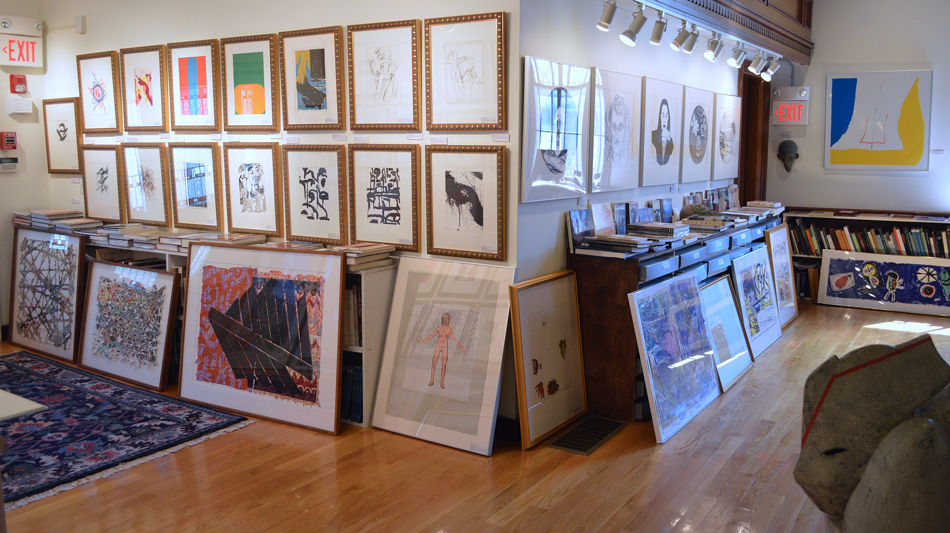
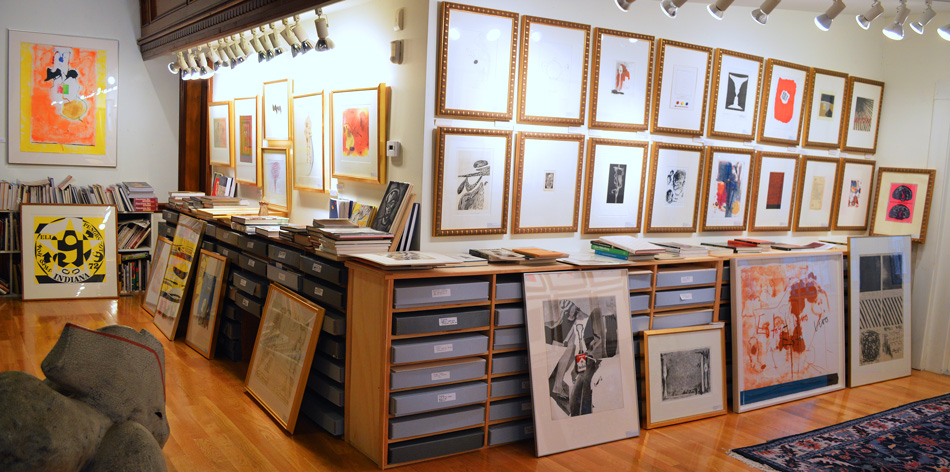
The view from just past the entry looking left: Sara Freeman (c. 1960?); TOP ROW: Untitled; James Rosenquist, Auto Tire, Dinner Triangle, 1955; Ellsworth Kelly, Red/Blue/Red and Green/Orange (1964); Adja Yunkers, Summer in Venise I (1966); Willem de Kooning, Untitled I and Untitled III, 1967; BOTTOM ROW: Elaine de Kooning, On the Way to San Remo (1967); Joan Mitchell, Meditations in an Emergency (1967); Barnet Newman, Sleeping on the Wing (1967); Grace Hartigan, The Day Lady Died (1967); Philip Guston, Composition I and II for "Ode to Michael Goldberg" (1967); Norman Bluhm, Naphtha (1967);. Beneath these works are three works by Bill Weege, each a unique piece or part of a series, each of which is different: left: Untitled, painted paper & string construction, 1978; Do not drop, painted paper & string construction, 1981; U.T. Hocker #31, mixed media on hand-made paper, 1982; Judy Chicago, Old, Original screenprint, 2013.
Wall to the right: 5 works for a deluxe edition of John Ashberry's Self-Portrait in a Convex Miroir (1984), a set of 7 works in various media printed on circular paper and presented in a large metal movie-film canister: our impressions are all numbered 117/175 and pencil signed by the artists, Jim Dine, Self-Portrait in a Convex Miroir; Elaine de Kooning, Portrait of John Ashberry, Alex Katz, Portrait in a Convex Miroir; Jane Freilicher, Still Life; and Larry Rivers, Pyrography: John Ashbery Working (hand-colored). missing from the wall (for reasons of space) is R. B. Kitaj, Self-Portrait; also missing is Willem de Kooning, Self-Portrait in a Convex Miroir, which we sold a number of years ago.
On the far well is Helen Frankenthaler, Sun Corner (HR 13, Harrison 12), 1968 (screenprint on aluminum, 17/50, published in 1968 by the Metropolitan Museum of Art for a travelling show of contempoary American art.
|
|
|
|
 |
|
|
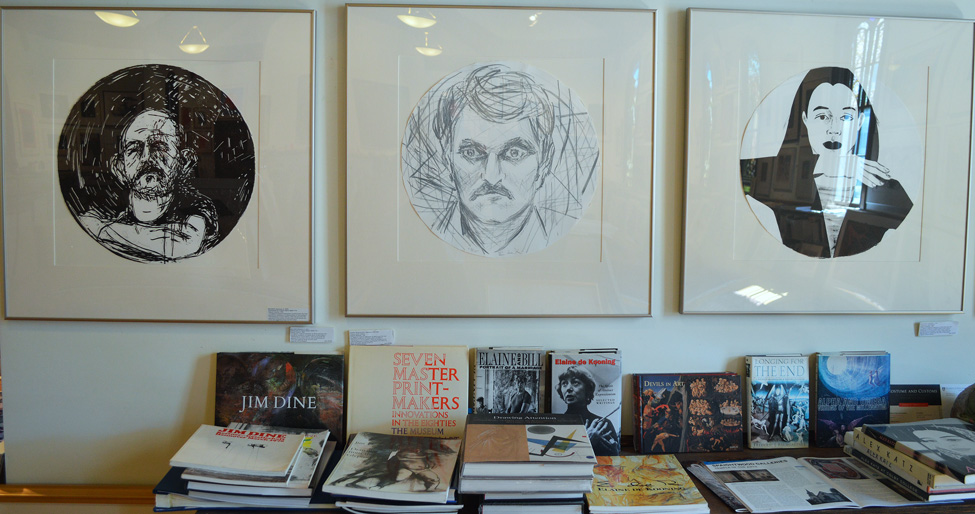
Since the lighting on the wall where the works from John Ashberry's Self-Portrait in a Convex Miroir (1984) are so hard to see in the image above, here are the first three works from the portfoloio: Jim Dine, Self-Portrait in a Convex Miroir, (D&F 179). Original woodcut, 1984. 175 signed & numbered impressions of which twenty five were reserved for contributors to a deluxe edition of John Ashbery's Self-Portrait in a Convex Mirror. Dine's woodcut is based upon Parmigianino's famous self- portrait. Image size: 387mm in diameter. Price: Please call or email for current pricing information.
Elaine de Kooning, Portrait of John Ashberry. Original lithograph, 1984. 175 signed & numbered impressions of which twenty five were reserved for contributors (including Richard Avedon, Jim Dine, Willem de Kooning, Elaine de Kooning, Jane Freilicher, Alex Katz, R. B. Kitaj, and Larry Rivers) to a deluxe edition of John Ashbery's Self-Portrait in a Convex Mirror. Image size: 387mm diameter. Price: Please call or email for current pricing information.
Alex Katz, Portrait in a Convex Miroir. Original lithograph, 1984. 175 signed & numbered impressions of which twenty five were reserved for contributors to a deluxe edition of John Ashbery's Self-Portrait in a Convex Mirror. Image size: 387mm in diameter. Price: Please call or email for current pricing information.
|
|
|
|
 |
|
|
|
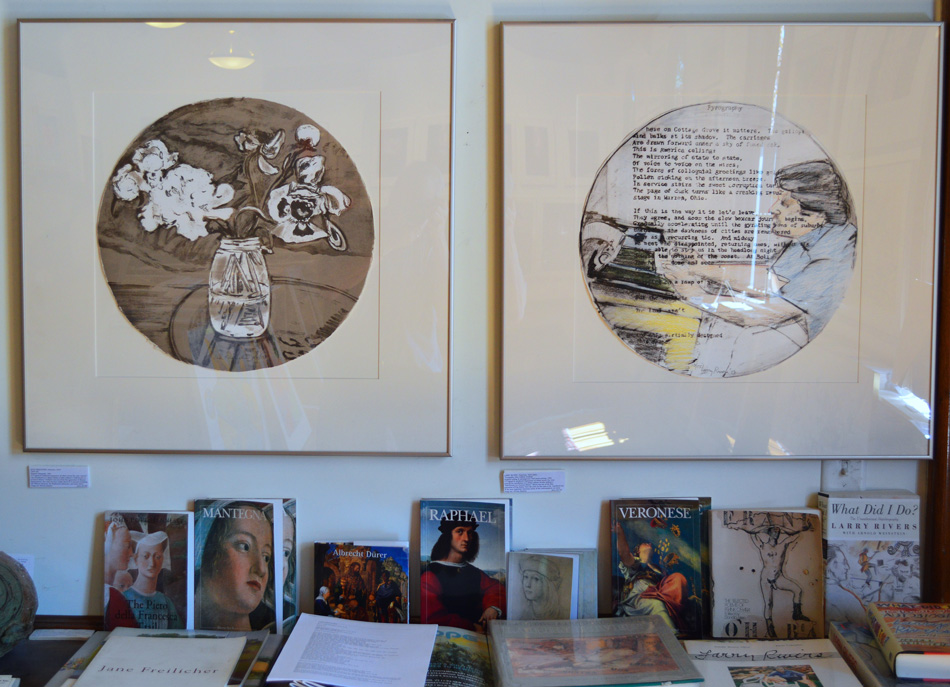
Here are the remaining works from the wall above: Jane Freilicher, Still Life. Original lithograph, 1984. 175 signed & numbered impressions of which 25 were reserved for contributors (including Richard Avedon, Jim Dine, Willem de Kooning, Elaine de Kooning, Alex Katz, R. B. Kitaj, and Larry Rivers) to a deluxe edition of John Ashbery's Self-Portrait in a Convex Mirror. Still lifes represent a mjaor portion of her work and many of them can be seen in Klaus Kertess' study. Image size: 387mm diameter. Price: Please call or email for current pricing information.
Larry Rivers, Pyrography: John Ashbery Working. Original etching & photogravure with hand-coloring, 1984. 175 signed & numbered impressions of which twenty five were reserved for contributors to a deluxe edition of John Ashbery's Self-Portrait in a Convex Mirror. Rivers was one of the first generation of Pop Artists. At the time of his death, he was acclaimed as one of the most important living American artists. Image size: 387mm diameter. Price: Please call or email for current pricing information.
|
|
|
|
 |
|
|
|
Long wall (at left): Helen Frankenthaler (American, 1928-2011), Solar Imp. Original 35-color screenprint, 2001. 126 signed and nummbered impressions on Somerset Textured Rag paper, of which this is n. 71/126. There were also 18 artist's proofs. Commissioned by Lincoln Center for the Performing Arts to help support the programs at Lincoln Center. In addition to the signed and numbered edition, there was also an unsigned poster edition with a printed text—Lincoln Center Salutes New York City Ballet—of about 800, 300 of which were used at Lincoln Center to advertise programs at the Center. Illustrated on p. 191 of "Art at Lincoln Center: The Public Art and List Print and Poster Collections" (2009). Image size: 1000x760mm. Mat size: 48x38 inches. Price: Please call or email for current pricing information.
For more on Frankenthaler's works at Spaightwood Galleries, please click here.
Beneath the Frankenthaler: Robert Indiana (American, b. 1928), V/H (9). Original color serigraph, 1982. 125 signed & numbered impressions. Image size: 610x610mm. Price: Please call or email for current pricing information.
On short wall: Dorothea Tanning (American, 1910-2012), Les demeures d'Hypnos: Combat, 1976.
Betye Saar (American, b. 1926), The Long Memory, 1998.
Robert Motherwell (American, 1915-1991), Altamira Elegy, 1979-80.
Joan Mitchell (American, 1926-1992. Tree. Original crayon drawing, c. 1992. N.F.S.
Lesley Dill (American, b. 1950), Listen: Dust is the only secret. Original lithograph on stained paper with synthetic fiber, 2006. 120 signed and impressions annotated "Ed. 120" for the Madison Print Club plus 20 artist proofs. Her work is included in the collections of the de Young Museum in San Francisco, The Library of Congress, MoMA, the Metropolitan and Whitney Museums, & many others. Image size: 410x260mm. Price: Please call or email for current pricing information.
Emmi Whitehorse (Native American, b. 1958), Leaf (T 97-343). Original 5-color lithograph, 1997. 15 signed & numbered impressions on Somerset + 3 artist's proofs & 3 Tamarind impressions. Signed lower right with three vertical red marks, her Navaho name; signed in pencil on the verso "Emmi Whitehorse." Image size: 279x353mm. Price: Please call or email for current pricing information.
|
|
|
|
 |
|
|
|
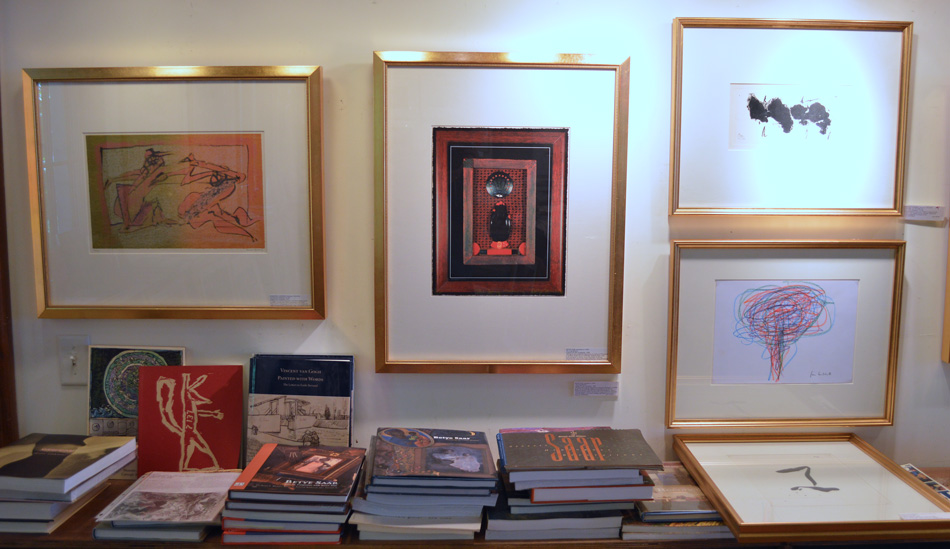
Left: Dorothea Tanning (American, 1910-2012), Les demeures d'Hypnos: Combat (HD 47, T. 322). Original color lithograph, 1976. 99 signed and numbered impressions. Image size: 250x390mm. Price: Please call or email for current pricing information.
Center: Betye Saar (American, b. 1926), The Long Memory. Original 18-color screenprint pubished by the National Museum of Women in the Arts, 1998. 100 signed and numbered impressions on Somerset UK printed at Grsham Studio Ltd. in Cambridge, England. Saar's early work attempted to destroy rascist stereotypes of African Americans; her more recent work explores her "deep-felt interest in the occult, astrology, and African consciousness." According to Yolanda M. Lopez and Moira Roth in The Power of Feminist Art, edited by Norma Broude & Mary D. Garrard (Abrams, 1994), "Over the past twenty years, Saar . . . [has] traversed her mystic worlds in which she weaves together interests in the occult, family, and black culture and history" (146). She has been called "one of the most visionary artists to emerge in the last forty years" (Robin D. G. Kelly, Freedom Dreams and is the subject of James Christen Steward et al, Betye Saar: Extending the Frozen Moment [Ann Arbor: University of Michigan Museum of Art, 2005]). Image size: 370x296mm. Price: Please call or email for current pricing information.
Top right: Robert Motherwell (American, 1915-1991), Altamira Elegy (Belknap 229, Engberg & Banach 262). Original lithograph printed in black and white from 2 aluminum plates collaged onto cream paper, 1979-80. 75 signed & numbered impressions, of which ours is n. 51/75. Arthur C. Danto discusses this work in "The 'Original Creative Principle': Motherwell and Psychic Automatism" in Rosand, 39-58: "in the lithographic Altamira Elegy [fig. 7], where the grass-style fibrilations have been exchanged for something heavy, as if deposited by a charged brush, there could be four shawled figures or four brooding trees, and there is a tense rhythm left and right and left. What gives it the elegiac feel is the heaviness, the downwardness of the forms, as if sorrow refused to let them rise. But perhaps one reads too much into it, knowing that the word 'elegy' appears in the title. The four heavy forms could be bunches of grapes or fruits on a table" (55). The Altamira Elegy was published in the deluxe edition of Reconciliation Elegy, a “photographic journal [that] records the collaboration of Robert Motherwell and his studio assistants in the creation of the artist’s monumental painting Reconciliation Elegy, a commission for the East Building, National Gallery of Art, Washington D.C.” According to the colophon of the deluxe edition, “The original edition of Reconciliation Elegy includes 75 copies numbered from 1 to 75, 15 artist’s proofs and 15 copies Hors Commerce numbered h.c. 1 to h.c. 15. Each of these 90 copies is accompanied by an original lithograph by Robert Motherwell signed and numbered by the artist.” The book is numbered N. 51 and so is the original lithograph, which came loosely inserted into a special flap in the inner front cover. The condition is excellent. This is a beautiful and subtle lithograph and comes with the matching copy of the book in which it was presented. After almost 30 years, it is uncommon to find both together. Image size: 101x235mm. Price: Please call or email for current pricing information.
Bottom right: Joan Mitchell (American, 1926-1992), Tree. Original drawing, c. 1992. In her last years, Mitchell drew a number of brightly-colored abstract trees and made a number of etchings and lithographs on the subject as well. Signed in pencil lower right. Image size: 237x327mm on thin white paper. Price: Not for sale.
|
|
|
|
 |
|
|
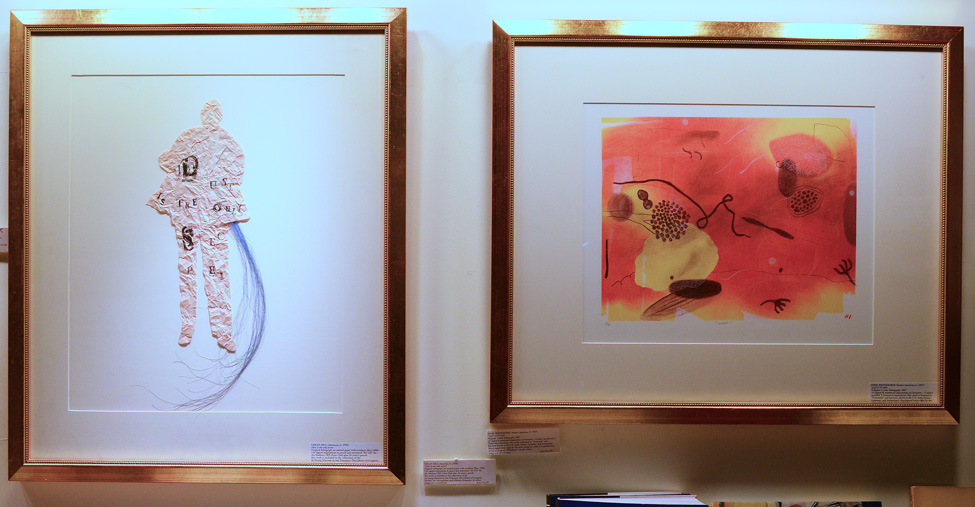
Lesley Dill (American, b. 1950), Listen: Dust is the only secret. Original lithograph on stained paper with synthetic fiber, 2006. 120 signed and impressions annotated "Ed. 120" for the Madison Print Club plus 20 artist proofs. Her work is included in the collections of the de Young Museum in San Francisco, The Library of Congress, MoMA, the Metropolitan and Whitney Museums, & many others. Image size: 410x260mm. Price: Please call or email for current pricing information.
|
|
Emmi Whitehorse (Navaho, b. 1958), Leaf (T 97-343). Original 5-color lithograph, 1997. 15 signed & numbered impressions on Somerset + 3 artist's proofs& 3 Tamarind impressions. Signed lower right with her Navaho name, three vertical red marks; signed in pencil on the verso "Emmi Whitehorse." Image size: 279x353mm. Price: Please call or email for current pricing information.
|
|
|
|
Spaightwood Galleries, Inc.
To purchase, call us at 1-800-809-3343 (1-508-529-2511 in Upton MA & vicinity) or send an email to spaightwood@gmail.com
We accept AmericanExpress, DiscoverCard, MasterCard, and Visa.
We also accept wire transfers and paypal.
For directions and visiting information, please call. We are, of course, always available over the web and by telephone (see above for contact information). Click the following for links to past shows and artists. For a visual tour of the gallery, please click here. For information about Andy Weiner and Sonja Hansard-Weiner, please click here. For a list of special offers currently available, see Specials.
All works are sold with an unconditional guarantee of authenticity (as described in our website listing).
Go back to the top of this page.
Visiting hours: Saturday 10:00 am to 5:00 pm and Sunday noon to 6:00 pm and other times by arrangement.
Please call to confirm your visit. Browsers and guests are welcome.
|
|
|
|
|
|
|
|
|
|
|
|
|
|
|
|
|
|
|
|
|
|
|
|
|
|
|
|
|
|
|
|
|
|
|
|
|

