Click image for BBB rating
See our Privacy Policy
|
Welcome to Spaightwood Galleries, Inc.
120 Main Street, Upton MA 01568-6193; 800-809-3343; email: spaightwood@gmail.com
You can follow us on Facebook and Twitter!
We blog regularly on Facebook and announce special events and special sales on both sites.
Studying War: Goya, Grosz, Rouault, and Dix, page 2
|
|
 |
|
|
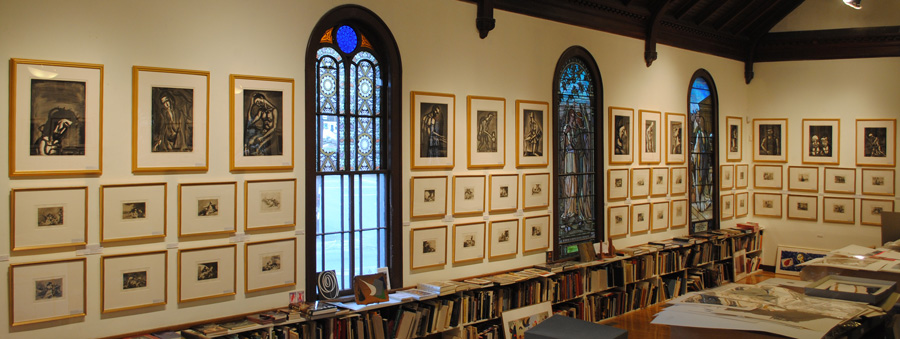
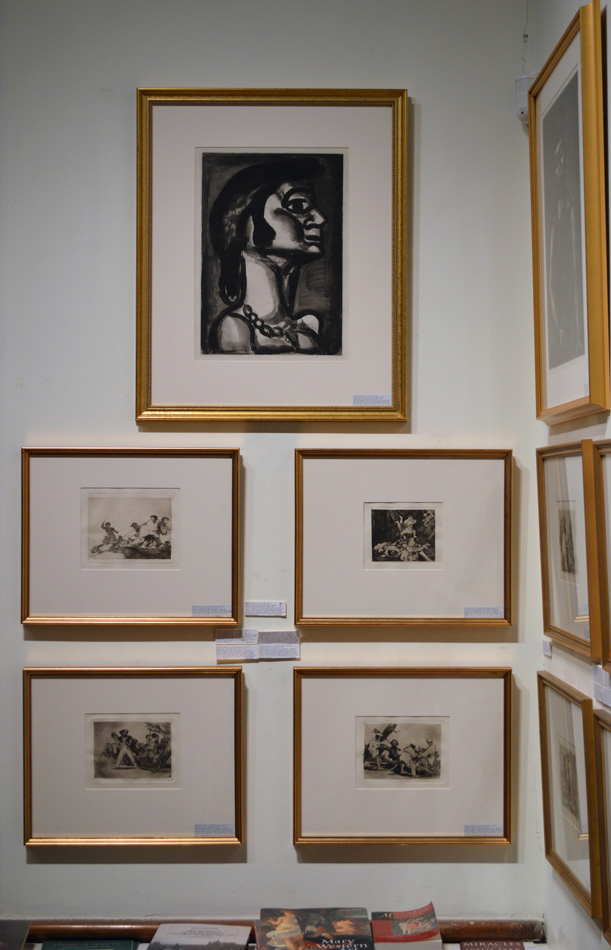
A view of the left wall from the ladder showing some of the 154 works in Studying War, our current exhibition, a 154-work meditation on war and society: more precisely, it includes Goya's Disasters of War (we have a complete set of 80 plus the unpublished plate 81, which was not included in the original edition and, after the plate was recovered in 1956, was printed in a small edition for the fellows of the institution where Goya’s copperplates are stored), Otto Dix's lithographs for The Gospel according to Saint Matthew (31 of the 32), in which the Temple Guards and the Roman soldiers are played by uniformed Nazi SA and SS troopers, the 16 color plates from George Grosz’ Ecce Homo (of which 15 will be on the wall and the other one available for viewing), and 27 selections from George Rouault's Miserere et Guerre, a two-part meditation upon our need for mercy and the prevalence of war done in the aftermath of World War I and full of mixed-media prints of people at war with themselves and each other. Those who have already seen it say that it is a powerful show. The show will end in mid-November, at which time the show of Pierre Alechinsky's works we had originally planned to have on the walls now will claim their promised place.
|
|
|
|
|
 |
|
|
|
|
A view of the left wall from the ladder showing some of the 154 works in Studying War, our current exhibition, a 154-work meditation on war and society: more precisely, it includes Goya's Disasters of War (we have a complete set of 80 plus the unpublished plate 81, which was not included in the original edition and, after the plate was recovered in 1956, was printed in a small edition for the fellows of the institution where Goya’s copperplates are stored), Otto Dix's lithographs for The Gospel according to Saint Matthew (31 of the 32), in which the Temple Guards and the Roman soldiers are played by uniformed Nazi SA and SS troopers, the 16 color plates from George Grosz’ Ecce Homo (of which 15 will be on the wall and the other one available for viewing), and 27 selections from George Rouault's Miserere, a two-part meditation upon our need for mercy and the prevalence of war, done in the aftermath of World War I and full of mixed-media prints of people at war with themselves and each other.
|
|
|
|
 |
|
|
|
At the top, we can see plate 1 of the Miserere, "Miserere mei, Deus, secondun magnum misericordiam tuam" ("Have mercy upon me O GOD, according to thy loving-kindness," Psalm 51:1); beneath, we can see the first four works in Goya's Los Desastres de la Guerra (The Disasters of War). We have devoted 8 web-pages on our website to the complete Disasters of War begining at http://www.spaightwoodgalleries.com/Pages/Goya_Desastres.html
Most of the Disasters are priced at Please call or email for current pricing information (or less); some are priced at more. Our impressions from the 80 mixed-media intaglios published first in 1863 come from the 4th edition, which Tomas Harris describes in his catalogue raisonné of Goya's prints as "excellently printed on very suitable papers" (p. 175).
We have also devoted 4 quite lengthy web-pages to the Miserere beginning at http://www.spaightwoodgalleries.com/Pages/Rouault.html
The 16 offset color lithographs for Grosz' Ecce Homo (the words spoken by Pilate as he showed Jesus off to the crowds after having had him whipped; there the words meant "Behold the man," In Grosz' masterpiece, however, the title more accurately could be translated as Behold man!) can be seen at http://www.spaightwoodgalleries.com/Pages/Grosz_EcceHomo_color.html and the following page
The Otto Dix lithographs can be seen at http://www.spaightwoodgalleries.com/Pages/Dix.html and the following two pages.
|
|
 |
|
|
Tristes presentimientes de lo que ha de accontecer / Sad presentiments of what must come to pass (Disasters, pl. 1, Harris 121, Delteil 120). Original etching, burin, drypoint, and burnisher. After the first edition, the plates were probably steel-faced and consequently do not degrade as quickly as they otherwise might. Our impression is from the 4th edition (1906) published from Goya's original plates in the Royal Academy in San Fernando, Spain, which Tomas Harris categorizes as excellently printed on very suitable papers." Illustrated in Hughes, p. 274, Licht, p. 129. Image size: 175x220mm. Price: Please call or email for current pricing information.
|
|
|
 |
|
|
|
The show includes 8 wall-panels (of which the one above is typical) each containing 8 Goya mixed-media intaglios and 3 Rouault mixed-media intaglios and 4 panels, three of which contain 4 Goyas and a Rouault plus a final one with 5 Goyas and no Rouaults. Instead of being cramed into a space about 5-1/2" x7-1/2", however, in the gallery each one is hung in a space about 9' x 9', so there is adequate space for seeing each piece both individually and as part of a larger whole. The three Rouaults illustrated above are plate 2, Jésus honni / Jesus reviled, plate 43, Nous devons mourir, nous et tout ce qui est nôtre / We are doomed to death, we and all that is ours; and plate 5, Solitaire, en cette vie d'embriches et de malices / Alone, in this life of pitfalls and malice; the first 7 Goyas can be found here; the last one begins the second page of the Disasters.
|
|
|
|
 |
|
|
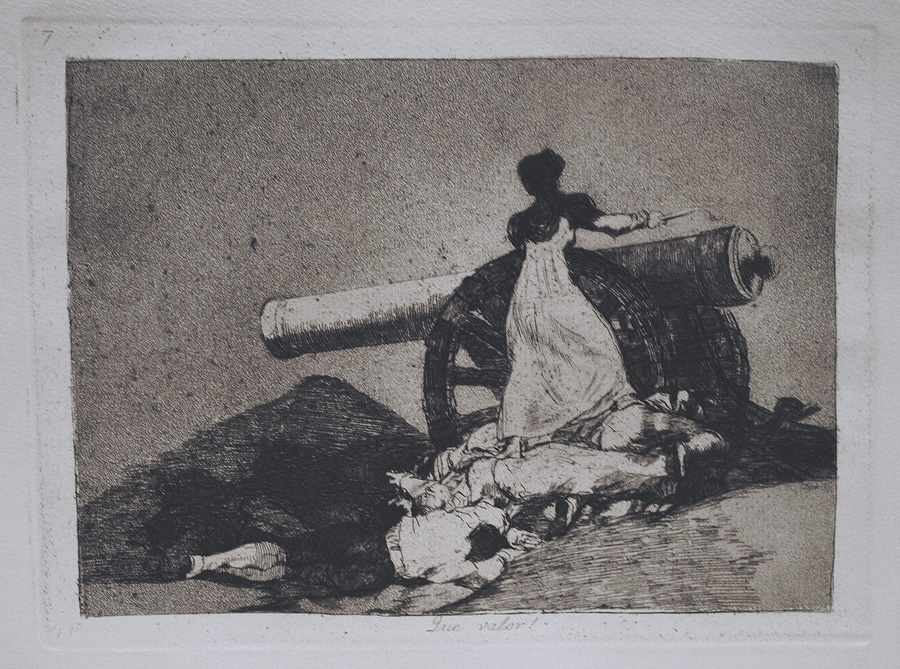
Que valor! / What courage! (Disasters of War, plate 7, Delteil 126, Harris 127). Original etching, aquatint, drypoint, burin, and and burnisher, 1808-1814. After the first edition, the plates were probably steel-faced and consequently do not degrade as quickly as they otherwise might. Our impression is from the 4th edition (1906) published from Goya's original plates in the Royal Academy in San Fernando, Spain, which Tomas Harris categorizes as "excellently printed on very suitable papers." Hughes comments: This "is the only conventionally 'heroic' plate in the whole series—heroic in that the artist presents a character as entirely courageous and worthy of admiration, neither a helpless victim, nor a person driven by terror to involuntary acts of courage, nor a bestial and atrocious intruder: in short, a citizen in full command of her humanity. This person was already a legendary heroine when Goya reached Zaragoza: she was Augustina of Aragón, a young Zaragozan woman who, with complete disregard for her own safety, had clambered over the bodies of slain defenders on the ramparts of the city (a pile said to have contained the corpse of her lover) in order to fire a twenty-six-pound cannon at the advancing French" (Hughes, Goya, p. 288). She is, however, standing upon a heap of corpses. However heroic she might be, the scene itself depicts a disaster. Illustrated in Hughes, p. 287 and Chapron, p. 173. Image size: 155x210mm. Price: Please call or email for current pricing information.
|
|
|
 |
|
|
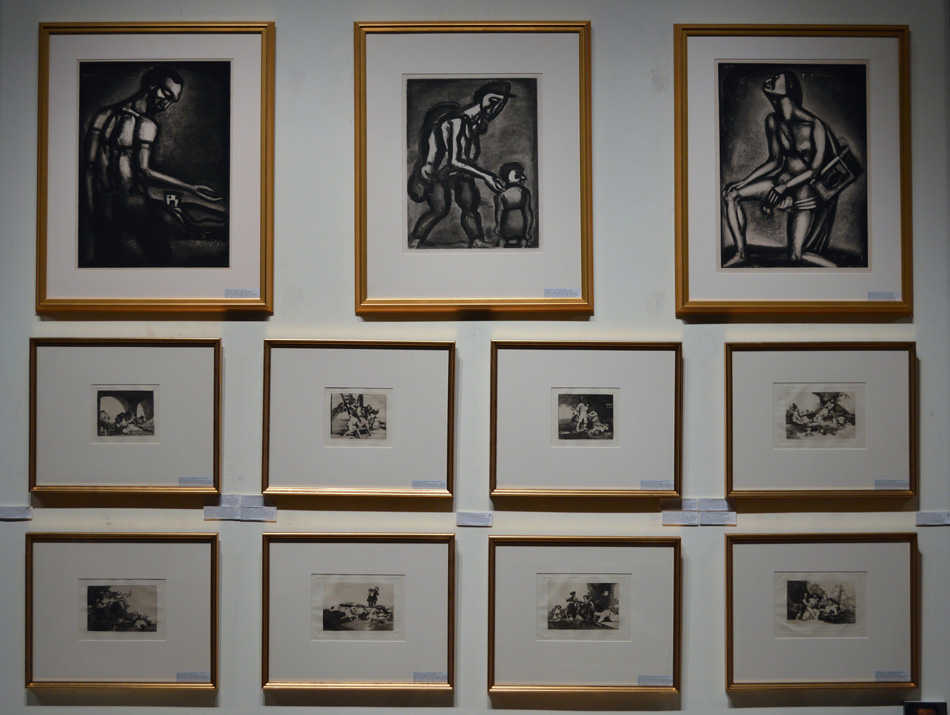
The show includes 8 wall-panels (of which the one above is typical) each containing 8 Goya mixed-media intaglios and 3 Rouault mixed-media intaglios and 4 panels, three of which contain 4 Goyas and a Rouault plus a final one with 5 Goyas and no Rouaults. Instead of being cramed into a space about 5-1/2" x7-1/2", however, in the gallery each one is hung in a space about 9' x 9', so there is adequate space for seeing each piece both individually and as part of a larger whole. The three Rouaults illustrated above are plate 22, En tant d'ordres divers, le beau métier d'ensemencer une terre hostile / In so many different domains, the noble task of sowing in hostile land; plate 4, Se réfugie en ton coeur, va-nu-pieds de malheur / Take refuge in your heart, poor vagabond, and plate 27, Sunt lacrymae rerum ... / Mortality hath her tears; Disasters 13-20 can be found here.
|
|
|
 |
|
|
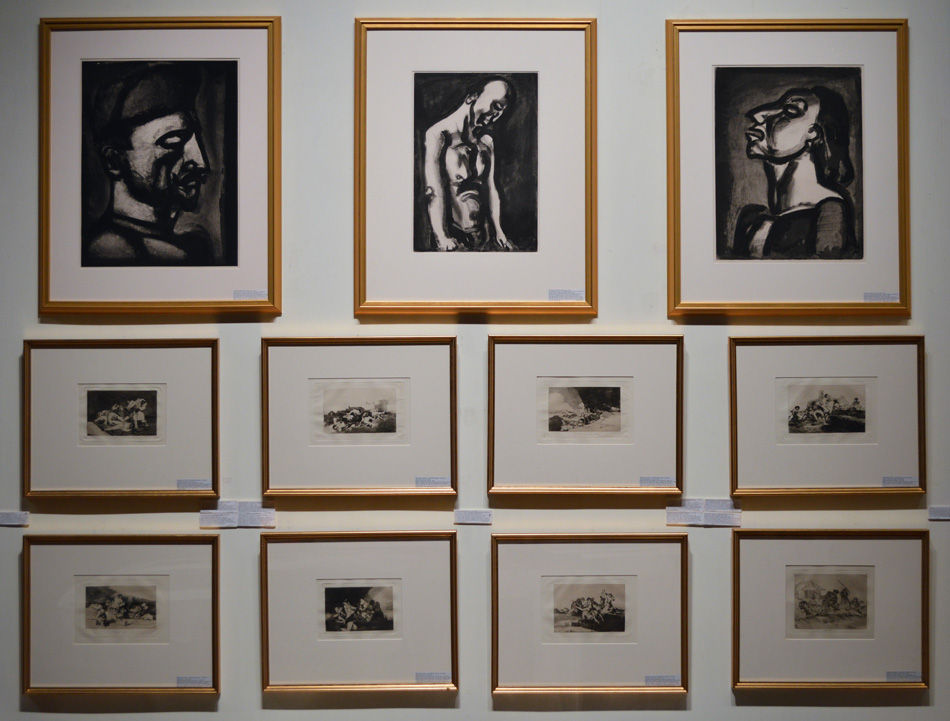
The show includes 8 wall-panels (of which the one above is typical) each containing 8 Goya mixed-media intaglios and 3 Rouault mixed-media intaglios and 4 panels, three of which contain 4 Goyas and a Rouault plus a final one with 5 Goyas and no Rouaults. Instead of being cramed into a space about 5-1/2" x7-1/2", however, in the gallery each one is hung in a space about 9' x 9', so there is adequate space for seeing each piece both individually and as part of a larger whole. The three Rouaults illustrated above are plate 52, Dura lex sed lex / The law is hard, but it is the law; plate 18, Le conamné s'en est allé... / The condemned man is led away, and plate 19, Son avocat, en phrases creuses, clame sa totale inconscience... /His lawyer, in hollow phrases, proclaims his complete indifference. Disasters 21-28 can be found here and here.
|
|
|
|
 |
|
|
|
The show includes 8 wall-panels (of which the one above is typical) each containing 8 Goya mixed-media intaglios and 3 Rouault mixed-media intaglios and 4 panels, three of which contain 4 Goyas and a Rouaults plus a final one with 5 Goya and no Rouaults. Instead of being cramed into a space about 5-1//2 x7-1/2 inches, howeever, in the gallery eah one is hung in a space about 9ft x 9 ft., so there is adequate space for seeing each piece both individually and as part of a larger whole. The Rouault illustrated above is plate 15, En bouche qui fut fraîche, goût de fiel / In the mouth that was sweet, the taste of gall; Disasters 29-32 can be found here.
|
|
|
 |
|
|
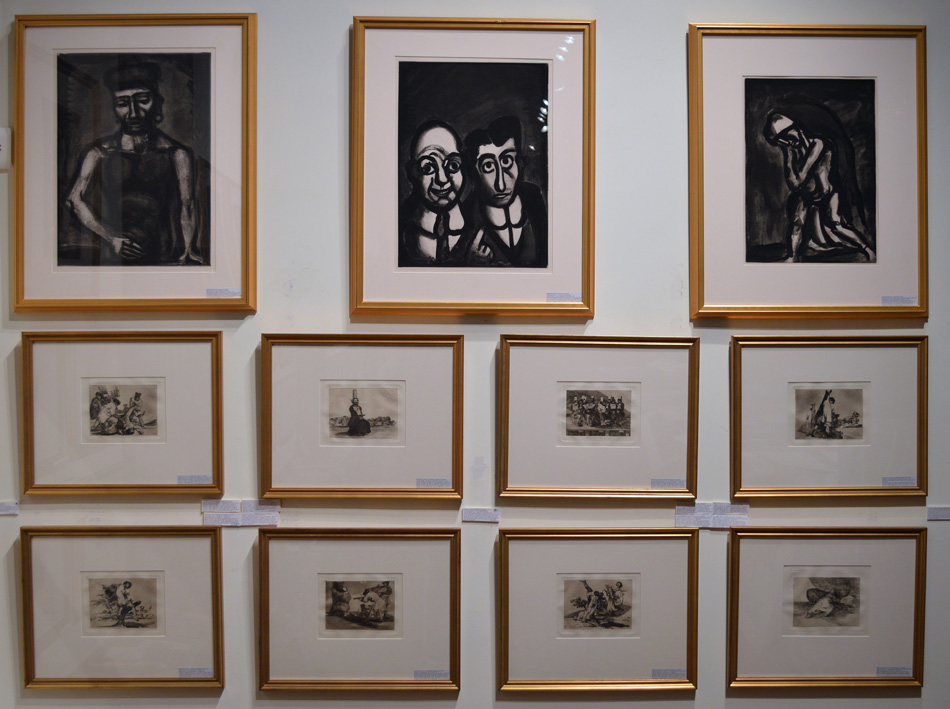
The show includes 8 wall-panels (of which the one above is typical) each containing 8 Goya mixed-media intaglios and 3 Rouault mixed-media intaglios and 4 panels, three of which contain 4 Goyas and a Rouault plus a final one with 5 Goyas and no Rouaults. Instead of being cramed into a space about 5-1/2" x7-1/2", however, in the gallery each one is hung in a space about 9' x 9', so there is adequate space for seeing each piece both individually and as part of a larger whole. The three Rouaults illustrated above are plate 25, Jean-François jamais ne chante alleluia / Jean-François never sings alleluia; plate 35, Nous sommes fou / We are insane, and plate 24, Hiver lepere de la terre / Winter, leper of the earth. Disasters 33-40 can be found here and here.
|
|
|
 |
|
|
|
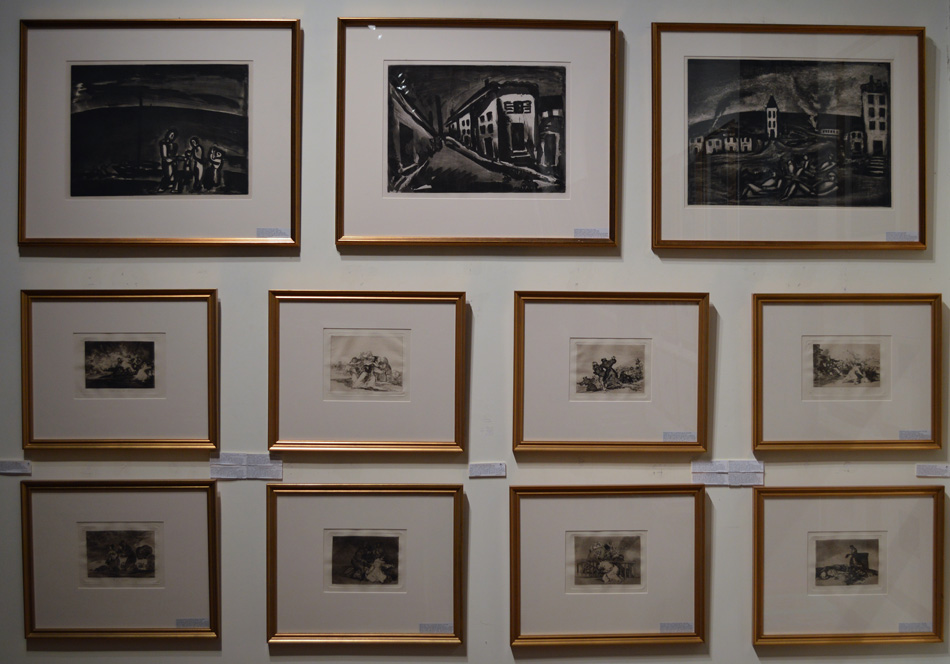
The show includes 8 wall-panels (of which the one above is typical) each containing 8 Goya mixed-media intaglios and 3 Rouault mixed-media intaglios and 4 panels, three of which contain 4 Goyas and a Rouault plus a final one with 5 Goyas and no Rouaults. Instead of being cramed into a space about 5-1/2" x7-1/2", however, in the gallery each one is hung in a space about 9' x 9', so there is adequate space for seeing each piece both individually and as part of a larger whole. The three Rouaults illustrated above are plate 9, Il arrive parfois que l'a route soit belle / Sometimes the way is beautiful; plate 23, Rue des Solitaires / Street of the Lonely, and plate 44, Mon doux pays, où êtes-vous / My sweet land, what has become of you?. Disasters 41-48 can be found here and here.
|
|
|
|
 |
|
|
|
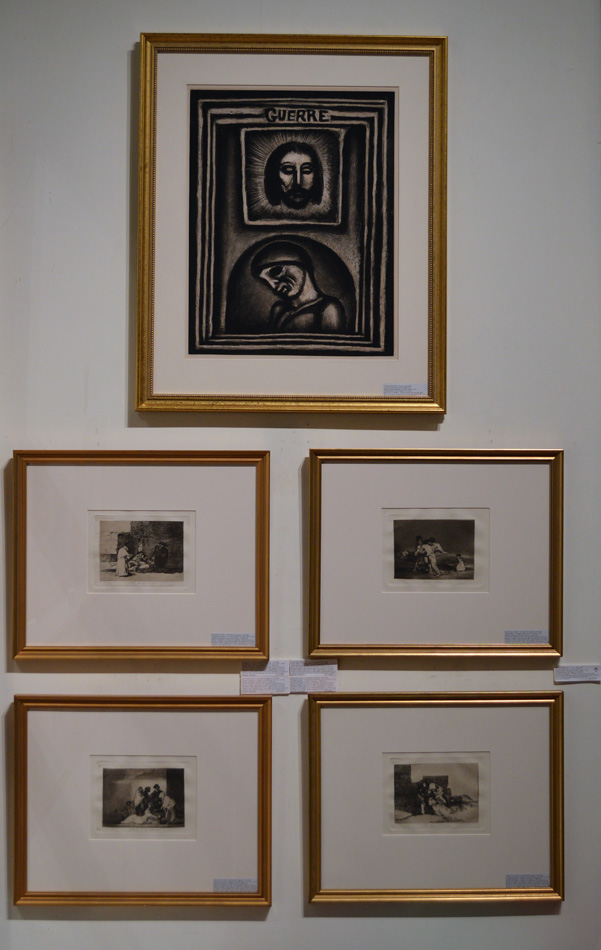
The show includes 8 wall-panels (of which the one above is typical) each containing 8 Goya mixed-media intaglios and 3 Rouault mixed-media intaglios and 4 panels, three of which contain 4 Goyas and a Rouault plus a final one with 5 Goyas and no Rouaults. Instead of being cramed into a space about 5-1/2" x7-1/2", however, in the gallery each one is hung in a space about 9' x 9', so there is adequate space for seeing each piece both individually and as part of a larger whole. The Rouault illustrated at left is plate 34, "Les ruines elles-mêmes ont péri" / Even the ruines hve perished (Lucan, Pharsaalia, IX, 969). The image counterpointss the face of Jesus as it appeared on the cloth with which St. Veronica wiped Jesus' face as he fell under the weight of the cross . Disasters 49-52 can be found here.
|
|
 |
|
|
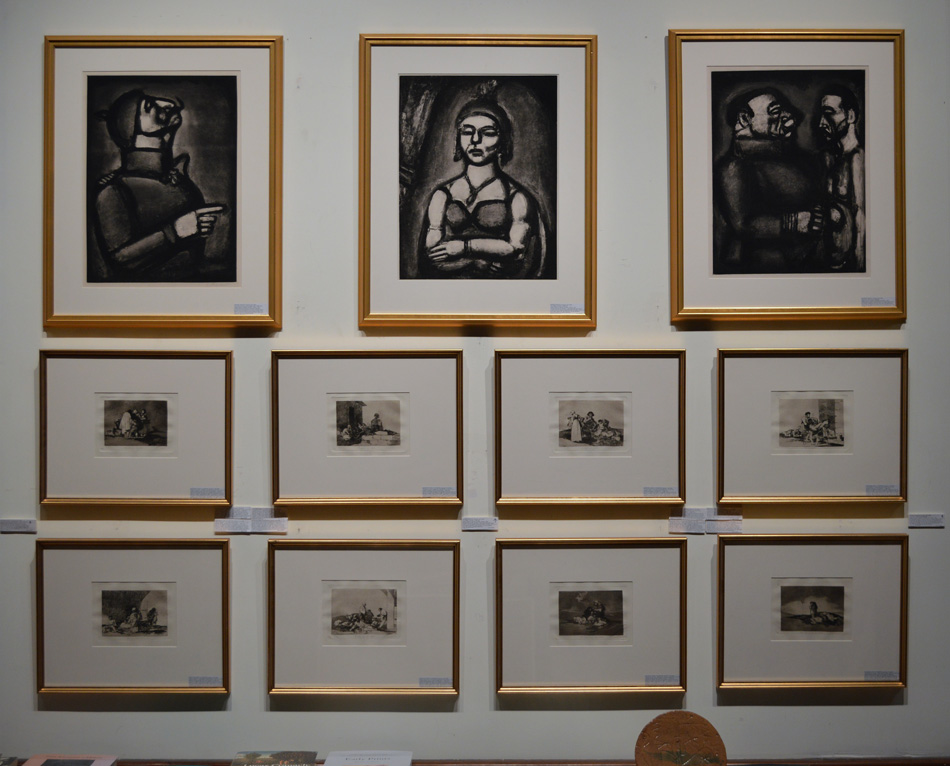
The show includes 8 wall-panels (of which the one above is typical) each containing 8 Goya mixed-media intaglios and 3 Rouault mixed-media intaglios and 4 panels, three of which contain 4 Goyas and a Rouault plus a final one with 5 Goyas and no Rouaults. Instead of being cramed into a space about 5-1/2" x7-1/2", however, in the gallery each one is hung in a space about 9' x 9', so there is adequate space for seeing each piece both individually and as part of a larger whole. The three Rouaults illustrated above are plate 49, "Plus le coeur est noble, moins le col est roide" / "The nobler the heart, the less stiff the collar"; plate 50, Des ongles et du bec / Tooth and nail, and plate 40, Face à face / Face to face. Disasters 53-60 can be found here and here.
|
|
|
 |
|
|
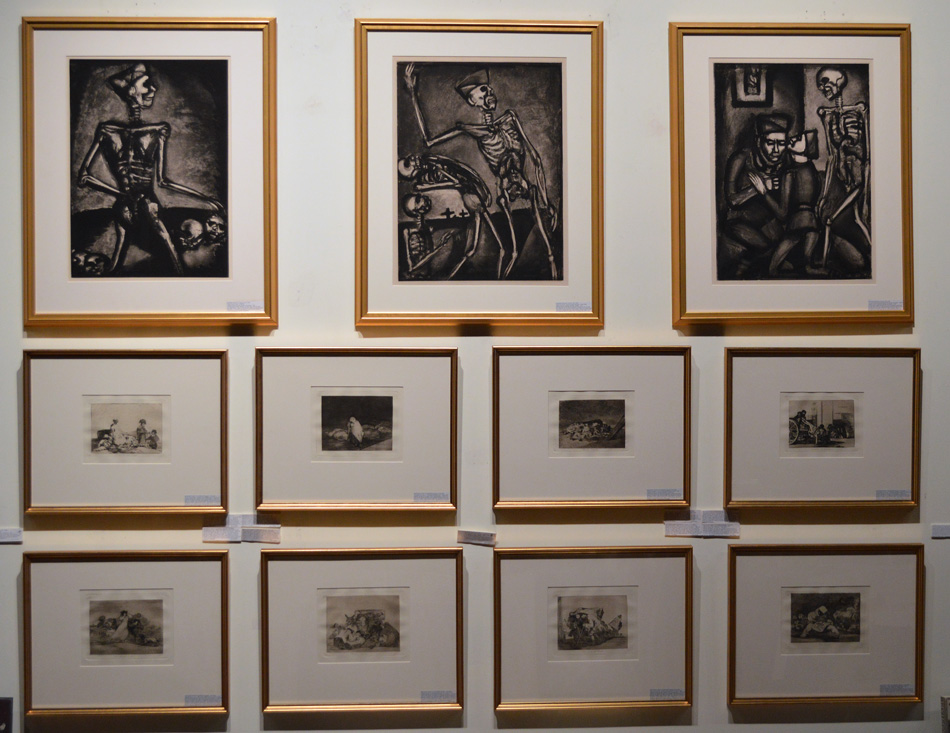
The show includes 8 wall-panels (of which the one above is typical) each containing 8 Goya mixed-media intaglios and 3 Rouault mixed-media intaglios and 4 panels, three of which contain 4 Goyas and a Rouault plus a final one with 5 Goyas and no Rouaults. Instead of being cramed into a space about 5-1/2" x7-1/2", however, in the gallery each one is hung in a space about 9' x 9', so there is adequate space for seeing each piece both individually and as part of a larger whole. The three Rouaults illustrated above are plate plate 37, Homo himinis lupus / Man is a wolf to man (Plautus), 54, "Debouts les morts!" / "Onward the dead!"; and plate 36, Ce sera la dernière, petit père! / This will be the last time, little father! Disasters 61-68 can be found here and here.
|
|
|
 |
|
|
|
|
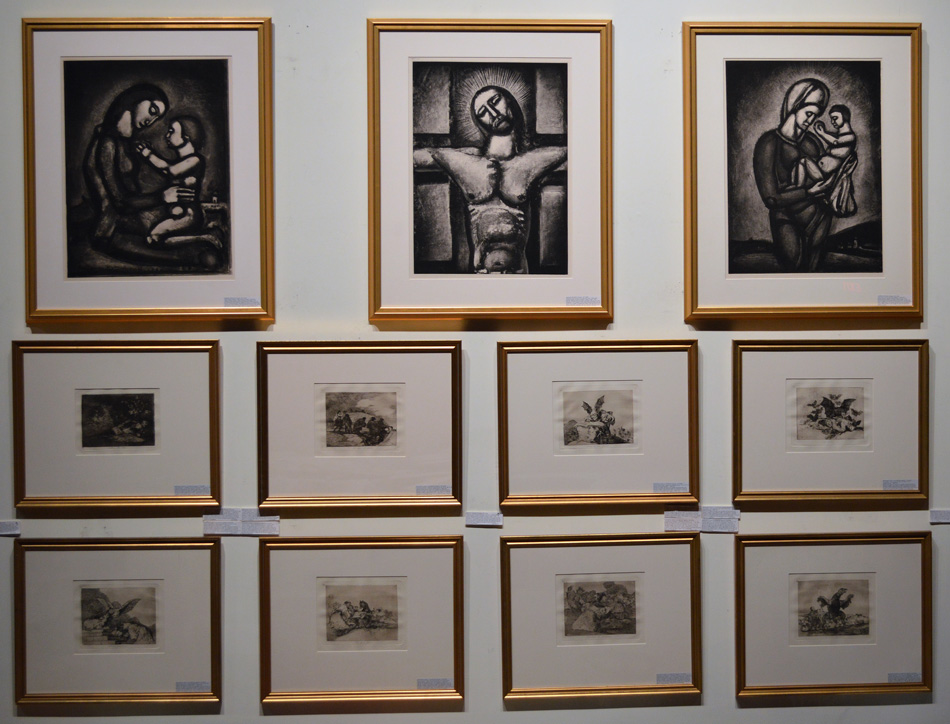
The show includes 8 wall-panels (of which the one above is typical) each containing 8 Goya mixed-media intaglios and 3 Rouault mixed-media intaglios and 4 panels, three of which contain 4 Goyas and a Rouault plus a final one with 5 Goyas and no Rouaults. Instead of being cramed into a space about 5-1/2" x7-1/2", however, in the gallery each one is hung in a space about 9' x 9', so there is adequate space for seeing each piece both individually and as part of a larger whole. The three Rouaults illustrated above are plate 42, Bella matribus detesta / Wars, dread of mothers(Horace, Odes, I, i, 24-25), plate 57:"Obéissant jusqu'à la mort et à la mort de la croix" / "Obedient unto death, even the death of the cross" (Phillipians 2, 8); and plate 56, En ces temps noirs de jactance et d'incroyance, Notre-Dame de la Fin des Terres vigilante / In these dark times of vainglory and unbelief, Our Lady of the Ends of the Earth keeps watch. Disasters 69-76 can be found here and here.
|
|
|
|
|
 |
|
|
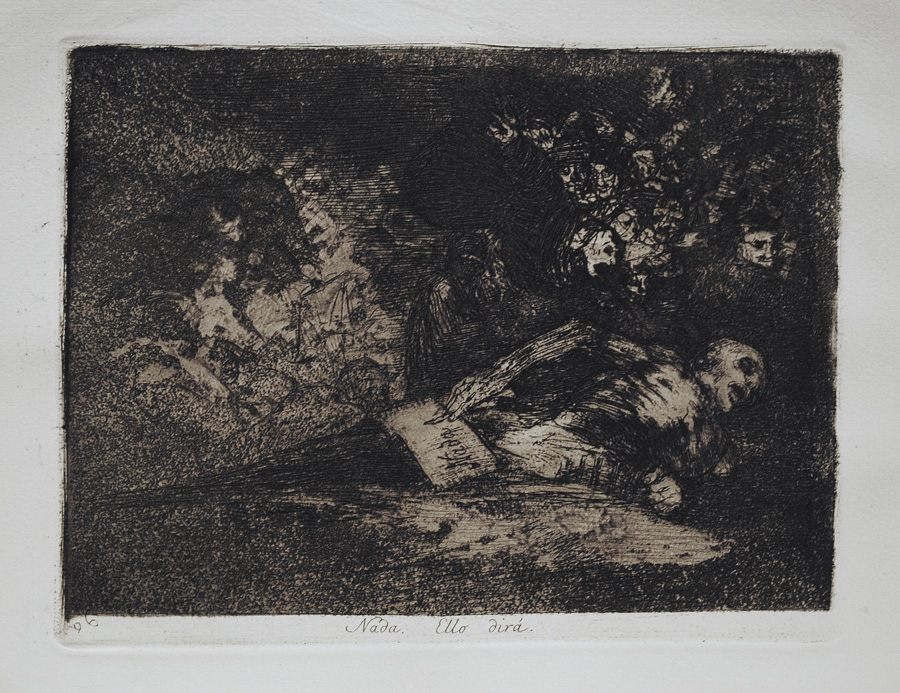
Nada. Ello Dira. / Nothing. The event will tell ( pl. 69, Harris 189, Delteil 188). Original etching, burnished aquatint, lavis, drypoint, and burin, c. 1808-1814. Harris describes the first edition as "good" and notes that in the 2nd to 7th editions, the plate is in fair condition: "Aquatint weakens. The highlights retain much of their cntrast. Lavis disappears entirely and as a result the figures to the left appear less confused. Burin work stands out strongly in the figures fo the left and on the outline of the corpse. The etching which was overbitten in some areas and burnished and altered in others is rather uneven." Our impression is from the 4th edition (1906) published from Goya's original plates in the Royal Academy in San Fernando, Spain, which Tomas Harris categorizes as excellently printed on very suitable papers." A corpse lies in the ground, one hand holding a stylus and a sheet of paoper on which is written the word "Nada" or "Nothing." Behind it on the right side, a heap of skulls identifies the scene as the interior of a charnel house, where the bones are stored until they can rise at the Last Judgment. Whether there is to be a Last Judgment, however, is exactly what is called into question here. Behind on the left side, someone seems to be crawling out of a large oven. In front of the oven is the skull of a large animal. This work is one of the most famous in the history of western European art. The doctrine of the Resurrection is one of the foundational beliefs of Christianity, yet here the only promise is "nothing." This work is still reverberating on our art and literature today. In one of Thomas Pyncheon's masterpieces, The Crying of Lot 49, the heroine's husband, Mucho Maas, explains to his wife his great discovery: "The bad dream that I used to have all the time, about the car lot, remember that? I could never even tell you about it. But I can now. It doesn't even bother me any more. It was only that sign in the lot, that's what scared me. In the dream I would be going about a normal day's business and suddenly, with no warning, there'd be the sign. We were a member of the National Automobile Dealers' Association. N.A.D.A. Just this creaking metal sign that said nada, nada, aginst the blue sky. I used to wake up hollering" (p. 107). As we approach the end of the novel, Oedipa realizes that she has stumbled into a universe in which there are only four interpretations of life as we kniow it, none of them tolerable, all of them totally lacking in any of the humanist values that our civilation is constructed upon. "She didn't like any of them, but hoped she was mentally ill; that that's all it was. That night she sat for hours, too numb even to drink, teaching herself to breathe in a vacuum. For this, oh God, was the void. There was nobody who could help her. Nobody in the world. They were all on something, mad, possible enemies, dead" (p. 128). Goya's image is illustrated in Hughes (p. 302), Licht (p. 155), and Rich (p. 60). Image size: 155x200mm. Price: Please call or email for current pricing information.
|
|
|
 |
|
|
|
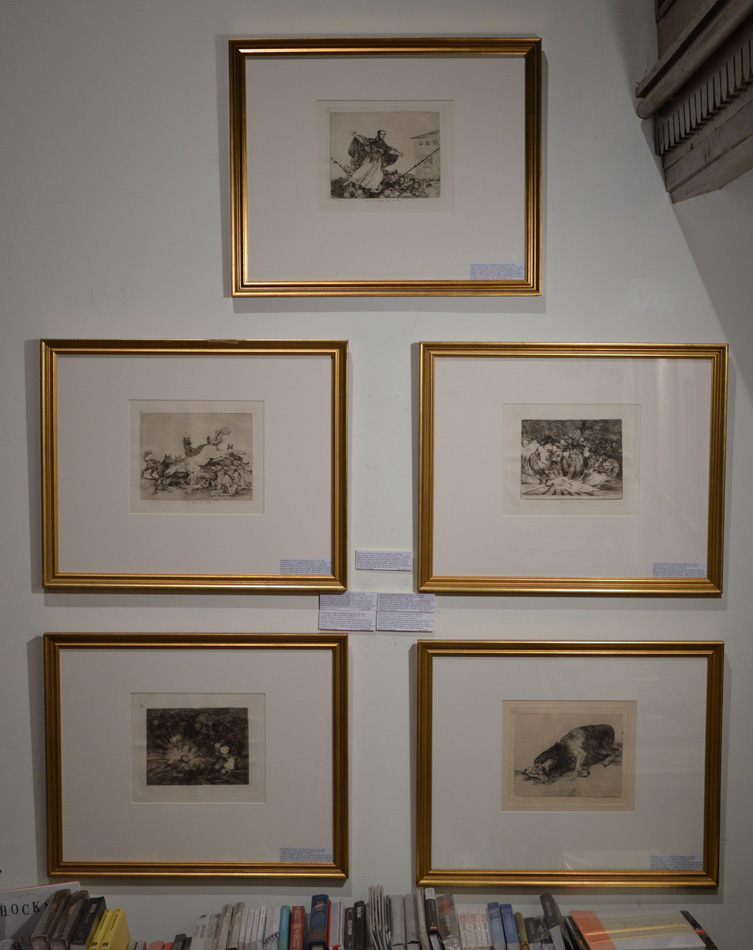
The show includes 8 wall-panels (of which the one above is typical) each containing 8 Goya mixed-media intaglios and 3 Rouault mixed-media intaglios and 4 panels, three of which contain 4 Goyas and a Rouault plus a final one with 5 Goyas and no Rouaults. Instead of being cramed into a space about 5-1/2" x7-1/2", however, in the gallery each one is hung in a space about 9' x 9', so there is adequate space for seeing each piece both individually and as part of a larger whole. The Rouault illustrated at left is plate 34, "Les ruines elles-mêmes ont péri" / Even the ruines hve perished (Lucan, Pharsaalia, IX, 969). The image counterpointss the face of Jesus as it appeared on the cloth with which St. Veronica wiped Jesus' face as he fell under the weight of the cross . Disasters 49-52 can be found here. Disasters 77-81. Now all you need is to imagine how much better it wold be to see this show in the flesh!
|
|
|
|
 |
|
|
|
Murió la verdad / Truth has died (Disasters, pl. 79, Harris 199, Delteil 198). Original etching and burnisher, c. 1808-1814. Harris notes that the "plate is in good to fair condition "for the first to seventh editions." Harris notes that the "Etching prints very well throughout. Where it was burnished on the faces of the bishop and monk, it prints with a blurred effect in the first edition. The plate was not clean wiped in the first edition and the impressions print with considerable tone. In the later, clean-wiped editions, the highlights contrast more strong with the etching." After the first edition, the plates were probably steel-faced and consequently do not degrade as quickly as they otherwise might. Our impression is from the 4th edition (1906) published from Goya's original plates in the Royal Academy in San Fernando, Spain, which Tomas Harris categorizes as excellently printed on very suitable papers." Truth is dead, and Justice, scales across her lap weeps, while a bloated bishop, his face in shadow, speaks of her corpse. Behind him, a large cast of clerical figures, most of them in darkness, except for a monk (left rear) wearing very thick glasses, whose path to Truth's body is blocked by another monk, whose back is illuminated by the rays from the corpse, but whose front is in darkness., her Image size: 175x220mm. Price: Please call or email for current pricing information.
|
|
|
 |
|
|
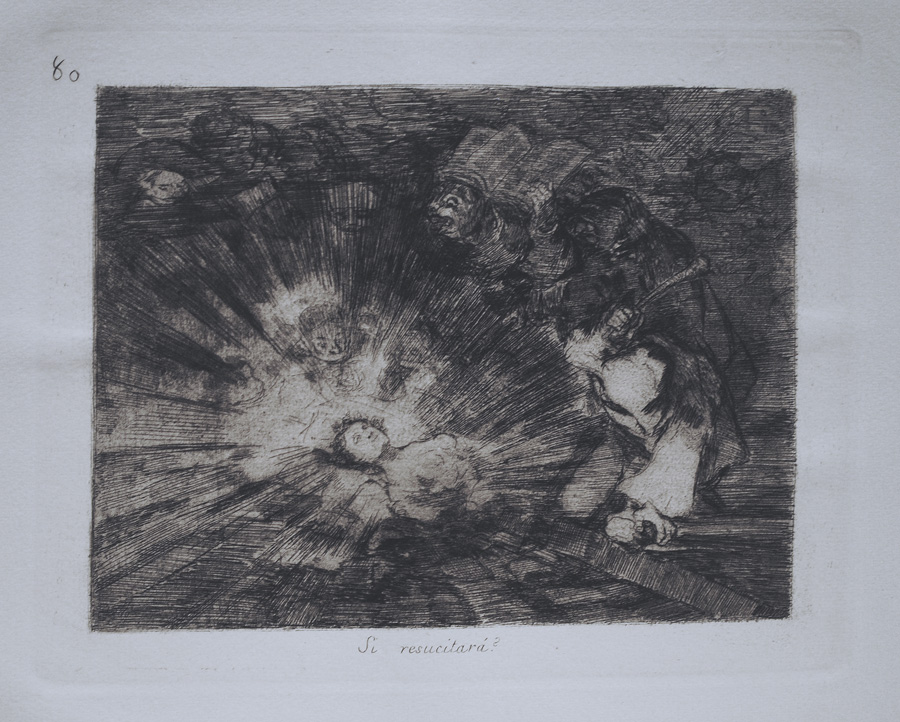
Si resucitará? Will she rise again? (pl. 80, Harris 200, Delteil 199). Original etching and burnisher, c. 1808-1814. Harris notes that the "plate is in good to fair condition for the first to seventh editions." Harris adds, "In the first edition, the burnishing marks round Truth's head and on the figure to the right are clearly visible and the plate prints with a general tone. Etching prints very well throughout." Our impression, from the 4th edition (1906) published from Goya's original plates in the Royal Academy in San Fernando, Spain, is a very strong one: the tone ranges from jet black to pure white and the lines are sharp enough that we can see Truth's open eyes, something that those surrounding her cannot since the are blinded by the light that they hate and fear. As Hughes puts it, "In plate 80 . . . lovely bare-breasted Truth begins to shine again, to move, while those who would bury her recoil in confusion, clutching their shovels and books. A feverish and tentative hope is reborn in Goya's darkness" (Hughes, p. 303, where the plate is illustrated as well). All of the clerical figures, however, prove themselves creatures of darkness, even to the point that one—holding a book over his head—appears to have an animals face. A strong and powerful work that witnesses to Goya's fearlessness despite the return of the Inquisition as well as his hope that his country and his fellow Spaniards might yet reach out for Truth, like the man praying over Truth, his hands clasped and his face bathed by the light Truth is giving off. A very powerful statement of rejection of the madness the Inquisition has perpetrated on his country. Image size: 175x220mm. Price: Please call or email for current pricing information.
|
|
|
 |
|
|
|
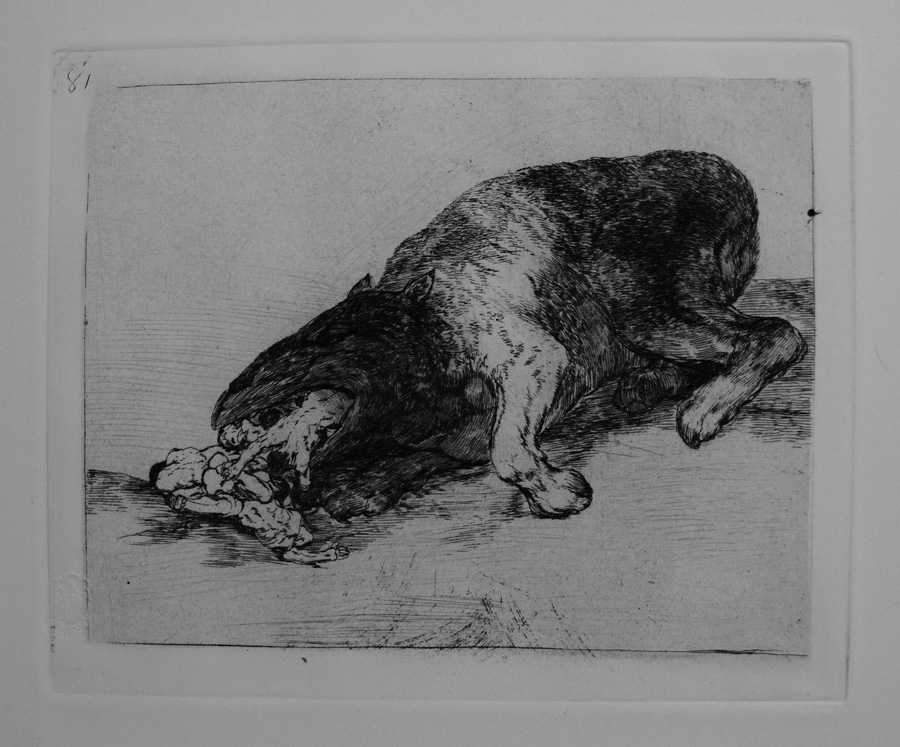
Fiero Monstruo! / Fierce monster! (pl. 81, Harris 201, Alfonso E. Pérez Sánchez, & Julián Gállego, pp. 140-41, Delteil 200; Hofer translates the title as Proud Monster ). Original etching, drypoint, and burin, c. 1808-1814. A very good impression on Arches paper from a plate excluded from the early published editions (which only had 80 prints) and only editioned in the 20th century (though several trial proofs were printed c. 1870). Sánchez and Gállego suggest that this print sums up the entire series in presenting war as a " 'fierce monster' from a terrible nightmare, devouring humanity with dreadful violence" (p. 141). Our impression is from the first edition published by the Calcografia Nacional in 1958-59 with their seal in the lower left margin; it was presented to the Academicians of San Fernando. Harris does not give a number, but the edition was presumably small because a second edition was printed in 1959 in an edition of 110 with the sheets numbered in pencil. Rare! Image size: 175x250mm. Price: Please call or email for current pricing information.
|
|
|
|
Spaightwood Galleries, Inc.
To purchase, call us at 1-800-809-3343 (1-508-529-2511 in Upton MA & vicinity) or send an email to spaightwood@gmail.com
We accept AmericanExpress, DiscoverCard, MasterCard, and Visa.
We also accept wire transfers and paypal.
For directions and visiting information, please call. We are, of course, always available over the web and by telephone (see above for contact information). Click the following for links to past shows and artists. For a visual tour of the gallery, please click here. For information about Andy Weiner and Sonja Hansard-Weiner, please click here. For a list of special offers currently available, see Specials.
All works are sold with an unconditional guarantee of authenticity (as described in our website listing).
Go back to the top of this page.
Visiting hours: Saturday 10:00 am to 5:00 pm and Sunday noon to 6:00 pm and other times by arrangement.
Please call to confirm your visit. Browsers and guests are welcome.
|
|
|
|
|
|
|
|
|
|
|
|
|
|
|
|
|
|
|
|
|
|
|
|
|
|
|
|
|
|
|
|
|
|
|
|
|
|
|
|
|
|
|
|
|
|
|
|
|
|

