Click image for BBB rating
See our Privacy Policy
cool="cool" width="784" height="12769" border="0" cellpadding="0" cellspacing="0" gridx="16" showgridx="showgridx" usegridx="usegridx" gridy="16" showgridy="showgridy" usegridy="usegridy" bgcolor="#99ccff">
|
|
|
 |
|
|
|
|
|
|
|
Spaightwood Galleries, Inc.
120 Main Street, Upton MA 10568; 800-809-3343
A Selection of Old Master Drawings and Prints:
Links to old master drawings and prints at Spaightwood Galleries
|
|
|
|
|
|
|
As former teachers of Renaisssance literature, we found ourselves drawn to the prints and drawings of the period. This interest (tending at times to obsession), prompted our acquisition over the past ten years of a number of old master drawings, including works by Netherlandish artists like Bernaert van Orley, Maarten de Vos, Jan Baptiste de Wael, Abraham Bloemaert, Peter Paul Rubens, Philipp Sadeler, and Nicolaes Maes; we have also found works by Italian artists like Raphael, Parmigianino, Marcantonio Raimondi, Giulio Romano, Perino del Vaga, Andrea Schiavone, Veronese, Federico Zuccaro, Luca Cambiaso, Alessandro Casolani, Matteo Rosselli, Annibale Carracci, Domenichino, and Simone Cantarini, Francesco Albani, Guercino, Pier Francesco Mola, Francesco Vanni, Odoardo Fialetti, Ercole Bazzicaluva, Baldassare Franceschini, Giovanni Battista Vanni, Antonio Busca, Giovanni Lanfranco, Giuseppe Maria Cresspi; also in our collection are a growing number of works by German artists like Virgil Solis, Hans von Aachen, and Johann Heinrich Roos and French artists like Charles de la Fosse, Etienne Parrocel "Le Romain," François Boucher, Jean-François de Neufforge, and Mouricault. Some of these works appear to be finished drawings, others attempts to conceptualize an artistic problem to be solved, still others models for members of the master's workshop to execute in whole or in part under the master's supervision, and many are drawings of paintings, sculptures, etchings or engravings by their contemporaries of they works wished to study or use in their own works (including works after Michelangelo, Titian, Tintoretto, Veronese, Palma Il Giovane, Agostino Carracci, Hendrik Goltzius, Rembrandt, among others). In addition to artists to whom we can authorship or attribute works, we have a number of works to which we can more or less confiently attribute only memebrship in a regional or national school, of which we have a number of examples of the Venetian (16th century), Genoese (17th century), and Bolognese Schools (17th century). Some of these drawings are stunningly beautiful finished works, some are quick sketches, and some are useful for studying how earlier collectors assembled their collections. We have found the study of these possibilities instructive towards our considerations of the art and practise of drawing and their relationship to both the paintings and the prints of the era. Old master prints long preceded old master drawings as objects of desire, and our collection of them goes back over 35 years (at least 5 years before we even dreamed of starting a gallery). Albrecht Durer's prints were our first love and it has been an enduring one; the works of early and mid 16th-century Italy, especially on mythoological and religious subjects, began next; the works of the later 16th-century Netherlandish Mannerists, particularly those working with designs by Maerten van Heemskerck, Maarten de Vos, and Hendrik Goltzius (including Goltzius himself), are a more recent love, and we are just beginning to study the works of the eatly-mid 17th century Dutch artists.
19th-century works include Theophile Chauvel (one of the Barbizon group), Heloise Suzanne Colin and Marianne Rohden, both wives and mothers of artists in addition to being well-known artists themselves, Adrian Ludwig Richter (one of whose watercolors sold at auction recently for Please call or email for current pricing information 220), Wilhelm Richter, Felix O. C. Darley (Winslow Homer's model for shaping an artistic career), Otto Greiner, and others. We are also featuring works by Impressionist and Post-Impressionist artists like Matisse's friend Henri-Edmund Cross, Maximilien Luce, Claude Monet's protégé André Barbier, Albert Besnard, Nataliya Goncharova (a beautiful and early abstract composition done in Russia c. 1913; one of her paintings sold at Sotheby's London in 1996 for Please call or email for current pricing information),André Derain, the sculptor Reuben Nakian, Rudolf Schlichter, the German Expressionist master (and friend of George Grosz, Bertolt Brecht, Kurt Weill and Lotte Lenya), Marcel Vertes, Isabel Bishop, Aaron Bohrod, outsider-artist Simon Sparrow, and many others. We are also presenting a large group of drawings ranging from the late 15th century to the 19th by that famous artist, "Anonymous" (his/her name is legion!). Our new acquisitions complement the drawings we already had by such modern and contemporary artists as Pierre Alechinsky, his fellow COBRA artist Lucebert, Joan Gardy Artigas, Jim Bird, Claude Garache, John Himmelfarb, Manel Lledos, Jean Tingueley, and Gerard Titus-Carmel, works by all of whom are also in the show. For those of you who saw our last old master drawing show in 2001, we have added 67 new drawings since then; for those of you who missed it, many treats await!
Thinking and looking at our newly expanded drawing inventory, we began thinking about the variety of our drawings and the various purposes for which they were made. In this show we want not merely to show some extraordinarily beautiful drawings but also to invite viewers to consider some of the many kinds of drawings, the multiplicity of uses of drawings, and the varying degrees of artistry of drawings, ranging from masters to amateurs. Because, particularly in the case of earlier artists, drawings were sometimes intended to be for the use of the artist and his assistants, remaining as valued property of the workshop for years, they are not always clearly identified on the sheet and attribution becomes a matter of interpretation. For one example, see the page on Pier Francesco Mola; for another, we offer the commentary below from Diane De Grazia, Correggio and His Legacy: Sixteenth-Century Emilian Drawings (Washington: National Gallery of Art, 1984): "The Brussels drawing is catalogued as a Zuccaro, but Anthony Blunt has suggested that it is the work of Francesco Vanni. However the application of red and black chalk is typical of Federico, and an attribution to him can be made with some security, Although the facial features of the more finished figures reflect those of Corregio, several of the lightly sketched angels in the background betray Federico's hand." As the history of the attribution of Rembrandt's paintings over the past forty years by a select committee trying to establish a definitive canon of his works, in which his numbers first sunk from a total of about 700 down to nearly 300, and have since risen to about 500 suggests, even experts can disagree and often the attributions of old master paintings and drawings may change from decade to decade even within the same museum based upon both the current state of knowledge about both artist and period and upon the changing knowledge of the expert doing the attributing.
|
|
|
|
|
|
|
|
|
|
|
 |
|
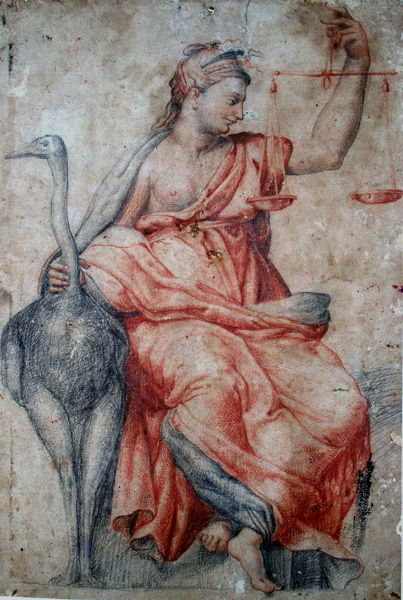
Giulio Romano (Giulio Pippi; Rome 1499-1546 Mantua), attributed, Justice. Black and red chalk on heavy laid paper. Attributed to Giulio on the verso. Justice has her right hand on an ostrich and holds a scale in her left towards which she directs her attention. As Millard Meiss argued (in “Ovem Struthionis,” Studies in Art and Literature for Belle da Costa Greene, ed Dorothy Miner [Princeton: Princeton University Press, 1954], 95), in explaining of the significance of the large egg (which he identifies as an ostrich egg) hanging over the enthroned Virgin and Child in Mantegna’s late fifteenth-century San Zeno altarpiece: “The great egg was . . . a common symbol of the immaculate conception of Christ. Both the Physiologus and the Bestiaries tell us that the eggs of the ostrich, abandoned by the mother bird, were hatched by the sun. This remarkable incubation was compared to the virgin birth of Christ. In the [translated] words of Albertus Magnus. . . . ‘If the sun can hatch the eggs of the ostrich, why cannot a virgin conceive with the aid of the true sun?’” Symbolically Giulio is juxtaposing an image of strict justice (the scales) with an image of mercy (Christ implied in the ostrich). Vasari reminds us that after the death of Pope Adrian, Giulio and his assistant threw down several walls in the Sala di Constantine that had been prepared for oil paintings, but left two decorations they had previously completed as decorations to accompany their portraits of the popes in the niches of the room, "Justice and another virtue." Since most of Giulio's later drawings were executed in pen and ink with washes while his early drawings were done in red and black chalk, it is possible that our drawing may relate to the "Justice" Vasari mentions in his life of Giulio in Part III of the Lives. Abrasions top left, bottom center-right, and right side not affecting image; tear extending from top margin down to Justice's hair. Image size: 381x254mm. Price: SOLD.
|
|
|
|
 |
|
|
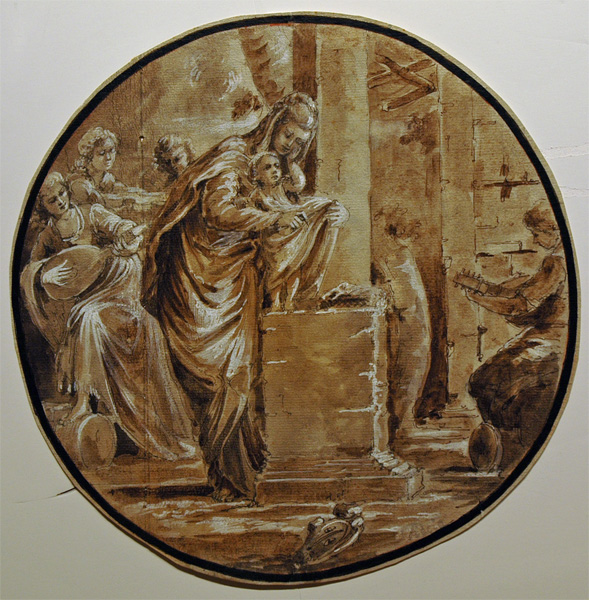
Our drawing is a variant of a drawing in the Louvre by Paolo Cagliari called Veronese (c. 1528-1588), titled "Pittura Quarta," and titled variously Virgin and Child with Musical Angels in the Wilderness (Richard Cocke, Veronese Drawings. A catalogue raisonne [London: Sotheby Publications, 1984], n. 19, p. 76) or The Madonna as a Seamstress (W. R. Rearick, The Art of Paolo Veronese 1528-1588 (Washington DC: National Gallery of Art, 1988). Brown wash base with pen and brown ink and heightening in white body color. Our drawing is on cream laid paper with a watermark close to Briquet 7112 (Salerno 1570) and 7113 (Ferrarra 1570) and a worn collector's mark on verso.
The Louvre's variant, "Pittura Quarta," depicts the Virgin and Child surrounded by six angels in a rectangular format. The Virgin holds what Cocke describes as the same "strange implement (a Pair of tongs?)" while Jesus reaches up to caress her face. On the left side, three musical angels in similar positions in a similar arrangement are serenading them; on the right, three more angels play for her, one of whom, seated playing a lute is close to ours, the only one on the right side of our drawing. In the background are the ruins of a building (perhaps the manger). Cocke dates the "splendid series of finished chiaroscuro drawings catalogued together (numbers 17-42) as independent works produced in the 1550s and early 1560s" [p. 21]). Rearick dates it 1583-84 and reproduces it as the frontispiece of The Art of Paolo Veronese 1528-1588 in a full-page illustration and discusses again on pages 164-65 with a smaller illustration. Our drawing is circular, the Louvre's is rectangular. Both are beautiful and well-executed drawings, ours, perhaps a presentation drawing, seems more brilliant, finished and assured. According to Cocke (p. 77, note 7), the Louvre's Veronese remained in Veronese's studio during the artist's lifetime: "That it remained in the studio may be confirmed by the painting in the collection of Antonio Zecchini in Pescara, which measured about the same size as the drawing and was, to judge from the engraving by Diogini Valesi, a studio derivation from the drawing." Our Veronese shows precisely the characteristics that Cock praises: "independent works in preparatory drawings and executed with a brilliance and fluidity in the white heightening that was copied but never equalled." Rearick identifies the "strange implement" as a pair of shears, with which the Virgin is trimming Jesus' garment. This makes sense of the little basket sitting next to Jesus' feet as her sewing basket. His arguments for the later date can be found on p. 165. Rearick's later date finds at least some support in Annalisa Scarpi's remarks on a drawing in pen and brown ink with white lead heigtening that Veronese prepared in connection with his Triumph of Venice for the ceiling of the Sala del Maggior Consiglio above the Doge's throne commissioned 1579 and completed by 1582 (see Giandomenico Romanelli et al, Veronese: Gods, Heroes and Allegories [Milan: Skira, 2004], p. 140; see also p. 142, where Scarpi dates another of the chiaroscuro drawings, The Triumph of Fame over Evil to the 1580s).
Cocke's comments on these chiaroscuro drawings are useful: "The independent chiaroscuro drawings were among the most admired of Veronese's drawings, being the only ones mentioned by his first biographer Ridolfi in 1648. Ridolfi's enthusiasm is understandable, for they were planned as independent works in preparatory drawings and executed with a brilliance and fluidity in the white heightening that was copied but never equaled. Veronese here turned to an older tradition of Venetian drawing with a sense of invention in conventional subjects, both religious and allegorical and in unusal variations on well-established themes (p. 71). If Rearick is correct in his dating and the date of ours is close to the year in which the paper was manufactured, ours is either a variant of another drawing of the scene not yet published or it is the original version of the Louvre's drawing.
One of Veronese's small ink drawings sold at auction at Christie's London on Dec. 5, 2006 for £180,000 (then Please call or email for current pricing information). We offer ours for a bit less than that price. Image size: 285mm diameter. Price: Please call or email for current pricing information.
|
|
|
 |
|
 |
|
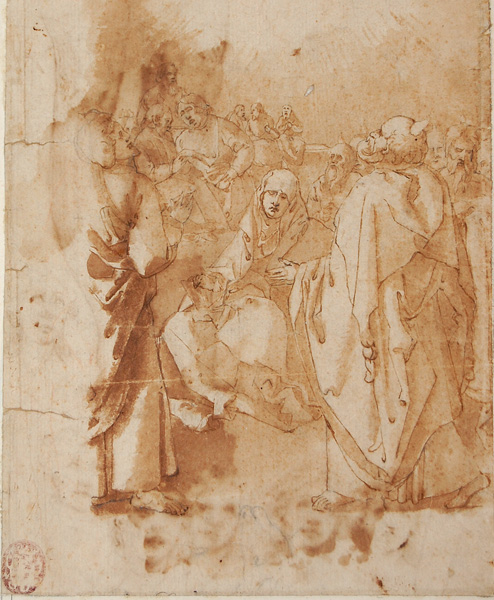
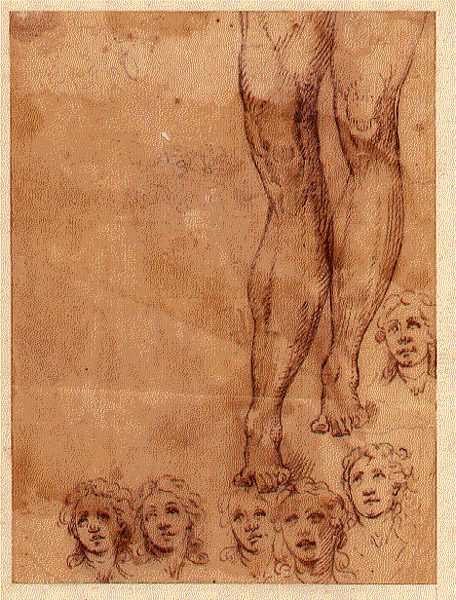
Paolo Veronese, attributed, Pentecost. Pen and brown ink and wash on cream laid paper, c. 1545-55?. Old collector's mark lower left. On the verso are 6 studies of heads looking upwards and a study of feet and legs, possibly a study for a crucifixion. The heads show through on the left side and the bottom of this sheet. If one compares this drawing with Durer's Pentecost in the Small Woodcut Passion, it is clear that Veronese was working with it close at hand. Image size: 215x165mm. Price: Please call or email for current pricing information.
|
|
VERSO: Paolo Veronese, attributed, Studies for a Crucifxion?. Pen and brown ink and wash on cream laid paper, c. 1545-55?. Old collector's mark verso lower left. On the verso is a study of Durer's Pentecost from the Small Woodcut Passion showing the Virgin and the Apostles receiving the Holy Spirit on Pentecost. Image size: 215x165mm.
|
|
|
|
|
|
|
|
In his introduction to W. R. Rearick, The Art of Paolo Veronese 1528-1588 (Washington DC: National Gallery of Art, 1988), Teresio Pignatti observes that one of the ways in which Veronese differs from his contemporaries is "his exceptional virtuosity in drawing," which was based "not only on direct acquaintance with the paintings to be seen in Mantua and Parma, but also on his familiarity with drawings and engravings by or after Parmigianino and his Venetian followers such as Schiavone" (p. 6). According to Pignatti, early critics of Veronese, starting with Vasari, stressed Veronese's graphic skill as "an essential aspect of an artist they viewed almost as repudiating the reigning principle in Venice, color." Pignatti notes that in 1556 Francisco Sansovino, the first critic to describe the paintings in the Sala del Consiglio dei Dieci in the Palazzo Ducale, affirmed that " 'Paolo is beginning to make himself known as something rare in his profession' and that his work proves him 'truly possessed of disegno [design, drawing] and delicacy.' " Pignatti also reminds us that Ridolfi's mid-17th century study of Veronese stresses that Veronese "used to train his hand by copying Durer's engravings and prints, and perhaps as well certain drawings by Parmigianino that he found in an album owned by the Muselli family in Verona" (p. 6). We may observe this in the drawing after Durer's Pentecost from his Small Woodcut Passion above left.
|
|
|
|
 |
|
|
|
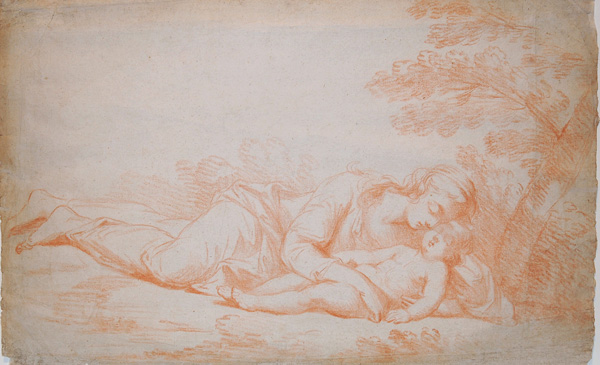
Matteo Rosselli (Italian, 1578-1651), attributed, Woman and child asleep in a landscape. Red chalk on cream laid paper, c. 1610. Image size: 285x443mm. Price: Please call or email for current pricing information.
|
|
|
|
|
|
|
 |
|
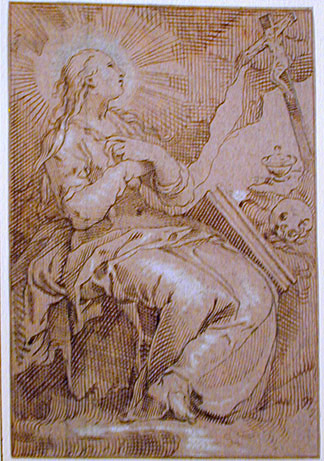
Abraham Bloemaert (Dutch, 1566-1651), attributed to, The Penitent Magdalene. Pen and brown ink heightened with white on gray paper, early 17th c. By the beginning of the 17th century, Bloemaert was the leading master in Utrecht. He was a prolific draftsman who executed over 1500 drawings, many of which served as models for prints. Image size: 130x90mm. Price: Please call or email for current pricing information.
|
|
|
|
|
|
|
 |
|
|
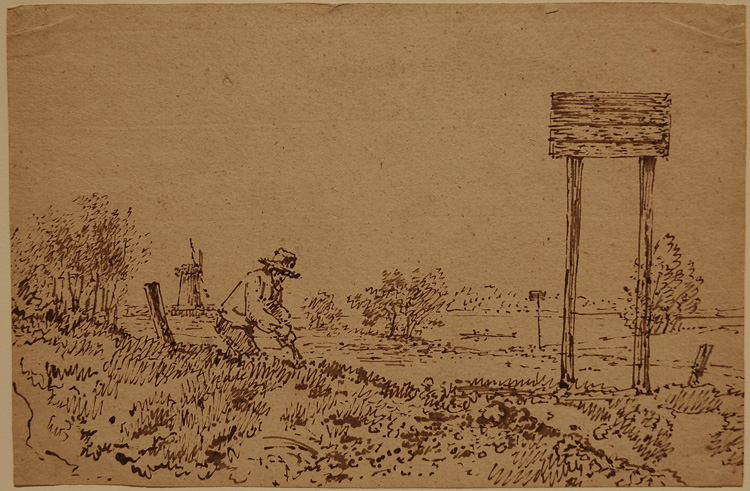
Rembrandt School (mid-17th century, Landscape with farmworker, windmill in the background. Pen and brown ink on laid paper, c. 1660. A very similar piece is shown in Drawings of the Rembrandt School, vol. 10, p. 5458, where it is attributed to Pieter de With, a painter and etcher active during the 1660s. Its similarities to a number of drawings by Rembrandt (e.g. Slive, Dover edition, numbers 62, 63, 73, 80, 126-27, 477, and 515, are apparent. Image size: 159x242mm. Price: Please call or email for current pricing information.
|
|
|
|
|
|
|
 |
|
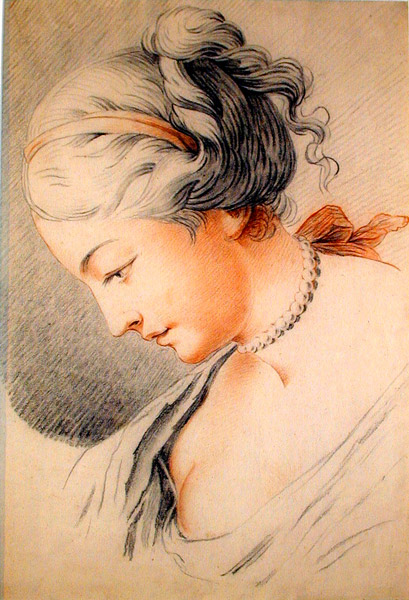
Jean-François de Neufforge (Belgium 1714-1791 France) Woman with pearl necklace looking down. Red and black chalk on laid paper. Image size: 450x305mm. Price: Please call or email for current pricing information.
|
|
|
|
|
|
|
|
 |
|
|
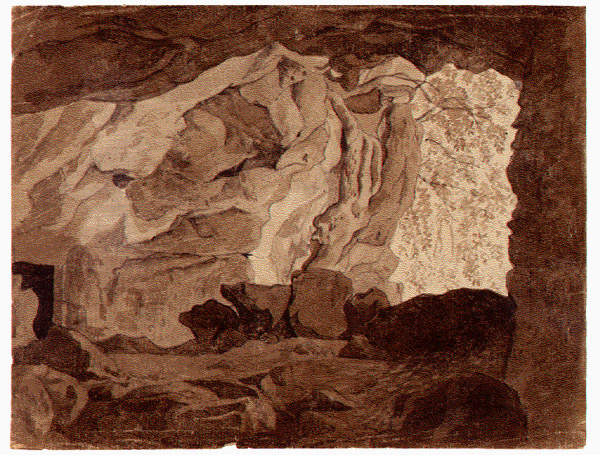
Marianne von Rohden (German, 1785-1866), View from a grotto. Brush, brown ink, and wash. The artist was a painter. She married the painter Ludwig Hummel, Their daughter, Suzette Hauptman, was also an artist and she too married an artist. Her brother, Johann Marten Rohden was also a painter. This family network suggests the kinds of tightly-knit communities that seem to support artists. Image size: 191x2476mm. Price: Please call or email for current pricing information.
|
|
|
|
|
|
|
 |
|
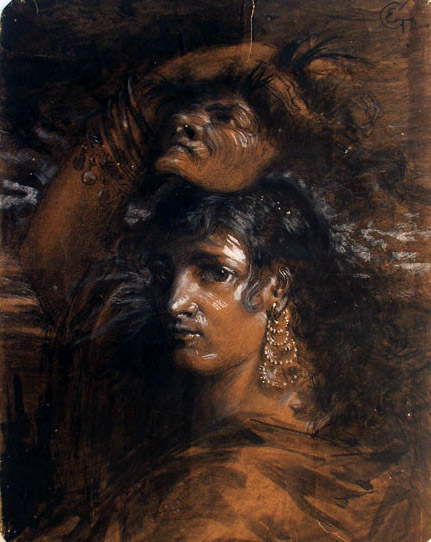
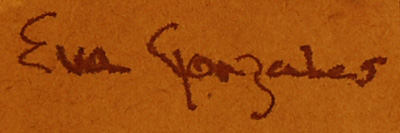
Eva Gonzalès (French, 1849-1883), An actress with a mask (detail as matted). Brush and black ink and wash with white gouache heightening and black chalk on tan wove paper. Initialed in pencil upper right recto with a small "E" within a large "G"; signed "Eva Gonzales" verso in pen (see below). Vertical tear top center; diagonal tear bottom right. Paper losses at corners. Image size: 296x220mm (11-3/4x8-3/4 inches). Price: P. O. R.
Gonzalès was Manet's only pupil. She showed regularly until her untimely death in childbirth. A recent show of "Impressionist Women: Mary Cassatt, Eva Gonzalès, and Berthe Morisot" at the Musée Marmotan in Paris and the accompanying book suggests that she indeed belongs in the company in which the show placed her. See the page dedicated to Gonzalès on our website for additional information.
|
|
|
|
 |
|
 |
|
|
|
|
|
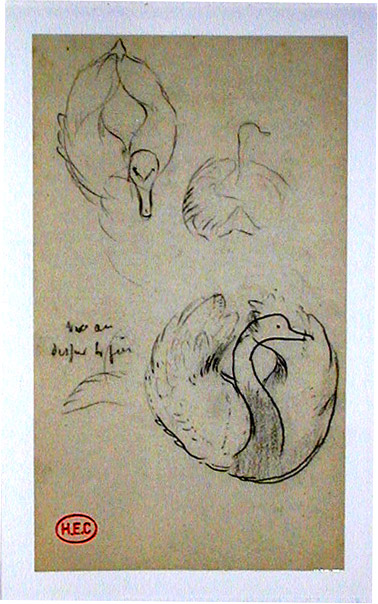
Henri-Edmond Cross (French, 1856-1910), Swans. Original ink drawing, c. 1899. Stamped with the Cross estate's studio stamp to indicate it was part of the estate at the time of the artist's death. There is also an unreadable inscription in ink left center. Image size: 170x98mm. Price: Please call or email for current pricing information.
|
|
|
|
|
|
|
 |
|
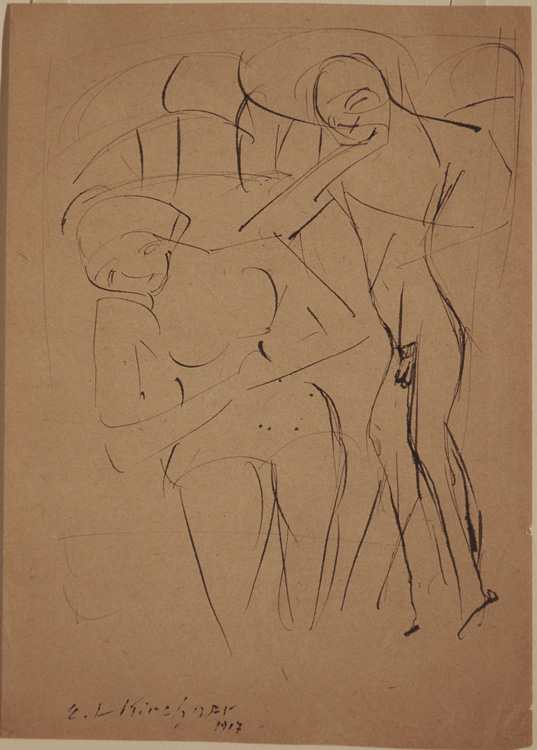
Akt und sitzenden Weib / Nude and sitting woman. Pen and ink onlight tan paper, 1917. Signed and dated 1917 in ink lower left. For other examples of Kirchner's signature on ink drawings see, for example, Karlheinz Gabler, E. L. Kirchner Zeichnungen, Pastelle, Aquarelle (Aschaffenburg: Museum der Stadt Aschaffenburg, 1980), p. 129. Image size: 190x135mm. Price: Please call or email for current pricing information.
|
|
|
|
|
|
|
Roman Norbert Ketterer's commentary upon Bathers in a Tub, a 1914 Kirchner drawing, seems very much to the point in suggesting a way of approaching our drawing of a standing male nude approaching a seated female, so I quote at some length: "In these quickly drawn scenes, in which an instantaneous impression was captured often in a matter of only a few minutes, a moment is represented. Much is superfluous and insignificant or implies something that was not actually seen. Kirchner is trying out a drawing style. The figures and their progressive movements are described differently than before. The lines are thin and long. They do not describe specific parts of the body but rather enclose the figures within a relatively common contour. . . . The lines cross, touch and move apart but nevertheless describe limbs. They serve simultaneously as contours which form the figure and enclose it within a geometric shape, and extend beyond the description of pure physicality or the pure outline of the body to merge with other linear configurations. It was only in 1914 that Kirchner began to employ this compositional achievement. The linear system in which the outline of a body is simultaneously a compositional contour continuously takes up the linear system which is imposed upon the entire drawing. It seems as though a carefully ordered framework has been superimposed on the entire drawing. The figures are elongated and attenuated, almost Mannerist in feeling" (in Roman Norbert Ketterer and Claus Zoege von Manteuffel, Ernst Ludwig Kirchner: Drawings and Pastels (NY: Alpine Fine Arts Collection, 1982), pages 118-19). From the fall of 1913 to 1915, when the final painting in the series was completed, Kirchner had been obsessed with his paintings, drawings, and prints of the Berlin Street Scene and of the prostitutes who met their customers before taking them off to their rooms. Also in 1915, Kirchner enlisted in the German Army and became an ambulance driver for an artillery regiment, but soon was diagnosed with a debilitating nervous condition and spent time in several sanitariums. He was discharged as unfit for service and, in 1916, he was rehospitalized for treatment in Germany. In 1917, he traveled to Davos, Switzerland for treatment and made it his permanent residence for the rest of his life. Our drawing may mark a moment in which he is revisiting the period immediately before his breakdown as a way of trying to recapture the creative energy of that period before he went to war. For the Berlin Street Scenes, see the catalogue of the recent spectacular show at the Museum of Modern Art by Deborah Wye, Kirchner and the Berlin Street (NY: MoMA, 2008); it is from this that I have taken the chronology above (see pages 129-30).
For additional drawings by German Expressionist artists, please click the links for Hannah Hoch, Rudolf Schlichter, and Georg Tappert.
|
|
 |
|
|
|
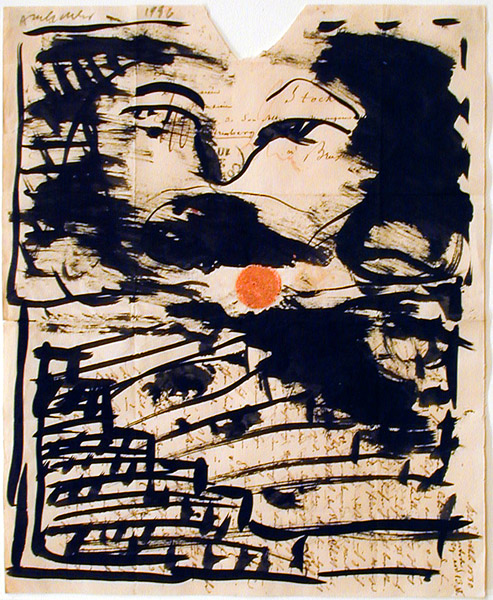
Pierre Alechinsky (Belgian, b. 1927), Escalier / Man on a staircase. Ink drawing and collage on aged letter paper, 1986. The red element in the center of the image is the wax seal originally affixed for privacy purposes, now serving to anchor the composition. Image size: 260x210mm. Price: Please call or email for current pricing information.
|
|
|
|
|
|
 |
|
|
|
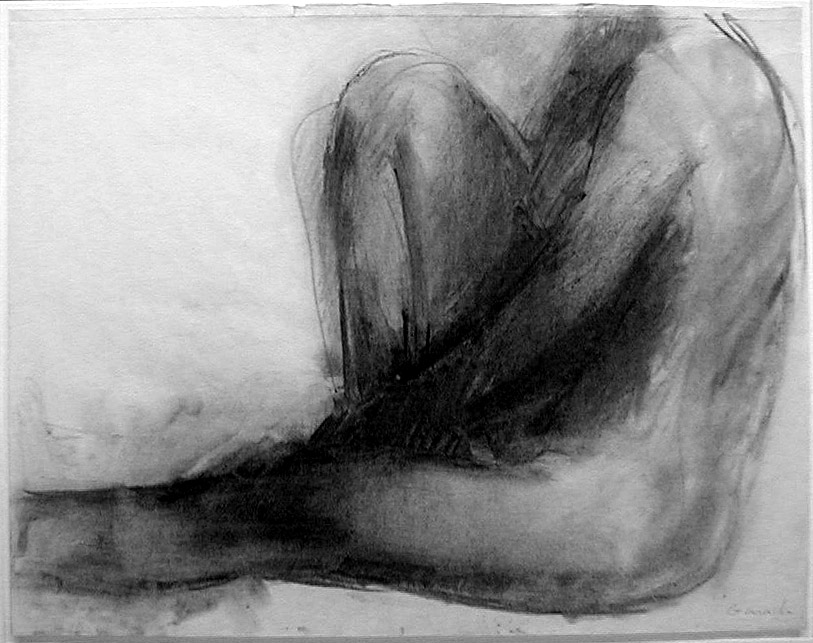
Claude Garache (French, b. 1929), Epiaire (Y. 18053). Charcoal drawing, 1973. Garache was the subject of a monograph by Jean Starobinski and his drawings were recently the subject of a book by Jacques Dupin, perhaps the world's leading expert on Joan Miró, who, along with Marc Chagall, recommended Garache to Aime Maeght back in 1966, beginning an association that lasted over 30 years with Galerie Maeght and its successor Galerie Lelong. Spaightwood Galleries has shown Garache's work since 1982. For other drawings by Garache, click here. Image size: 650x500mm. Price: SOLD.
|
|
|
|
|
 |
|
|
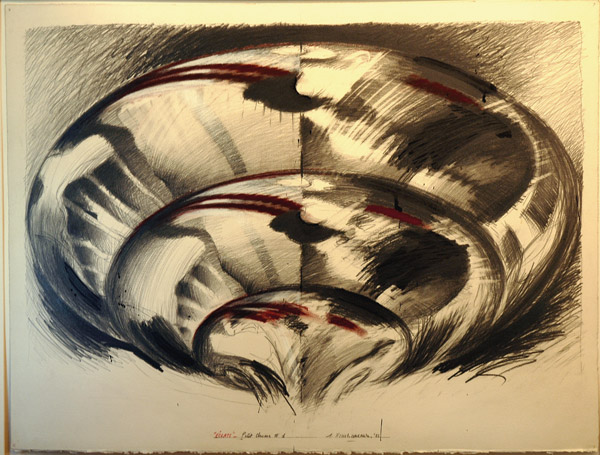
Gérard Titus-Carmel (French, b. 1942), Eclats: Petit Chrome 1 (see (Reperes 1, p. 32). Mixed media, 1982. Combining mine de plomb, encre de chine, crayon sanguine, and crayon de couleur (graphite pencil, sanguine, conte crayon, and ink). Between 1980 and 1982, Titus-Carmel worked on a series of large mixed-media drawings based upon reflections in a lamp. The series was first shown at Galerie Maeght in Paris and was featured in the first issue of repères: cahiers d'art contemporain, published by Galerie Maeght and devoted to Titus' Eclats & Caparacons 1980/1982. Our drawing, reproduced in black and white, serves as the frontispiece to the catalogue. The series of Eclats consisited of 3 sets of 10 drawings ranging from large to very, very large and three small etchings (Machida 128-130). Signed, titled, and dated center bottom. Image size: 655x800mm. Price: Please call or email for current pricing information.
For other drawings by Titus-Carmel, please click here.
|
|
|
|
|
Spaightwood Galleries, Inc.
To purchase, call us at 1-800-809-3343 (1-508-529-2511 in Upton MA & vicinity) or send an email to spaightwood@gmail.com.
We accept AmericanExpress, DiscoverCard, MasterCard, and Visa.
We also accept wire transfers and paypal.
For directions and visiting information, please call. We are, of course, always available over the web and by telephone (see above for contact information). Click the following for links to past shows and artists. For a visual tour of the gallery, please click here. For information about Andy Weiner and Sonja Hansard-Weiner, please click here. For a list of special offers currently available, see Specials.
All works are sold with an unconditional guarantee of authenticity (as described in our website listing).
Copyright 2004-2017, Spaightwood Galleries, Inc.
Go back to the top of this page.
Visiting hours: Saturday 10:00 am to 5:00 pm and Sunday noon to 6:00 pm and other times by arrangement.
Please call to confirm your visit. Browsers and guests are welcome.
|
|
|
|
|
|
|
|
|
|
|
|
|
|
|
|
|
|
|
|
|
|
|
|
|
|
|
|
|
|
|
|
|
|
|
|
|
|
|
|
|
|
|
|
|
|
|
|
|
|
|
|
|
|
|
|
|

