Click image for BBB rating
See our Privacy Policy
cool="cool" width="882" height="4353" border="0" cellpadding="0" cellspacing="0" gridx="16" showgridx="showgridx" usegridx="usegridx" gridy="16" showgridy="showgridy" usegridy="usegridy" bgcolor="#99ccff">
|
|
|
|
|
|
|
|
|
 |
|
|
|
Spaightwood Galleries, Inc.
120 Main Street, Upton MA 10568
Drawings from the late 15th century to the early 21st
June 8 to August 19, 2001
|
|
One-of-a-kind drawings:
A masterful, powerful show for Spaightwood Galleries
|
|
|
By Kevin Lynch, The Capital Times
18 July 2001
A drawing often has the feeling of a primal creative act. That's part of the intrigue and quiet excitement of the current Spaightwood Galleries show. The art dealer has built a reputation and reasonably strong art business largely through [original] art prints.
At a glance, the new show has the familiar blend of striking form, concept and intimate detail one expects of Spaightwood print shows. In fact, "Drawings From the Late 15th Century to the Early 21st," running through Aug. 19, is unprecedented in the 21-year history of the galleries at 1150 Spaight St. (Hours are noon to 6 p.m. Saturday and Sunday, and weekdays by appointment, at 255-3043.)
This is the Spaightwood's first-ever show of [nothing but] one-of-a-kind works by various artists, rather than pieces from multiple-print editions.
So if you want a work of art that represents a unique moment of creative endeavor, here's your chance. This show also reflects substantially more Old Masters-period works than normally seen at the modernist-oriented gallery. Visitors of virtually all art tastes may find something here.
With their typical marketing savvy, Andrew and Sonja Weiner have also integrated works by the favorite contemporary artists in their massive inventory. Most of those contemporary works, as with most of the pieces in the show, have never been shown here.
All these points of distinction wouldn't mean much if the art itself wasn't good, and this work is never less than very good and is sometimes exquisite. That's where the special evidence and vibrancy of drawings come into play. Some pieces have the feel of improvisation and unfinished work, but those qualities often add to the visual intrigue. Others are intensely realized where they need to be, such as a small drawing just inside the foyer door.
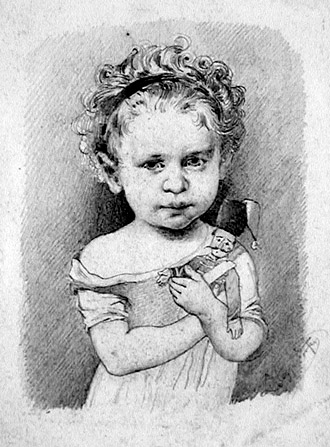
Small Child With Toy Soldier by the 19th-century German artist Lothar Meggendorfer is a rich characterization in a stark, realist manner. The child's face has a presence beyond her years—her eyes are steadfast but her faintly bit lower lip suggests that this child's secret garden isn't all roses and butterflies. Or, as Andrew Weiner says, "a Huck Finn-type kid, perhaps strong, willful and capable of mischief."
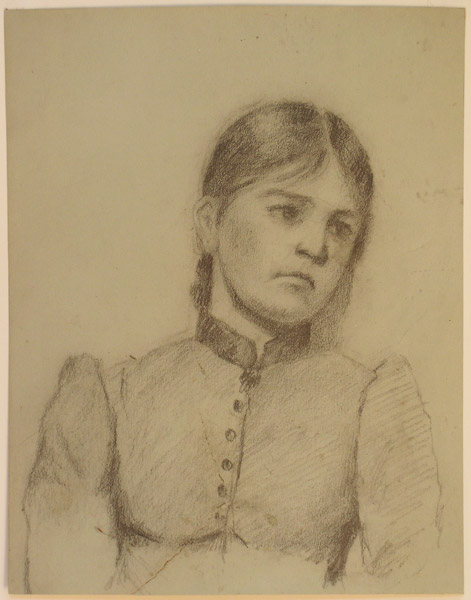
Another stunning portrait, by an anonymous French artist in the 19th century, captures an elegant Young woman pensively gazing off to the side, oblivious to the viewer. Buttoned tightly to the neck, she seems to be bound by Victorian conventions.
The show also reveals how some 17th- through 19th-century artists creatively explored how drawing and watercolor can prompt expressively abstracted effect.
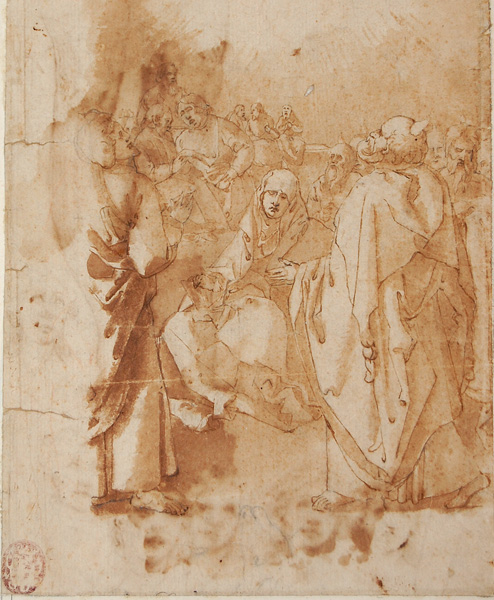
Veronese, a celebrated Italian Renaissance artist, manages in Pentecost to lend a spiritual aura to the famous biblical scene. Several [Apostles] stand over Mother Mary, [ecstatically receiving the Holy Spirit, the fruits of] her son's persecution. The two apostles in the foreground seem to be enveloped by the burning white light from above.
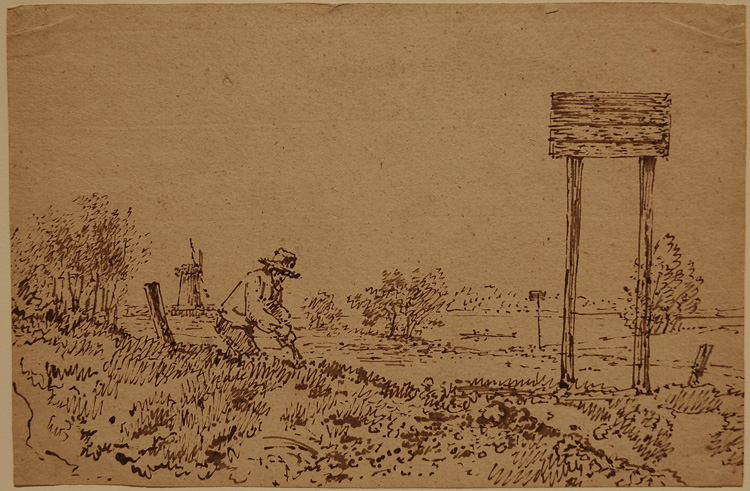
Many of these artists may be unfamiliar to contemporary viewers, which makes the show such a discovery. However, there are several works done by direct contemporaries of Rembrandt, including one fetching scene of a farmer in a field, with a windmill in a deftly rendered distance. The Rembrandt-style hatching, like bits of blown grain, quietly animates the scene.
Among the contemporary works, two reveal the human energy in the creative act. Joan Gardy Artigas' vibrant mixed-media drawing "Le Peintre" ("The Painter") seems to signify the essence of this show. We see an artist placing his paint-covered palm on a canvas. His hunched shoulder and sweeping arm suggest that this is the sort of inspired impulse that can trigger sudden art, or more ambitious labors.
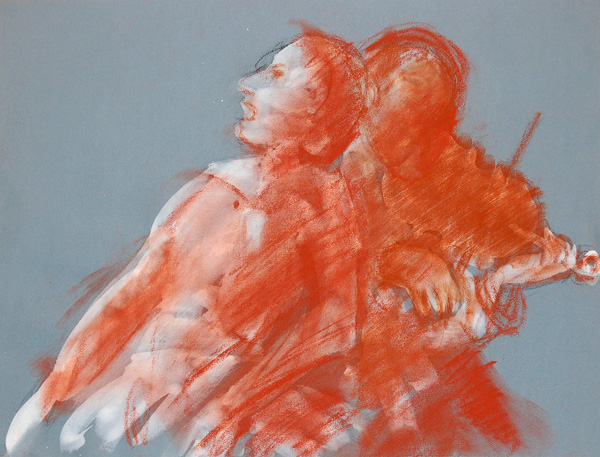
Another superb recent work is Claude Garache's "Choregies d'Orange: Etude II," a sanguine, gouache and charcoal drawing of a violinist and listener. Their physical closeness and the listener's absorption—mouth agape—convey the powerful chemistry that can occur between musicians and listeners. This work was used as a poster for a music festival, the name of which is also the title of this work.
Andrew Weiner is struck by the implications of this show. "For one thing, we couldn't have done this sort of show without the huge surge in Internet sales this year, which helped us purchase many of these works," he says.
Weiner says he may mount more shows of one-of-a-kind art to allow viewers to think about "the differences between multiples and unique things. That's something that we may all need to think about if books ever become things that exist in raw electronic shape and allow each individual reader to interact uniquely with a given text, to set up his or her own links, or perhaps even insert illustrations. "In a way, it is like undoing Gutenberg, but still allowing for mass production," he adds.
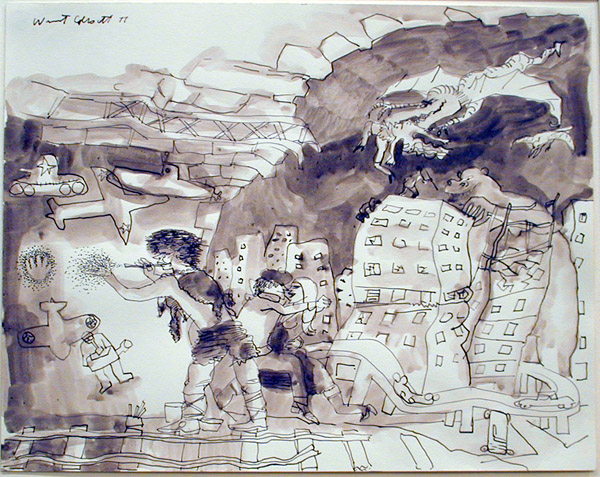
Another work on the stairway gallery echoes the Artigas work and speculates on the fate of creative documents and civilization. Madison area artist Warrington Colescott's satiric ink drawing 'The Last Printmaker" depicts an apocalyptic scene in which an artist is blowing ink onto his hand to create a ghost image of the hand in mid-air. As excess development and monster-movie creatures destroy the city around him, the artist's simple act of ingenuity recalls the earliest artifacts of visual culture: prehistoric cave drawings.
In this unsettling scene, culture has come full-circle. This powerful show—at once elemental and masterful—helps seal that circle for civilized posterity.
|
|
|
|
|
 |
|
Lothar Meggendorfer (German, 1847-1925), Small child with toy soldier. Pencil on wove paper, last third of the 19th century. Meggendorfer studied with Strähuber, Anschütz, and W. van Dietz. In 1886 he founded the Meggendorfer Blatter and published his writings and illustrations there. The Munich Municipal Museum has a collection of his drawings. Signed lower right corner in image (just below elbow). Image size: 120x90mm. Price: SOLD.
|
|
|
|
 |
|
Jean-François Millet (French, 1814-1875), attributed. Catherine Lemaire as a Young woman. Pencil on bluish green tinted paper. Long repaired tear snaking its way up from the lower left to the left shoulder. This work is strongly reminiscent of Millet's portrait of his wife in 1848-49 in the Museum of Fine Arts, Boston. The subject here is several years younger and is seen before she began giving birth to Millet's children. After looking at photographs of several thousand 19th-century drawings, this one struck us as one of the most tender, wistful, and lovely drawings of its kind that we have ever seen. Image size: 261x203mm. Price: SOLD
|
|
|
|
 |
|
Paolo Veronese, attributed, Pentecost. Pen and brown ink and wash on cream laid paper, c. 1545-55?. Old collector's mark lower left. On the verso are 6 studies of heads looking upwards and a study of feet and legs, possibly a study for a crucifixion. The heads show through on the left side and the bottom of this sheet. If one compares this drawing with Durer's Pentecost in the Small Woodcut Passion, it is clear that Veronese was working with it close at hand. Image size: 215x165mm. Price: Please call or email for current pricing information.
|
|
|
|
|
|
|
|
 |
|
Rembrandt School (mid-17th century, Landscape with farmworker, windmill in the background. Pen and brown ink on laid paper, c. 1660. A very similar piece is shown in Drawings of the Rembrandt School, vol. 10, p. 5458, where it is attributed to Pieter de With, a painter and etcher active during the 1660s. Its similarities to a number of drawings by Rembrandt (e.g. Slive, Dover edition, numbers 62, 63, 73, 80, 126-27, 477, and 515, are apparent. Image size: 159x242mm. Price: Please call or email for current pricing information.
|
|
|
|
 |
|
Claude Garache (French, b. 1929), Chorégies d'Orange: Etude II. Original sanguine, gouache, and charcoal drawing, 1993. Signed lower right. This work, on mi-teinte Canson bleu, was the model for a poster for a music festival. Image size: 488x682mm. Price: Please call or email for current pricing information.
|
|
|
|
 |
|
Warrington Colescott (American, b, 1921), History of Printmaking: The last printmaker. Original watercolor, 1977. One of the preparatory sketches for the etching of the same title in Colescott's celebrated History of Printmaking series. Image size: 354x280mm. Price: Please call or email for current pricing information.
|
|
|
|
|
|
Spaightwood Galleries, Inc.
To purchase, call us at 1-800-809-3343 (1-508-529-2511 in Upton MA & vicinity) or send an email to spaightwood@gmail.com. We accept AmericanExpress, DiscoverCard, MasterCard, and Visa.
For directions and visiting information, please call. We are, of course, always available over the web and by telephone (see above for contact information). Click the following for links to past shows and artists. For a visual tour of the gallery, please click here. For information about Andy Weiner and Sonja Hansard-Weiner, please click here. For a list of special offers currently available, see Specials.
Visiting hours: Saturday 10:00 am to 5:00 pm and Sunday noon to 6:00 pm and other times by arrangement. Please call to confirm your visit. Browsers and guests are welcome.
|
|
|
|
|
|
|
|
|
|
|
|
|
|
|
|
|
|
|
|
|
|
|
|
|
|

