Spaightwood Galleries

Updated 4-19-09
Home / Gallery Tour 1 / Master Drawings and Prints / Gallery Tour 2 / Artists

Luca Cambiaso (Genoa, 1527-1585, El Escorial, Madrid)

15th century North Italian Illuminated Manuscript / Italian School, 16th and early 17th-Century Drawings
Michelangelo Buonarotti (After) / Raphael / Parmigianino / Marcantonio Raimondi
Giulio Romano / Titian (after) / Andrea Schiavone / Tintoretto / Veronese / Federico Zuccaro
Jacopo Palma il Giovane / Luca Cambiaso / Cherubino Alberti / Annibale Carracci

Italian School, 17th-Century Drawings / Drawings2 / Simone Cantarini / Domenichino / Guercino / Pier Francesco Mola

Italian School Printmakers, 15th-17th Centuries: Venetian School, c. 1500 / Raphael School / Giovanni Jacopo Caraglio
Marcantonio Raimondi / The Master of the Die / Anea Vico / Agostino Veneziano / Nicholas Beatrizet
Michelangelo Buonarotti (After) / Girolamo Fagiuoli / Cherubino Alberti / Titian (after) / Tintoretto (after)
Parmigianino / Giorgio Ghisi / Diana Scultori / Agostino Carracci / Annibale Carracci / Ludovico Carracci
Simone Cantarini / Elisabetta Sirani / Gerolamo Scarsello

Netherlandish School 15th-17th-Century Drawings / Flemish School, 17th-Century
Bernaert van Orley / Lucas van Leyden / Maarten de Vos / Jan Baptiste de Wael / Abraham Bloemaert
Peter Paul Rubens / Philipp Sadeler / Nicolaes Maes / Rembrandt School

Netherlandish Printmakers 16th-17th Centuries: Lucas van Leyden, Maarten van Heemskerck, Dirck Coornhaert,42
Cornelis Cort, Philips Galle, Abraham de Bruyn, Hans (Jan) Collaert, Adriaen Collaert, Karel de Mallery, Theodore Galle,
Hendrik Goltzius, Julius Goltzius, Jacob Matham, Jan Sanraedam, Maerten de Vos, Jan Sadeler, Aegidius Sadeler,
Raphael Sadeler, Crispin de Passe, Magdalena de Passe, Wierix Brothers, Rembrandt, Rembrandt School, Jan Lievens,
Jan Joris van Vliet, Ferdinand Bol, Govert Flinck

German Drawings: Hans Sebald Beham / Virgil Solis / Hans von Aachen / Joseph Heinrich Roos
German 16th century printmakers: Heinrich Aldegrever, Jost Amman, Hans Sebald Beham, Hans Brosamer, Hans Burgkmair, Lucas Cranach, Albrecht Durer, Albrecht Durer (After), Hans Holbein (After), Hopfer Brothers, Georg Pencz, Hans Schäufelein, Virgil Solis, Wolfgang Stuber.

18th-Century Drawings / 19th-Century Drawings / 20th-Century Drawings
Luca Cambiaso's father was a painter, and he received his first training from him, but the son far surpassed his father in terms both of his commissions and his art. He was the leading painter in Genoa for the second half of the 16th century and introduced Mannerism to Genoa. He also attracted international patrons and died in Madrid while working on a series of large paintings for Philip II's Escorial palace / retreat / monastery. The arrival in 1528 of Perino del Vaga, Raphael's pupil and an important member of his workshop, fleeing from the Sack of Rome, transformed the sleepy Genoese art scene. Andrea Doria, the ruler of Genoa, immediately hired Perino as de facto artistic director, much as the Gonzagas in Mantua had hired Giulio Romano in similar circumstances. Perino's decorative scheme became for the next generation of Genoese artists what Raphael's logge had become in Rome: a school for artists. It remained, however, for Luca Cambiaso to define in fullness the style that would dominate in Genoa for a considerable time to come. Combining his knowledge of works by Perino, Beccafumi, Pordenone, Giulio Romano, Michelangelo, Correggio, Titian, and Veronese, he defined the high style of art in Genoa for the immediate future. As Bettina Suida Maning put it, "Numerous frescos, thousands of drawings, revealing a wealth of imagination which seems to go beyond the capacity of a single human being, and easel paintings of great beauty and serenity are the legacy that Cambiaso bestowed upon Liguria. Within the little more than three decades of his activity in and around Genoa, Luca Cambiaso created a style so clearly defined and of such immediate appeal and deep-rooted strength that he succeeded in educating an indigenous group of artists who, borne on the powerful pinions of his genius, emerged strong enough not to be consumed by the effulgence of such overwhelming artists as Rubens and Van Dyck" (Genoese Masters: Cambiaso to Magnasco, 1550-1750, no page numbers). Luca produced many drawings (perhaps, as Jonathan Bober has suggested, because Genoa had no tradition of print making able to spread the ideas and inventions of artist, he decided to use "the systematic and extensive  . . . replication of drawings" as a substitute [Luca Cambiaso 1527-1585, 84-85): "The replicas were of autonomous works and preparatory studies alike. The most faithful repeat their prototypes with such uncanny fidelity to every mark that they can be distinguished only be a slightly more uniform speed and deliberate gesture" (p. 84) and, most interestingly, Bober suggests that they also satisfied a burgeoning desire among collectors for drawings "in which a graphic personality is paramount" (85). In the 17th century, etchings done by the artists themselves would serve this need, but in Genoa, Cambiaso's solution seems to have worked.

Select Bibliography: Dante Bernini, ed., Luca Cambiaso e la sua cerchia: Disegni inedit da un album Palermitano del '700 (Genova: SAGEP Editrice, 1985); Jonathan Bober, ed., Luca Cambiaso 1527-1585 (Milano: Silvana Editoriale, 2006); Piero Boccardo, Franco Boggero, Clario Di Fabio, and Lauro Magnani, eds. with Jonathan Bober, Luca Cambiaso. Un maestro del Cinquecento europeo (Milano: Silvana Editoriale, 2007); Veronique Damian, Luca Cambiaso (1527-1585): Trois Nocturnes Resdecouverts (Paris: Galerie Canesso, 2004); Lauro Magnani, Luca Cambiaso, Da Genova all' Escorial (Genova: SAGEP 1995); Lauro Magnani & Heribert Schulz, Geometrie der Figur: Luca Cambiaso und die moderne Kunst (Museums-U. Kunstverein Osnabrück, 2007); Lauro Magnani & Giorgio Rossini, La "maniera" di Luca Cambiaso. Confronti, spazio decorativo, tecniche (Genova: San Giorgio Editrice, 2008); Bettina Suida Manning & Robert L. Manning, Genoese Masters: Cambiaso to Magnasco, 1550-1750 (Dayton: Dayton Art Institute, 1962); Bettina Suida Manning & William Suida, Luca Cambiaso, La Vita e Le Opere (Milan: Casa Editrice Ceschina, 1958).
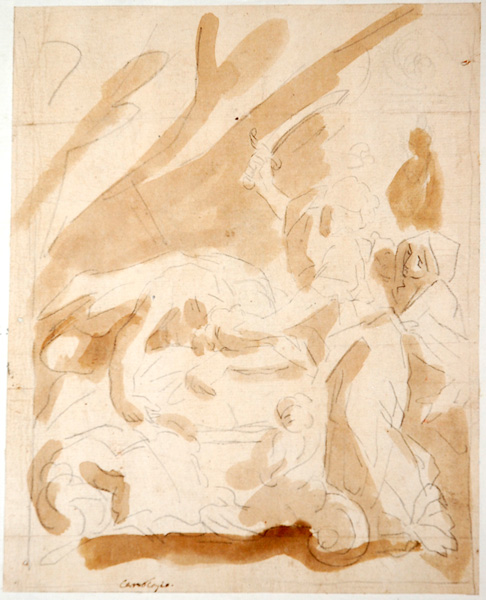
Luca Cambiaso, attributed to, Judith beheading Holofernes. Pen and brown ink and wash and pencil. A quick sketch of a woman holding a sword in her right hand while a servant waits behind her as they approach a man sprawled on a bed. Cream laid paper mounted on laid paper. Attributed to Cambiaso in brown ink left-center at the bottom of the sheet. A master of a quick spontaneous drawing style, Cambiaso produced many "ebullient and energetic drawings." This one seems to date from the earlier part of his career. Image size: 225x180mm. Price: $9500.
Luca Cambiaso, attributed to, The Adoration of the Magi. Pen and brown ink and wash, c. 1575. In her comments on Luca's drawings in Drawings in the Fogg Museum of Art (Cambridge: Harvard University Press, 1940), Agnes Mongan very pithily discusses a function of his later drawing style: "Long before the days of cubism, Cambiaso adopted a cubistic vocabulary. Through the simplification of form he attained a clarity of composition which would have been impossible had he drawn in detail the many figures that crowded his scenes. He was free to concentrate on arrangement of groups, spacing, and problems of light. The impression of rapid movement and vibrant life of his cubistic figures is often amazing and sometimes droll" (I, 58). A look at this small but powerful and elegant drawing, however much lacking in drollness, suggests how much he gained with his late style: the angular strokes on the body outlines give them a surprising intensity and nervous energy when contrasted with the calm and more traditional background of landscape and buildings. In the course of working out his invention and disposition of figures, Luca's drawings sometimes seem to go through three broadly-defined stages. In the early stages of Luca's cubistic drawings, the figures tend to have square faces with no expressions; intermediate stages sometimes show faces like the ones above, verging upon the triangular; final versions have rounded off the points of the triangles and moved towards "normal" Manneristic distortions. For examples, see Bober, plate 75 (first stage), Bober, plate 86 (intermediate stage); Bober, plate 89 (closer to final stage). Provenance: John Flaxman R.A., English, 1755-1826; Flaxman worked in Rome 1787-1794. On the provenance, see the letter below and the reproduction of the verso of the drawing below that, where it is titled "The wise men's offering." Image size: 88x110mm. Price: $7500.
John Flaxman (England, 1755-1826) was "the most famous English Neo-classical sculptor of the late 18th century and the early 19th. He . . . became noted for the piety and humanity of his church monuments. He also had an international reputation based on his outline illustrations to the works of Homer, Aeschylus and Dante, which led him to be described by Goethe as the 'idol of all the dilettanti' " (David Bindman, "John Flaxman," Grove Dictionary of Art 11: 162-65; here at 162). Flaxman was in Rome from 1787-1794 and would have had opportunities to purchase Italian Renaissance drawings. We also purchased the Raphael mentioned in the letter reproduced above. The initial "T" above seems to come from the same hand that made the "F" at the bottom left of the Raphael drawing (click here for comparison) where it is signed "J. F."

Spaightwood Galleries, Inc.

To purchase, call us at 1-800-809-3343 (508-529-2511 in Upton MA & vicinity) or send an email to sptwd@verizon.net. We accept AmericanExpress, DiscoverCard, MasterCard, and Visa.

For directions and visiting information, please call. We are, of course, always available over the web and by telephone (see above for contact information). Click the following for links to past shows and artists. For a visual tour of the gallery, please click here. For information about Andy Weiner and Sonja Hansard-Weiner, please click here. For a list of special offers currently available, see Specials.

Visiting hours: Saturday and Sunday noon to 6 pm and other times by arrangement. Please call to confirm your visit. Browsers and guests are welcome.