|
|
|
 |
|
|
|
|
|
|
|
|
Welcome to Spaightwood Galleries, Inc.
120 Main Street, Upton MA 01568-6193
Last updated: 6/23/2019
Old Master Drawings: 17th-Century Italian Drawings I
|
|
|
|
|
|
As former teachers of Renaisssance literature, we found ourselves drawn to the prints and drawings of the period. This interest (tending at times to obsession), prompted our acquisition of a number of old master drawings, including works by Netherlandish artists like Bernaert van Orley, Maarten de Vos, Jan Baptiste de Wael, Abraham Bloemaert, Peter Paul Rubens, Philipp Sadeler, and Nicolaes Maes; we have also found works by Italian artists like Raphael, Parmigianino, Marcantonio Raimondi, Giulio Romano, Perino del Vaga, Andrea Schiavone, Veronese, Federico Zuccaro, Luca Cambiaso, Alessandro Casolani, Matteo Rosselli, Annibale Carracci, Domenichino, and Simone Cantarini, Francesco Albani, Guercino, Pier Francesco Mola, Francesco Vanni, Odoardo Fialetti, Ercole Bazzicaluva, Baldassare Franceschini, Giovanni Battista Vanni, Antonio Busca, Giovanni Lanfranco, Giuseppe Maria Cresspi; also in our collection are a growing number of works by German artists like Virgil Solis, Hans von Aachen, and Johann Heinrich Roos and French artists like Charles de la Fosse, Etienne Parrocel "Le Romain," François Boucher, Jean-François de Neufforge, and Mouricault. Some of these works appear to be finished drawings, others attempts to conceptualize an artistic problem to be solved, still others models for members of the master's workshop to execute in whole or in part under the master's supervision, and many are drawings of paintings, sculptures, etchings or engravings by their contemporaries of they works wished to study or use in their own works (including works after Michelangelo, Titian, Tintoretto, Veronese, Palma Il Giovane, Agostino Carracci, Hendrik Goltzius, Rembrandt, among others). In addition to artists to whom we can authorship or attribute works, we have a number of works to which we can more or less confiently attribute only memebrship in a regional or national school, of which we have a number of examples of the Venetian (16th century), Genoese (17th century), and Bolognese Schools (17th century). Some of these drawings are stunningly beautiful finished works, some are quick sketches, and some are useful for studying how earlier collectors assembled their collections. We have found the study of these possibilities instructive towards our considerations of the art and practise of drawing and their relationship to both the paintings and the prints of the era. Old master prints long preceded old master drawings as objects of desire, and our collection of them goes back over 35 years (at least 5 years before we even dreamed of starting a gallery). Albrecht Durer's prints were our first love and it has been an enduring one; the works of early and mid 16th-century Italy, especially on mythological and religious subjects, began next; the works of the later 16th-century Netherlandish Mannerists, particularly those working with designs by Maerten van Heemskerck, Maarten de Vos, and Hendrik Goltzius (including Goltzius himself), are a more recent love, and we are just beginning to study the works of the eatly-mid 17th century Dutch artists.
|
|
|
|
|
 |
|
 |
|
|
|
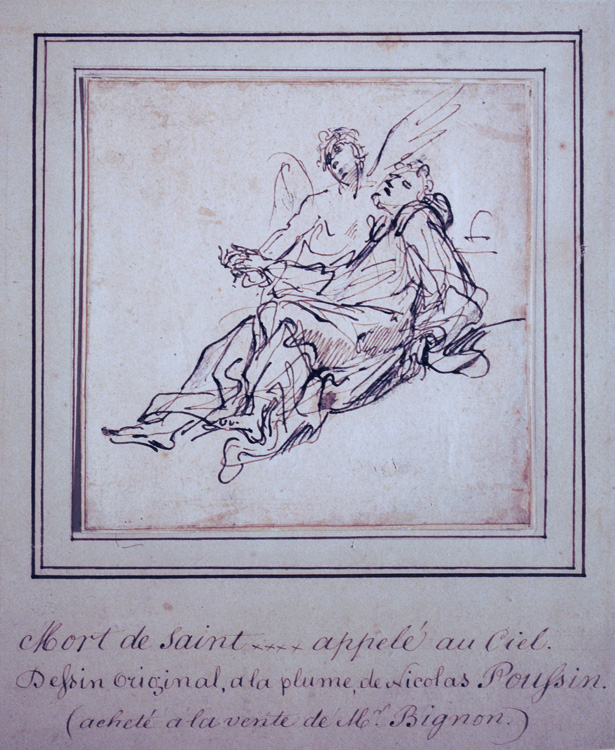
Giovanni Baglione ((Rome, 1566-1644), attrib., Death of a Saint called to Heaven. Pen and brown ink on cream laid paper. An angel supports a dying saint in this drawing on cream laid paper mounted on card stock. The mount bears an early attribution to Nicholas Poussin in ink and notes that it was purchased at the "vente de M. Bignon." This may refer to the sale of the collections of Abbé Bignon (1662-1743). Image size: 115x115mm. Price: Please call or email for current pricing information.
|
|
Baglione paricipated in some of the most important fresco campaigns undertaken by Popes Sixtus V, CLement VIII, and Paul V. He was thrice elected as "principe" of the Academy of St. Luke, yet his reputation was sullied by Caravaggio's attacks upon his ability as a painter and Baglione's subsequent action of libel against Caravaggio and his allies. (For more on this episode, see Maryvelma Smith O'Neill, Giovanni Bagione: Artistic Reputation in Baroque Rome [Cambridge: Cambridge University Press, 2002) and the review of the book by Stephen S. Ostrow, The Art Bulletin (2003). Ostrow's comments upon Baglione as a draftsman are directly to the point: "Baglione was, without question, a gifted draftsman, steeped in the tradition of Roman disegno. His chalk and pen and ink drwings reveal a force and lyricism rarely found in his paintings; indeed one of the values of . . . [Smith O'Neill's] book is the serious consideration it gives to the artist's graphic output and the intergration of his preparatory drawings into the discussion of this paintings." For another study of Baglione, see Stefania Macioce, Giovanni Baglione (1566-1644): Pittore e biografo di artisti (Rome: Lithos editrici, 2002) aand the very full bibliography she gives on pp. 225-46).
|
|
|
|
 |
|
|
|
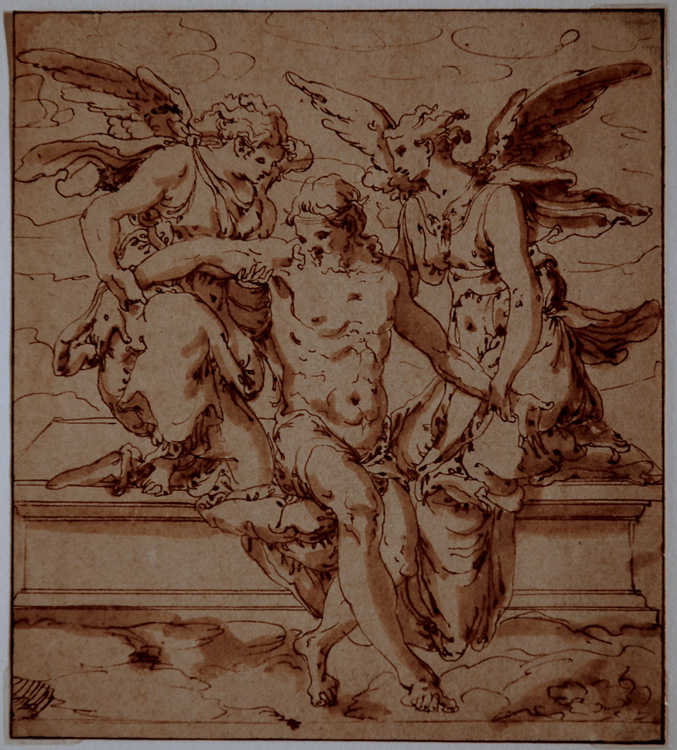
Pier Francesco Mazzuccelli, il Morazzone (Morazzone, 1573-1626) attributed, Christ on a tomb supported by two angels. Pen and brown ink and wash on cream laid paper. In this effective and moving drawing, the two angels present the dead body of the crucified Christ directly to the viewer. It is incumbent on the viewer not to give in to a Good Friday despair but instead to have faith that the promised Easter Resurrection will occur. The painter was taken to Rome by his father, a master mason, in 1592. According to Alberto Bertoni's entry in the Grove Dictionary of Art (22: 81-83), "Borsieri (1619) claimed that he was taught there principally by the Sienese painter Ventura Salimbeni, whereas Baglione (1642) stated that he frequented the various academies of Rome" (81). Bertoni suggests that "it is likely that he also gained experience in the workshop of the Cavaliere d'Arpino" (81). He was apparantly able to attract attention fairly quickly, working in several important churches in Rome. After training in Rome for about 5 years, Il Morazzone returned to Lombardy, where he painted frescoes in churches and palaces in Varese, Milan, Como, Varollo, Turin, and Mantua. According to Bertoni, "With Cerano, Giulio Cesare Procaccini, and Tanzio da Varallo, he was one of the principal Lombard painters of the early 17th century. Like many of his contemporaries, he was strongly affected by the piety and mysticism of the teaching of St. Carlo Borromeo, yet his work is distinguihsed from theirs by a greater classicism, owing to his training in Rome" (81) Bertoni also praises him as "an original draughtsman" and notes that the major collections of his drawings are in Milan and Florence (in the Uffizzi). For a comparable drawing, see Martin Royalton-Kisch, Hugo Chapman, and Stephen Coppel, Old Master Drawings from the Malcolm Collection (London: British Museum, 1996), p. 91. Image size: 164x145mm. Price: SOLD.
|
|
 |
|
|
|
Agostino Carracci (Bologna, 1557-1602), AFTER, Pieta. See Diane Bohlin, Prints and Related Drawings by the Carracci Family (Washington DC: Nstional Gallery of Art, 1979), n. 102, p. 199. Pen and brown ink and gray wash on cream laid paper, after 1582. This drawing after Agostino's engraving after Paolo Veronese's painting suggests the way that paintings, drawings, and prints might all function in the artistic market. De Grazia suggests that Agostino interpreted Veronese's painting with Veronese's consent. Our drawing shows an artist studying Agostino's work. Image size: 403x295mm. Price: Please call or email for current pricing information.
|
|
|
 |
|
|
|
|
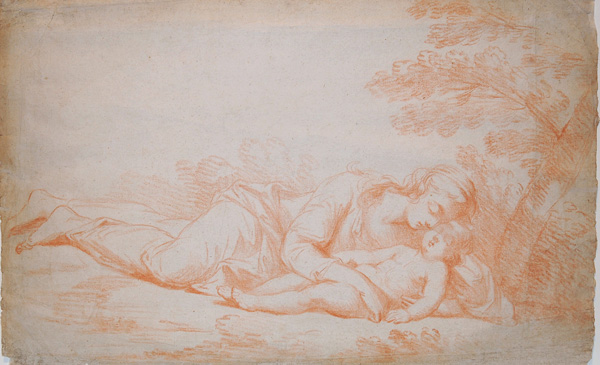
Matteo Rosselli (Italian, 1578-1651), attributed), Woman and child asleep in a landscape. Red chalk on cream laid paper, c. 1610. Rosselli was a successful painter of the late Florentine Counter-Maniera and the early Baroque. On 26 February, 1599, he was inducted to the Accademia del Disegno. His most important commissions include frescoes on the lives of Servite monks (1614-18) in the Palazzo Pitti and in the Cloister of the Basilica della Santissima Annunziata; a Madonna and Child with Saint Francis altarpiece for the Church of Santa Maria Maggiore in Florence; and an Adoration of the Magi (1607) for the Church of Sant'Andrea in Montevarchi. He painted a Crucifixion (1613) now in the parish church at Scarperia. He painted a Last Supper (1614) now in Conservatorio di San Pier Martire. After Henri IV's assassination, he was commissioned to make two commemorative paintings of events in the life of the French king. He also completed an Assumption (1613) for the church of San Domenico in Pistoia. He was also chosen by Michelangelo Buonarroti the younger to execute a number of frescoes for the Casa Buonarroti based on events of Michelangelo's life. In 1621, he was selected to paint a Triumph of David (Pitti) and a Lot and his Daughters and Tobias and The Angel (Galleria Corsini). in 1622–1623 was commissioned by Leopoldo de’ Medici to execute several frescoes for the Casino di San Marco. Leopoldo also commissioned from Rosselli the allegorical paintings (1622) in the Sala della Stufa in Palazzo Pitti. He frescoed in reception rooms of the Villa di Poggio Imperiale with scenes portraying European emperors amid biblical and historical scenes (1619-1623). He painted a Madonna of the Rosary (1649) for the Cathedral of Pietrasanta and a canvas of The Mission of Saint Paul in Damascus for the Duomo di Volterra. The largest collection of Rosselli drawings is contained within the Louvre Museum, Paris, many of which are preliminary sketches for other works, suggesting that this might have been intended for a Rest on the Flight into Egypt. Although our large drawing has seen some hard wear about the edges, this central parts of this charming drawing are in good condition and amply demonstrate Rosselli's skill as a draftsman. Image size: 285x443mm. Price: Please call or email for current pricing information.
|
|
|
|
|
|
|
 |
|
|
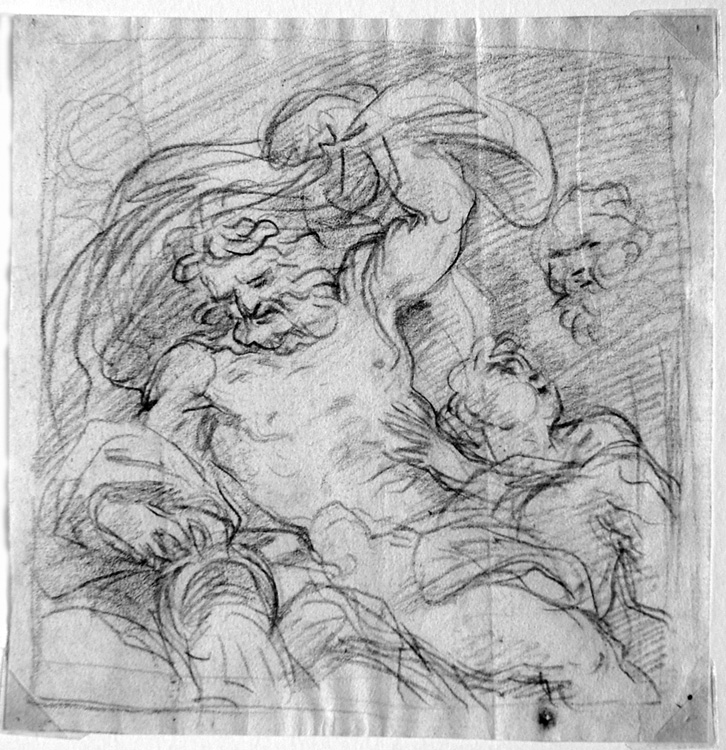
Baldassare Franceschini called Il Volterrano (Italian, 1611-1669), Aeolus supported by the winds. Black chalk on cream laid paper (watermark: 6-pointed star with a cross and the letter N in a circle–Briquet 6089 1587-88 and after). Il Volteranno was the son of a sculptor and a prodigy. He studied with Matteo Rosselli in Florence and was then sent to work with painters in Parma and Bologna. He worked in both fresco and oil for the Medici. Aeolus, the subject of our drawing, was the god of the winds in classical mythology. Here he rests upon a cloud accompanied by two of the Winds and observes the goings on beneath his throne. Image size: 143x148mm. Price: Please call or email for current pricing information.
For a selection of Il Volterrano's drawings, see Catalogue of An Important Gruop of Drawings by Baldassare Franceschini, called Il Volterrano (London: Sotheby's, 1980), which includes 102 lots.
|
|
|
 |
|
|
|
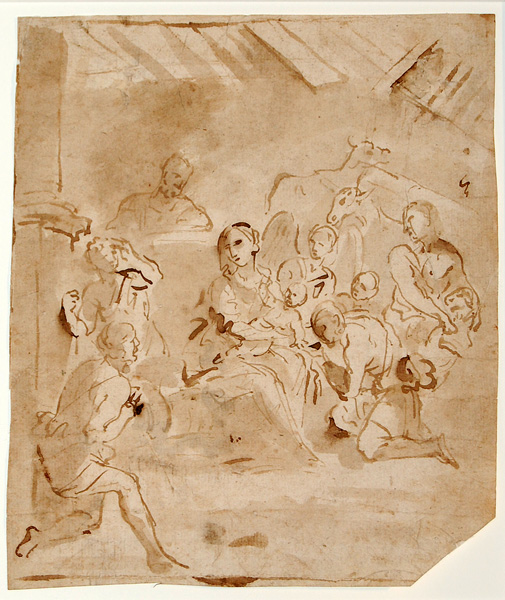
Pier Francesco Mola (Italian, 1612-1666), attributed to, Adoration of the Shepherds. Pen and brown ink and wash on thin laid paper, c. 1650. Lower right corner detached, holes and thin spots across the top of the drawing where the work was once glued down. Roseline Bacou, Great Drawings of the Louvre Museum: The Italian Drawings (NY: George Braziller, 1968), notes (fig. 92) that "Pier Francesco Mola did most of his early work in Northern Italy and did not go to Rome until 1642. The sensibility of his eclectic nature is disclosed in his poetic evocations of landscape backgrounds which show the influence of the Venetian school and of Guercino's luminism." Ever since one of Mola's paintings sold for almost Please call or email for current pricing information,000 the price of his drawings has risen sharply. Image size: 237x203mm. Price: Please call or email for current pricing information.
|
|
|
|
|
 |
|
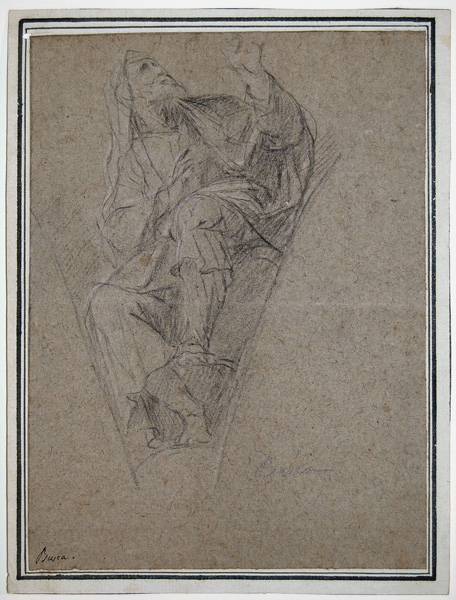
Antonio Busca (Milan, 1625-1684), Study of a Prophet Black and white chalk drawing on grayish-tan laid paper. Attributed to Busca in pen and black ink lower left recto and in pencil to the right and below the prophet's feet. Busca studied with Ercole Procaccini before travelling to Rome in 1650-51 with Giovanni Ghisolfini, where he came under the influence of Pietro da Cortona. Our drawing is a design for a pendentive, possibly in preparation for a commission to paint frescoes with prophets and angels in the cupola of the family chapel in San Vittore al Corpo in Milan in 1669. Two of his drawings were published by Ugo Ruggeri in Disegni Lombardi (Venice, 1982), numbers 148-49. Image size: 208x156mm. Price: Please call or email for current pricing information.
|
|
|
|
|
|
|
|
|
 |
|
|
|
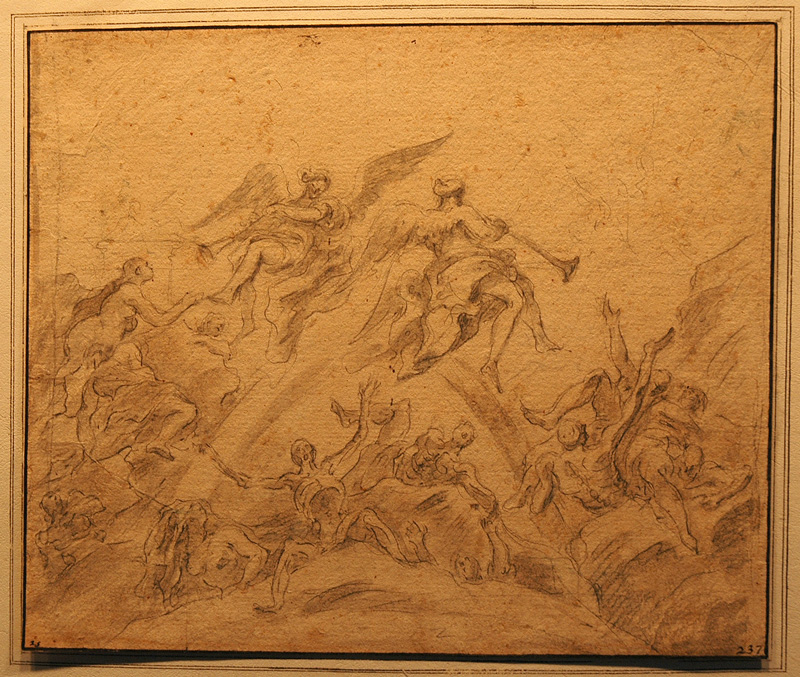
Paolo di Matteis (Italian, 1662-1728), The Last Judgment. Pencil and wash drawing formerly attributed to Luca Giordano. From the collections of W. Konig and Dr. Geiger. The Getty Museum gives a brief biography as follows:
Paolo de Matteis first trained in Luca Giordano's workshop in Naples. Before 1683 he launched his career in Rome, where, according to legend, he was "discovered" by the Spanish ambassador while copying altarpieces in Saint Peter's Cathedral. When the ambassador was nominated Viceroy of Naples, de Matteis followed him there. Responding to changing tastes and Carlo Maratta's influence, de Matteis developed a delicate, graceful manner that broke with the vigor of the Baroque. Within ten years, his reputation was international, rivaling that of Francesco Solimena. From 1702 to 1705, de Matteis worked for the French court in Paris, where he met influential nobles and bankers; the elegant French style confirmed the direction his painting had already taken. Returning to Naples, which the Austrians had seized from Spain, de Matteis accepted commissions from both the Austrian aristocracy and intellectuals and nobility abroad. Renowned for his speed and virtuosity, he also painted decorative schemes for Neapolitan churches. In 1712 the third Earl of Shaftesbury, a renowned aesthetician, hired de Matteis to paint a canvas according to the Earl's own aesthetic theories. Between 1723 and 1725, de Matteis lived in Rome, where he received a commission from Pope Innocent XIII. In his final years, he made models for sculpture in silver. Several of di Matteis' drawings are in the collection of the Metropolitan Museum of Art in New York City. Image size: 237x282mm. Price: SOLD.
|
|
|
 |
|
|
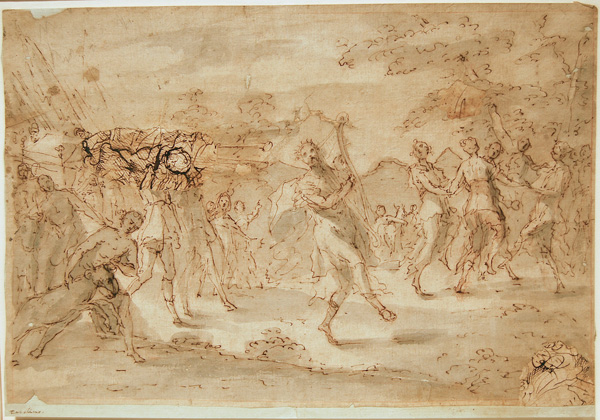
Italian School (late 16th-early 17th century). David Dancing Before the Ark of the Covenant. Pen and brown ink and gray wash on cream laid paper. There are three areas where the paper has suffered losses and those losses patched with pieces of other drawings (left center, upper right above the head of the 2nd dancer from left, and bottom right in the foliage). Laid down on card stock with a not-quite legible attribution ending in "chino." Image size: 260x387mm. Price: SOLD.
I would like to thank Professor Robert Randolf Coleman (Art History ), University of Notrew Dame(NOtre Dame, IN), for the corrected title. I had not noticed the arc being carried in the upper left.
|
|
|
 |
|
|
|
|
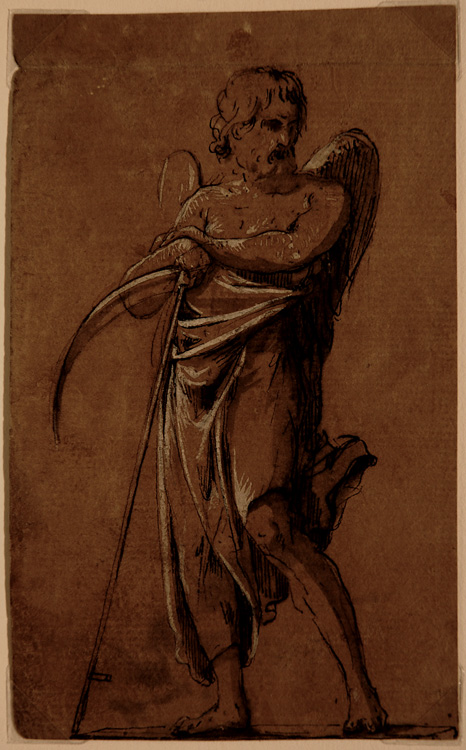
Italian School, early 17th-century. Time with his scythe. Pen and black ink and white bodycolor on brown laid paper, For a late 16th-century description of Time as the destroyer of all things beautiful, like the lilies of the field, see Edmund Spenser's The Faerie Queene, Book III, Canto vi, Stanza 39:
Great enimy to it, and to all the rest,
That in the Gardin of Adonis springs,
Is wicked Time, who with his scyth addrest,
Does mow the flowring herbes and goodly things,
And all their glory to the ground downe flings,
Where they doe wither, and are fowly mard:
He flyes about, and with his flaggy wings
Beates downe both leaues and buds without regard,
Ne euer pittie may relent his malice hard.
Image size: 157x96 mm. Price: Please call or email for current pricing information.
On my 24-inch monitor, this is about life-size.
|
|
|
|
|
|
 |
|
Italian School, 17th-century, Studies for a sculpture of John the Baptist in the wilderness with a lamb. Pen and brown ink and wash on laid paper. Beneath the two studies showing John leaning against a rock formation located upon a large flat rock (deal for a sculpture stand) holding his bowl in one hand and a cross in the other which he is using as a shepherd's crook, there is another drawing below showing a scantily-dressed woman reclining on some pillows (perhaps Salomé, perhaps Venus accompanied by Cupid). There is another drawing on the verso (see below) showing a kneeling figure presenting a head for the approval of a standing figure. Another figure, perhaps leaning on a cloud, perhaps leaning on a rock formation, watches. Beneath them, two more figures, a man and a woman or a woman and a child. This drawing exemplifies an important aspect of Renaissance drawing: paper was expensive, and the first thoughts of artists tended to be small and scattered. Examples can be easily found in the corpus of drawings by Michelangelo and Veronese. Image size: 130x100mm. Price: Please call or email for current pricing information.
On my 24-inch monitor, this is about life-size.
|
|
|
|
|
 |
|
Italian School, 17th-century, Studies for a sculpture of John the Baptist in the wilderness with a lamb—Verso. A kneeling figure presenting a head for the approval of a standing figure (Saul's head for David?). Another figure, perhaps leaning on a cloud, perhaps leaning on a rock formation, watches. Beneath them, two more figures, a man and a woman or a woman and a child. Image size: 130x100mm.
On my 24-inch monitor, this is about life-size.
|
|
|
|
|
|
 |
|
|
|
|
|
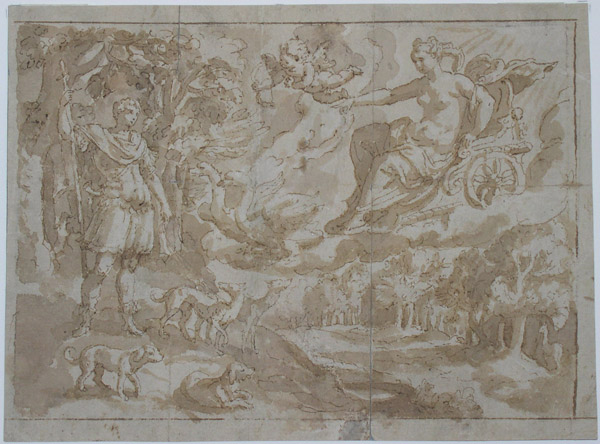
Italian School (early-mid 17th century). Venus warns Adonis not to hunt dangerous animals. Pen and brown ink and wash on cream laid paper. Venus accompanied by Cupid and seated in her chariot pulled by some very large doves warns Adonis to beware large savage animals like the boar that will shortly kill him, but to stick with small harmless ones. Adonis will disregard her warning and perish. Image size: 168x227mm. Price: SOLD.
|
|
|
 |
|
|
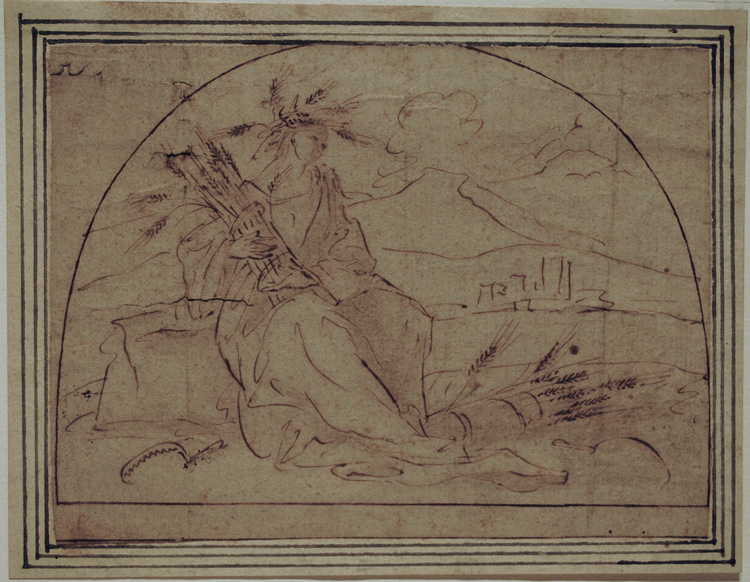
Italian School (early-mid 17th century). Ceres. Pen and brown ink on cream laid paper mounted on card stock. Ceres, the goddess of Agriculture, was a popular subject for artists in Renaissance both in Italy and the Netherlands. Image size: 110x145mm. Price: Please call or email for current pricing information.
|
|
|
 |
|
|
|
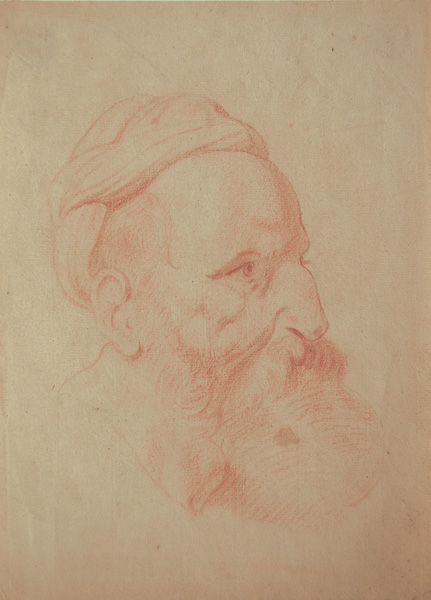
Italian School (17th century), Head of an old man turned to the right. Drawing in red chalk on thin laid paper. There is a wonderful clarity to the face of this man, recalling that of Domenichino and Guercino. The line is delicate but sure, the presentation is direct: this man is who he is with no apologies. Perhaps a study for a painting by the as-yet unidentified artist. Image size: 185x143mm. Price: Please call or email for current pricing information.
|
|
|
|
|
|
 |
|
|
|
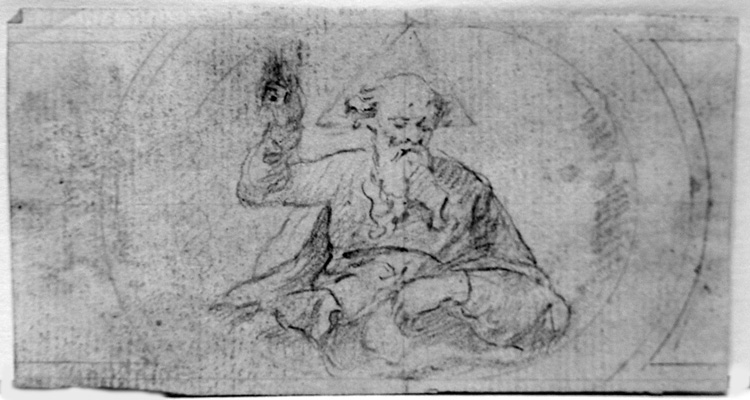
Italian School, 17th-century, The Trinity. Black chalk drawing on thin laid paper. The Father, surrounded by a triangular halo, holds his dead Son in his lap while a Dove spreads Its wings to cover Christ's face. The verso has been blacked out, perhaps to make a tracing to transfer this drawing to another sheet? From this oblong frame drawn around the composition, it would seem that this was a sketch for a ceiling composition to be inscribed within a roundel. Image size: 45x84mm. Price: Please call or email for current pricing information.
|
|
|
|
|
|
|
|
 |
|
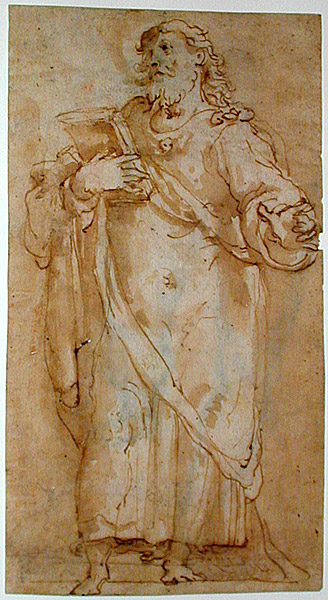
Italian School, 17th-century, Study of a Prophet. Brush and brown ink and wash drawing on cream laid paper. There is a study of a figure on the verso. Image size: 195x103mm. Price: SOLD
|
|
|
|
 |
|
|
|
|
F. Zanara (Italian, active late 17th century), Glorification of the Virgin. Sanguine drawing for a ceiling painting. Note the correction on the sheet of paper inserted into the drawing. From the collection of W. Konig. Image size: 345x345mm. Price: Please call or email for current pricing information.
|
|
|
|
|
 |
|
|
|
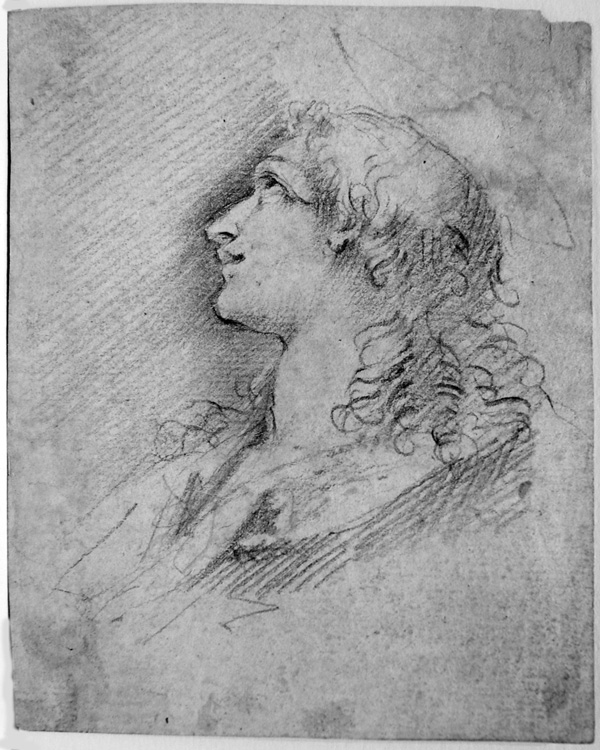
Italian School, late 17th-early 18th century, Portrait of a young gentleman. Black chalk drawing on heavy cream laid paper with no watermark. Some Veronese drawings show similarities to this composition. The uneven trimming of the paper suggests that it might once have been a part of a larger composition and may signal that this collection was put together for the assistants in the workshop of an artist successful enough that he needed assistants. Image size: 114x90 mm. Price: Please call or email for current pricing information.
On my 24-inch monitor, this is about life-size.
|
|
|
|
Spaightwood Galleries, Inc.
To purchase, call us at 1-800-809-3343 (1-508-529-2511 in Upton MA & vicinity) or send an email to spaightwood@gmail.com.
We accept AmericanExpress, DiscoverCard, MasterCard, and Visa.
We also accept wire transfers and paypal.
For directions and visiting information, please call. We are, of course, always available over the web and by telephone (see above for contact information). Click the following for links to past shows and artists. For a visual tour of the gallery, please click here. For information about Andy Weiner and Sonja Hansard-Weiner, please click here. For a list of special offers currently available, see Specials.
All works are sold with an unconditional guarantee of authenticity (as described in our website listing).
Go back to the top of this page.
Visiting hours: Saturday 10:00 am to 5:00 pm and Sunday noon to 6:00 pm and other times by arrangement.
Please call to confirm your visit. Browsers and guests are welcome.
|
|
|
|
|
|
|
|
|
|
|
|
|
|
|
|
|
|
|
|
|
|
|
|
|
|
|
|
|
|
|
|
|
|
|
|
|
|
|
|
|
|
|
|
|
|
|
|
|
|
|
|
|
|
|
|
|
|
|
|
|
|
|
|
|
|