|
Welcome to Spaightwood Galleries, Inc.
You can follow us on Facebook and Twitter!
We blog regularly on Facebook and announce special events and special sales on both sites.
Old Master Drawings and Engravings: Ludovico Carracci (Italian, 1555-1619)
|
|
|
|
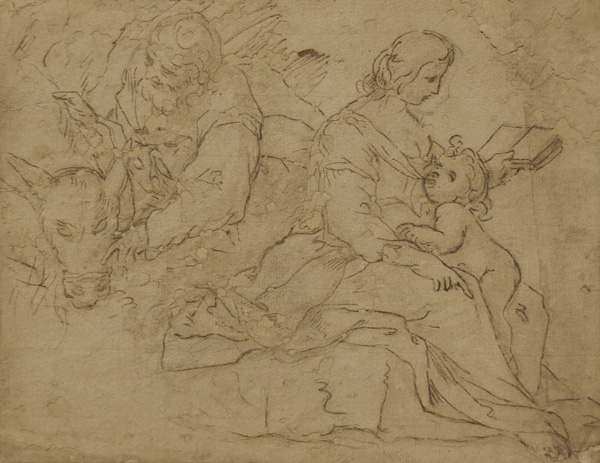
From their studio, the Italian brothers Annibale (1560-1609) and Agostino Carracci (1557-1602), with their cousin Ludovico (1555-1619), produced art that greatly influenced European painting and drawing of the 17th and 18th centuries. Through their study of nature and the art of Correggio, Titian, and Veronese, they rejected the mannered approaches of contemporaries and laid the foundation for the development of Baroque art. Though many drawings were studies in preparation for painting commissions, they drew everything they observed more extensively than previous generations of artists: people, animals, landscapes, and everyday life scenes. They studied these drawings and students in the Academy they founded studied them. Their drawings influenced the great English architect, Inigo Jones, and Carracci drawings entered England's Royal Collection as early as the 1700s.
As Nicholas Turner writes in his lengthy essay on Ludovico in the Grove Dictionary of Art (3, 849-56), "The Carracci's artistic reform was rooted in a profound disaffection with current Mannerist practice and an equally deep commitment to north Italian naturalism and colore. In order to escape the sterility of maniera, they turned to the study of nature on the one had and of the paintings of non-Mannerist artists such as Corregio, Titian, and Veronese on the other. Incorporating elements of these masters' stules into their own works, they sought to combine truth to nature with a direct appeal to the beholder's sentiments. Within a decade, they overcame initial oppostion to their new style and were acknowledged as the leading artists in Bologna." After Annibable and Agostino left for Rome to work for the Farnese family, Ludovico was the leading recipient of commissions for altarpieces and frescoes in Bologna for the next 10 years until Guido Reni began challenging him by underbidding him by as much as 50%.
We will be adding illustrations of engravings by Annibale and Agostino as soon as time permits.
Selected Bibliographty:
Diane DeGrazia Bohlin, Prints and related drawings by the Carracci Family. A catalogue raisonne (Washington DC: National Gallery of Art, 2000); Babette Bohn, Ludovico Carracci And The Art Of Drawing (Harvey Miller Publishers, 2005); Alessandro Brogi, Ludovico Carracci 1555-1619 (2 vol.; Bologna: Ediz.Tipoarte 2001); Andrea Emiliani, Le storie di Romolo e Remo di Ludovico Agostino e Annibale Carracci in Palazzo Magnani a Bologna (Padova, 1989); Andrea Emiliani, Ludovico Carracci (Bologna: Nuova Alfa Editoriale, 1993; English edition, with essay and catalogue by Gail Feigenbaum published Fort Worth: Kimbell Art Museum, 1994); Carl Goldstein, Visual Fact over Verbal Fiction. A Study of the Carracci and the Criticism, Theory, & Practice of Art in Renaissance & Baroque Italy (Cambridge: Cambridge University Press 1990); Diane De Grazia, Corregio and His Legacy: Sixteenth-Century Emilian Drawings (Washington: National Gallery of Art, 1984); (Andreas Henning and Scott Schaefer, ed. Captured Emotions: Baroque Painting on Bologna, 1575-1725 (Los Angeles: J. Paul Getty Museum, 2008); Catherine Loisel, Louvre Drawing Library: Ludovico Carracci (Milano: Five Continents, 2004); Emilio Negro e Massimo Pirondini, ed. La Scuola dei Carracci dall'Accademia alla Bottega di Ludovico (Modena: Poligrafico Artioli 1994); Donald Posner, Annibale Carracci: A Study in the Reform of Italian Painting around 1590, 2 vols. (NY: Phaidon, 1971); Clare Robertson and Catherine Whistler, Drawings by the Carracci from British Collections (Oxford: Ashmolean Museum, 1996).
|
|
|
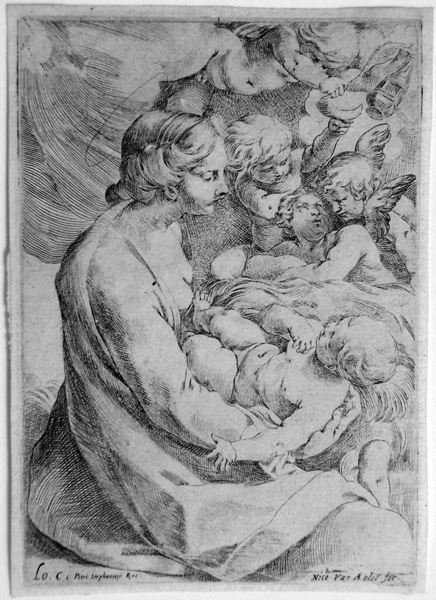
Madonna and Child with Angels (Bartsch 2 iii/iii; Bohlin 3 iii/iii). Engraving and etching, c. 1595-1610, c. 1606. Signed "Lo[dovico]. C[arracci]. Petri Stephanony Exc [i.e Lodovico Carracci engraved it, Petri Stephanony published it.]" lower left; lower right: Nico. van Aelst for[mis] or published it." The preparatory drawing for this print is in the British Museum and is reproduced by Bohlin as fig. 3a on p. 484). The first edition was published by Stephanoni (Vicenza before 1589?-Rome, after 1614), the second by Joannes Orlandi (Giovanni Orlandi, active Rome and Naples c. 1590-1644), and the third by Nicholas Van Aelst (active Brussels and Rome, 1582-1623). If Bohlin is correct, the terminus for publication is 1623; if Le Blanc, who gave the second edition to Van Aelst and the third to Orlandi, the terminus is still 1623. Given Lodovico's very limited output—he only made 4 print— all of his prints are rare and hard to find. Image size: 163x115mm. Price: Please call or email for current pricing information.
|
|
|
|
Spaightwood Galleries, Inc.
To purchase, call us at 1-800-809-3343 (1-508-529-2511 in Upton MA & vicinity) or send an email to spaightwood@gmail.com.
We accept AmericanExpress, DiscoverCard, MasterCard, and Visa.
We also accept wire transfers and paypal.
For directions and visiting information, please call. We are, of course, always available over the web and by telephone (see above for contact information). Click the following for links to past shows and artists. For a visual tour of the gallery, please click here. For information about Andy Weiner and Sonja Hansard-Weiner, please click here. For a list of special offers currently available, see Specials.
All works are sold with an unconditional guarantee of authenticity (as described in our website listing).
Copyright 2004-2017, Spaightwood Galleries, Inc.
Go back to the top of this page.
Visiting hours: Saturday 10:00 am to 5:00 pm and Sunday noon to 6:00 pm and other times by arrangement.
Please call to confirm your visit. Browsers and guests are welcome.
|
|
|