Click image for BBB rating
See our Privacy Policy
cool="cool" width="785" height="10942" border="0" cellpadding="0" cellspacing="0" gridx="16" showgridx="showgridx" usegridx="usegridx" gridy="16" showgridy="showgridy" usegridy="usegridy" bgcolor="#99ccff">
|
|
|
 |
|
|
|
|
|
|
|
Spaightwood Galleries
120 Main Street, Upton MA 01568-6193; 800-809-3343
|
|
|
|
|
|
The title of this show is actually a misnomer; a more accurate title would indicate that this is the art that the Kaiser hated, that the right-wingers who helped to bring about the downfall of the Weimar Republic hated, and that the militarists who ultimately threw their support to the Nazis hated. And yet, it is still amisnomer: in a sense, the term German Expressionism really means Modernist works done in Germany and Austria from the late 19th century until the Nazis took control, after which the works went underground, but, in many cases, continued to be made until the artist making them died. Just as French Impressionism reallymeant Modernist works made in France by people who had in common only their rejection of the official art that preceded them and that dominated the salons when the artists whom we now call the Impressionists began trying to show their works. It spawned in due time other movements like Post-Impressionism, Pointilism, the Nabis, the Symbolists, and ultimately the modernists who turned away from these variants of their predecessors and gave birth to Cubism, Fauvism, and Surrrealism; so the German Modernists had varied interests: The artists of the Blaue Reiter (Blue Rider) Group—Kandinsky, Klee, Munter, Marc, and Macke—were moving toward abstraction, the artists of Die Brücke (the Bridge), led by Erich Heckel, E. L. Kirchner, Max Pechstein, Emil Nolde, and Karl Schmidt-Rottlff were rejecting their immediate predecessors and trying to create an art that linked the great German artists of the Renaissance, especially Dürer, whose masterful woodcuts seemed the perfect vehicle for a new renaissance of German art, with an art for the present and the future. The first World War, which seemed to artists like Kokoschka and Dix to offer a chance to see heroism in action and perhaps to be heroic (Dix was a machine gunner, Kokoschka was a cavalry officer), quickly led instead to horror and mental breakdowns, and the aftermath of the war led to cynicism and disgust at the society that replaced the autocratic rule of the Kaiser. The Dadaists (including Hoch, Schlicter, and Grosz as well as Duchamp, Arp, and Picabia)) began with a feeling of disgust and hatred for the war and moved on to reject the values that allowed it to occur, nationalist politics and a culture of materialism. They rejected the conventions of their society and the art that had nurtured and sustained that society, cultivating a sense of the absurd and seeking artistic techniques to embody their contempt for it. The Neue Sachlichkeit (New Objectivity) group, including Max Beckmann, Otto Dix, George Grosz, Rudolf Schlichter, and Georg Tappert, hoped through their art to change their society by, as Grosz wrote, convincing "the world that it was ugly, sick, and mendacious." Kollwitz and Barlach, whose work predated all of these movements, yet agreed politically and artistically in the need to hold a mirror up to society so that it might see how much it needed to change itself. Artists like Meidner and Hofer do not easily fit into these groups, yet are clearly of their time, Hofer seeking symbolic forms to suggest the possibility of a more ideal life and the reality of approaching disasters, Meidner imagining the apocaltpse to come and portraying the passionate intensity of those who would bring it about.
Selcted Bibliography: Stephanie Barron and Wolf-Dieter Dube, ed., German Expressionism: Art and Society (NY: Rizzoli, 1997); Stephanie Barron, et al, German Expressionist Prints and Drawings. The Robert Gore Rifkind Center for Expressionist Studies, Vol. 1 (LA: Los Angeles County Museum of Art, 1989); Stephanie Barron, ed, German Expressionism 1915-1925: The Second Generation (LA: Los Angeles County Museum of Art, 1988); Frances Carey and Anthony Griffiths, The Print in Germany 1880--1933: The Age of Expressionism (London: British Museum, 1984, 1993); Stephanie D'Allessandro, et al, German Expressionist Prints: The Marcia and Granvil Specks Collections (Milwaukee: Milwaukee Art Museum, 2003); Bruce Davis, German Expressionist Prints and Drawings. The Robert Gore Rifkind Center for Expressionist Studies, Vol. 2: Catalogue of the Collection (LA: Los Angeles County Museum of Art / Prestel, 1989);Bruce Davis, German Expressionist Prints and Drawings: The Robert Gore Rifkind Center for German Expressionist Studies Elvejhem Museum of Art, The Graphic image: German Expressionist Prints (Madison: Elvejhem Museum of Art, 1983); Reinhold Heller, Brücke: German Expressionist Prints from the Granvil and Marcia Specks Collection (Evanston: Mary and Leight Block Gallery, Northwestern Uninversity, 1988); Orrel P. Reed Jr., German Expressionist Art: The Robert Gore Rifkind Collection—Prints, Drawings, Illustrated Books, Periodicals, Posters (Los Angeles: Frederick S. Wight Art Gallery, University of California, Los Angeles, 1977); Andrew Robison, ed., German Expressionist Prints from the Collection of Ruth and Jacob Kainen (Washington, D.C.: National Gallery of Art, 1985); Serge Sabarsky, Graphics of the German Expressionists (Mt. Kisco NY: Moyer Bell Ltd, 1984); Peter Selz, German Expressionist Painting (Berkeley: University of California Press, 1957, 1974); Horst Uhr, Masterpeices of German Expressionism at the Detroit Institute of Arts (NY: Hudson Hills Press, 1982); Shane Weller, ed, German Expressionist Woodcuts (NY: Dover, 1994).
|
|
|
|
|
|
|
|
 |
|
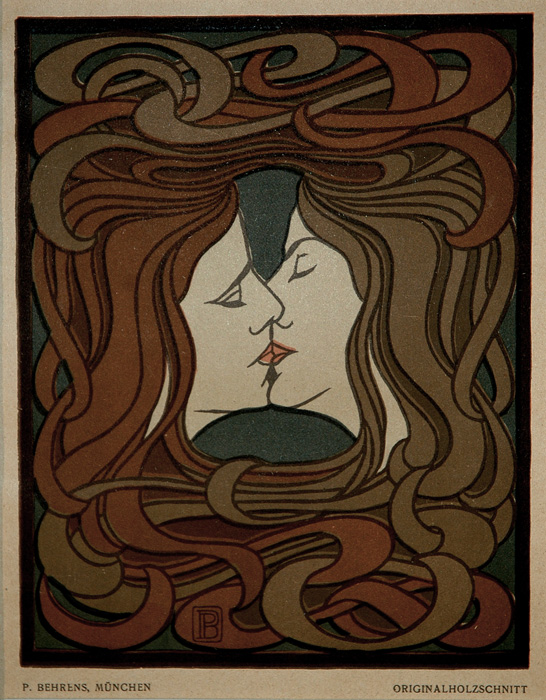
Peter Behrens (German, 1886-1940), Untitled / The Kiss. Original 6-color woodcut, c. 1898. According to Iain Boyd White, "The Kiss depicts a kissing couple, their faces framed and joined by voluptuous Jugendstil curves formed of their own tresses." One of the most acclaimed prints of the Jugendstil movement and a modern masterpiece. Image size: 272x215mm. Price: Please call or email for current pricing information.
|
|
|
|
|
 |
|
|
|
|
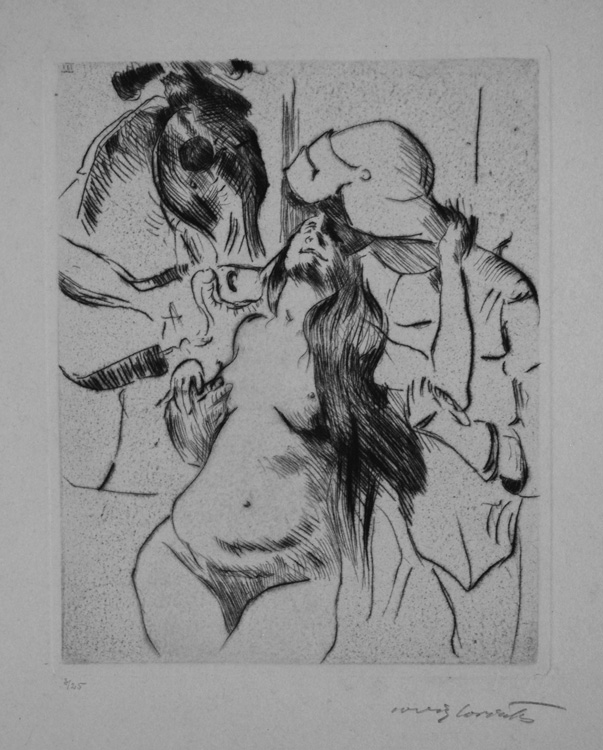
Frauenraub IV / Rape IV (Schwartz 176). Original etching, 1914. 25 signed and numbered impressions on Van Gelder paper, of which ours is n. 3/25. One of the most important German Impressionist painters, Lovis Corinth gradually became more and more expressionist in his art early in the second decade of the 20th century. Originally fiercly hostile to expressionism, he underwent a major transformation, perhaps reflected in the brooding quality of his work, and was welcomed by the German Expressionists. After Hitler came to power, his works were posthumously declared decadent and they were exhibited with the other German Expressionists declared morally unfit by the Nazis and burnt in the Nazi bonfires. Corinth's works have been shown frequently in American and European museums and galleries since the end of World War II.Image size: 250x200mm. Price: Please call or email for current pricing information.
|
|
|
|
|
|
|
 |
|
|
|
|
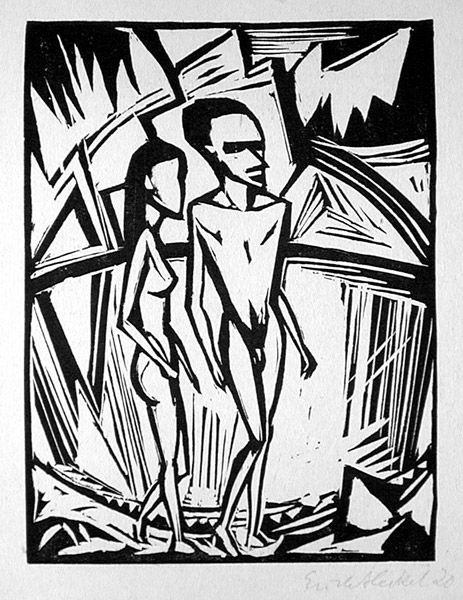
Erich Heckel (German, 1883-1970), Zwei am Meer / Couple by the sea (Dube 326, Davis-Riffkind 1052). Original woodcut, 1920. Edition: 100 signed and dated impressions published in the deluxe edition of Paul Westheim's Das Holzschnittbuch (Pottsdam, 1921). A very good dark and evenly printed impression. Illustrated A Breadth of Vision: The Ritz Collecetion (Milwaukee Art Museum, 1992), p. 18; illustrated in German Expressionist Prints from the Collection of Ruth and Jacob Kainen (Wasington DC: NAtional Gallery of Art, 1985), p. 64. Image size: 178x136mm. Price: Please call or email for current pricing information.
|
|
|
|
|
|
|
 |
|
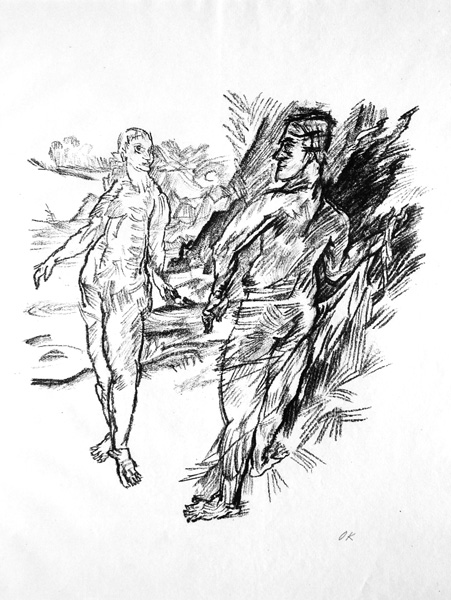
Oskar Kokoschka (Austria, 1886-1980, Bergegnung / Encounter (Wingler-Welz 51, Davis-Rifkind 1562: 9). The Man (Kokoschka) and the Woman (Alma Mahler) meet. The Woman reaches out to the Man, who seems both attracted and uncertain about whether to respond. Iconographically the imagae reminds us of the fall of Adam in the Garden of Eden as he accepts the Apple Eve offers him. Image size: 309x295mm. Price: Please call or email for current pricing information.
|
|
|
|
 |
|
|
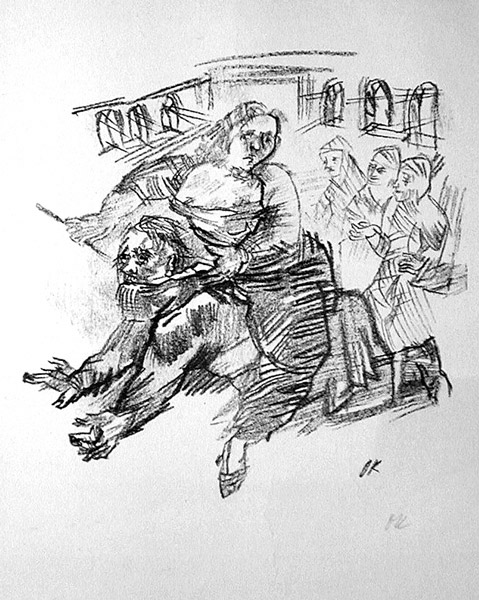
Oskar Kokoschka (Austria, 1886-1980, England), Aristoteles und Phyllis (Davis-Rifkind 1561: 2, Wingler-Welz 36). Original lithograph, 1914. Initialed in pencil lower right and signed in the stone. A fine impression with full margins. Ours is one of 30 signed and numbered impressions with large margins from the portfolio edition. There was also a book edition of 200 for Die chinesische Mauer / The Chinese wall (Leipzig: Kurt Wolff Verlag, 1914). The image depicts the philosopher Aristotle saddled and ridden by Phyllis, a young woman whom he had previously told Alexander to avoid, because rulers needed to rule their passions. After Aristotle himself fell in love with her, she punished him by showing him that men are indeed the slaves of their lusts. A favorite theme in the art of the early German Renaissance, Kokoschka is here reviving it in recognition of his own enslavement to his desires for Alma Mahler. Image size: 280x278mm (plus large margins). Price: Please call or email for current pricing information.
|
|
|
|
|
|
|
|
|
 |
|
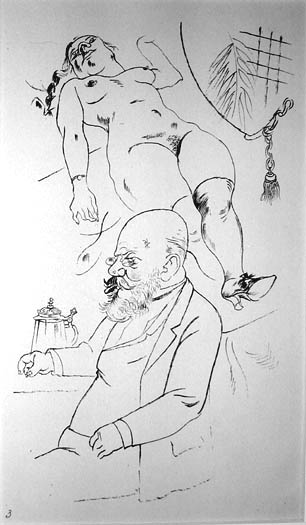
Georg Grosz (German, 1893-1958), Jugendzeit / Halcyon Days (Duckers S1-3, Davis-Rifkind 952: 3). Offset lithograph for Ecce Homo, 1922. Our impression from the unsigned Ausgabe C of the first edition of Ecce Homo (Berlin, 1923). The image seems to depict Freud making notes while thinking about naked women he has known. Image size: 277x160mm. Price: Please call or email for current pricing information.
|
|
|
|
 |
|
Karl Hofer (German, 1878-1955)., Zenana plate 3: Couple (Rathenau 175). Original lithograph, 1923. Published in Zenana, a portfolio of 11 original lithographs published by Marees-Gesellschaft R. Piper & Co., Munich; printed by Hermann Birkholz, Berlin for Marees-Gesellschaft. Edition size: 200 signed impressions, 80 on Japon and 120 on Velin with the drystamp of the Marees-Gesellschaft, of which ours is one. Illustrated in Ruckhaberle, et al, Karl Hofer 1878-1955. Image size: 272x171mm. Price: Please call or email for current pricing information.
|
|
|
|
|
|
 |
|
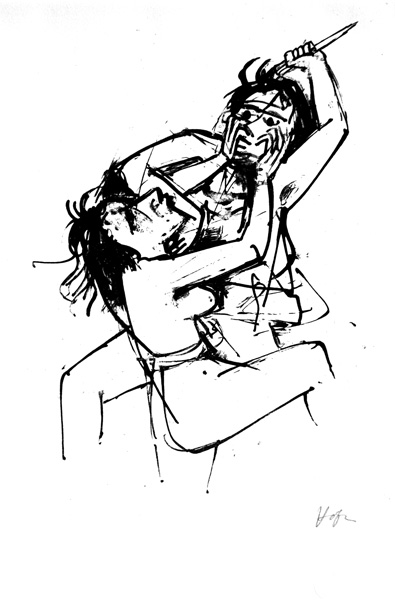
Karl Hofer (German, 1878-1955)., Zenana plate 9: Lustmord (Rathenau 181). Original lithograph, 1923. Published in Zenana, a portfolio of 11 original lithographs published by Marees-Gesellschaft R. Piper & Co., Munich; printed by Hermann Birkholz, Berlin for Marees-Gesellschaft. Edition size: 200 signed impressions, 80 on Japon and 120 on Velin with the drystamp of the Marees-Gesellschaft, of which ours is one. Illustrated in Ruckhaberle, et al, Karl Hofer 1878-1955. Image size: 267x183mm. Price: Please call or email for current pricing information.
|
|
|
|
 |
|
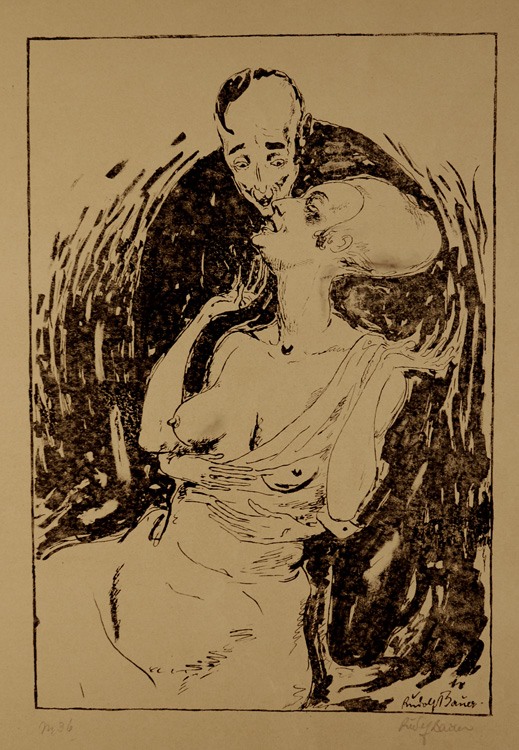
Rudolf Bauer (Germany, 1889-1953, USA), Amorous Couple. Original lithograph on tan paper, c. 1914-1921. Edition size unknown. Our impression is numbered 36 lower left, signed in the stone and pencil-signed lower right. Bauer was involved in the avant-garde group Der Sturm in Berlin and showed with them from 1915-1925. His work was central to the Non-Objective art collection of Solomon R. Guggenheim. His works were included in the Nazi's Degenerative Art Show and, after returning from America, where he sold some paintings to Guggenheim, he was arrested and jailed by the Gestapo for "Black-market speculation." Bailed out by Guggenheim and spirited to the U.S. in 1939, his work was crucially important to the early years of the Guggenheim Museum's exhibitions until, after Solomon Guggenheim's death, all of the "Non-Objective" art, except for Kandinsky's works, was put into storage. There has been a revival of his work recently. In 1967 Bauer’s work was shown at the Guggenheim in Seven Decades: A Selection for the first time since his death. In 1969 his work was given a large retrospective at the Galerie Gmurzynska in Cologne. This was followed by several solo exhibitions in New York and Europe. Since that time, Bauer’s work has begun to get more attention from art collectors and museums. In 2005 the Guggenheim Museum mounted Art of Tomorrow: Hilla Rebay and Solomon R. Guggenheim, which featured many Bauer works and traveled also to the Museum Villa Stuck and the Deutsche Guggenheim, Berlin. A major retrospective of Bauer’s work took place at Weinstein Gallery, San Francisco, in 2007, and Steven Lowy's study, Rudolf Bauer, published for the show illustrates a gouache, ink, and watercolor of this same subject; see p. 131) . Image size: 421x287mm. Price: Please call or email for current pricing information.
|
|
|
|
|
|
|
|
 |
|
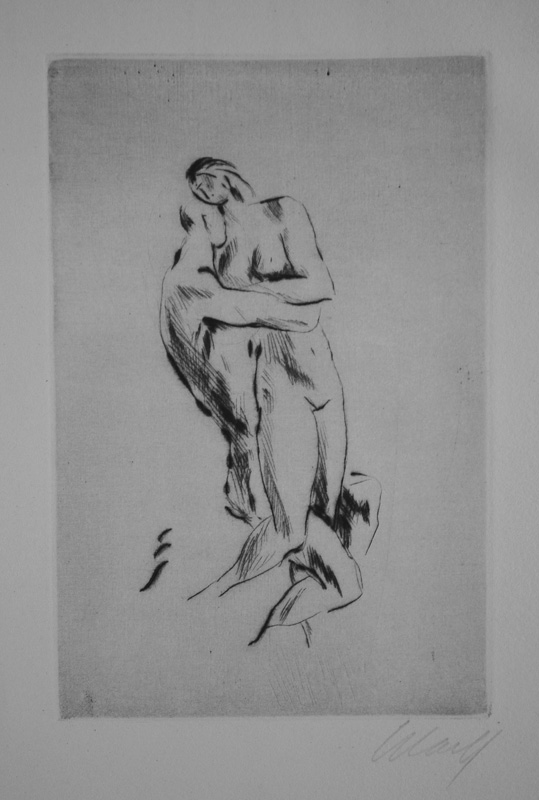
Edwin Scharff (German, 1887-1955), Amorous Liebespaar / Lovers. Original etching, 1922. 100 pencil-signed impressions for the deluxe edition of the Jahrbuch der Jungen Kunst, one of the most important German Expressionist annual publications. Ours is a beautiful impression with rich detail in the dark areas and very good plate tone. The Robert Gore Rifkind Collection of German Expressionist Art at the Los Angeles County Museum of Art illustrates 16 of his prints in their their catalogue raisonné, although they lack this one. In addition to his work as a printmaker, Scharff was also a painter and a sculptor. On a fellowship to Paris, Scharff became acquainted with the works of Rodin and Maillol and produced his first important sculptural works c. 1913. He was one of the founders of the Muenchener Neue Secession in 1913. Seriously wounded during World War I, his post-war works tended to become more abstracted figurally. In 1923, he was appointed to the post oof Professor of Sculpture in Berlin, from which he was removed by the Naxis in 1933. Condemned by the Nazis as a "degenerate" artist in 1937, he was forbidden to make any artworks, though he continued to do so in secret, working in the sacristy of a church. After the fall of the Third Reich, he worked from 1945-1949 on the bronze portal for a church in Marienthal. In 1946 he was appointed a professor at the Landeskunst schule in Hamburg. Scharff's works are also in the permanent collections of The Museum of Modern Art, the Fine Art Museums of San Francisco, the Lehmbruck Museum in Duisburg, the Hamburg Kunsthalle, the Scharff Museum in Neu-Ulm, and the University of Michigan Art Museum. Image size: 146x95mm. Price: Please call or email for current pricing information.
|
|
|
|
|
 |
|
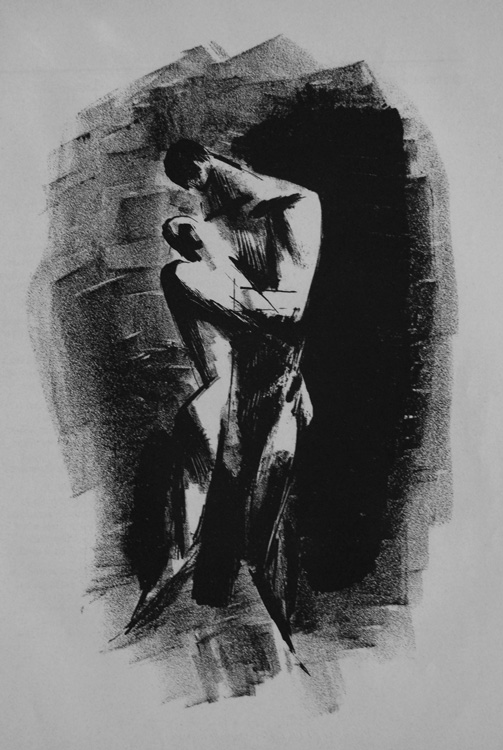
Edwin Scharff (German, 1887-1955), Die Bruder / Brothers (Davis-Rifkind 2476). Original lithograph, c. 1921. Published on wove paper with no watermark in Genius. Zeitschrift für alt und werdende Kunst with the printed text on the verso: "Edwin Scharff / Die Bruder. Originallithographie." Image size: 270x170mm. Price: Please call or email for current pricing information.
|
|
|
|
 |
|
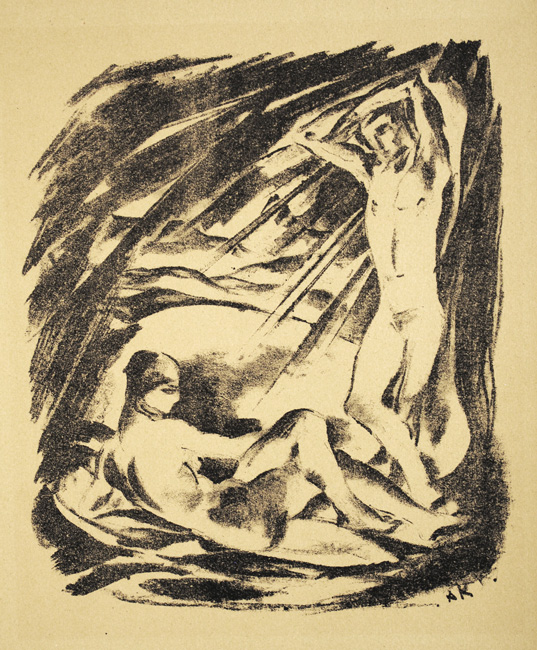
Adolf Koglsperger (German, 1891-), Hohe Stunde / The Sublime Hour (Davis-Rifkind 1550). Original lithograph, 1919. Published on wove paper in the Joachim Kirchner portfolio, Junge Berliner Kunst (Berline: Ernst Wasmuth, 1919). Signed in the stone lower right with the initials AK. Image size: 213x181mm. Price: Please call or email for current pricing information.
|
|
|
|
 |
|
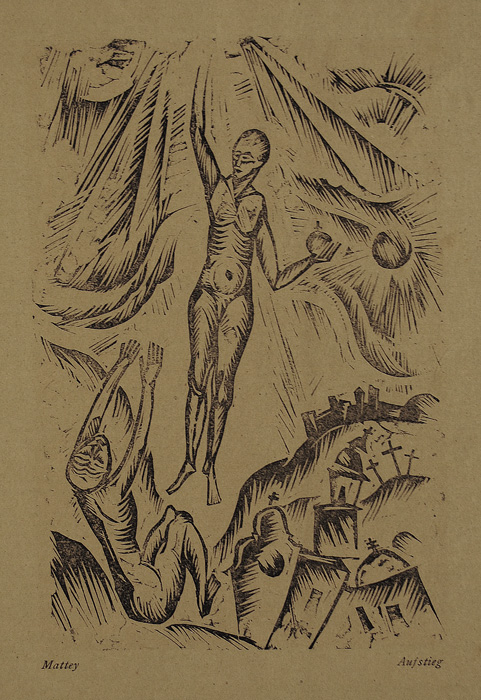
Georg A. Mathey (German, 1888-1968), Aufstieg / Ascent (Davis-Rifkind 1874). Original woodcut on wove paper, 1919. Published Die Aktion 9: 2/5 (1919). Some browning at edges far from the image with accompanying scattered losses not affecting the woodcut itself. Printed text "Mattey" lower left beneath woodcut and "Aufstieg" lower right. A powerful depiction of the desire for spiritual ascent at the heart of German Expressionism with a possible political overtones with the establishment of the Weimar Republic and the end of the autocratic rule of the Kaiser. Image size: 179x120mm. Price: Please call or email for current pricing information.
|
|
|
|
|
|
|
 |
|
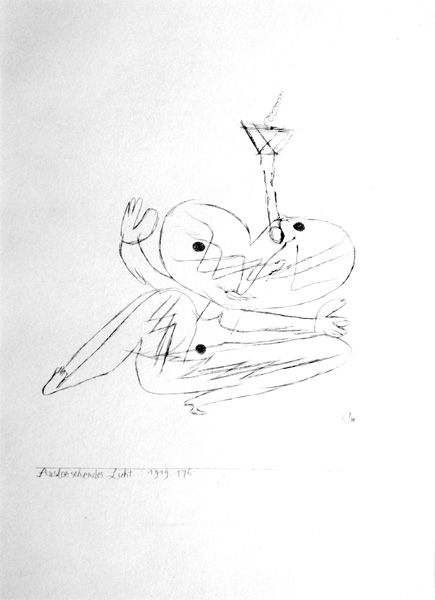
Paul Klee (Swiss, 1879-1940), Auslöschendes Licht / Extinguished Light (Kornfeld 75b; Davis-Rifkind 1492). Original lithograph, 1919. Edition: second state of two, signed "Klee" in the stone lower right; titled and dated in the stone lower left, with the printed text verso giving title, artist, and identifying it as an "originallithographie." Published in Das Kestner Buch (Hannover, 1919). A heart-faced figure throws an extinguished torch in the air while preparing to leap up or in the process of falling down. The gender ambiguity combines with the uncertain action to suggest the trials of the heartL love lost but not forgotten: the light, after all, will come again with the morning. Image size: 160x130mm. Price: Please call or email for current pricing information.
|
|
|
|
|
|
|
 |
|
|
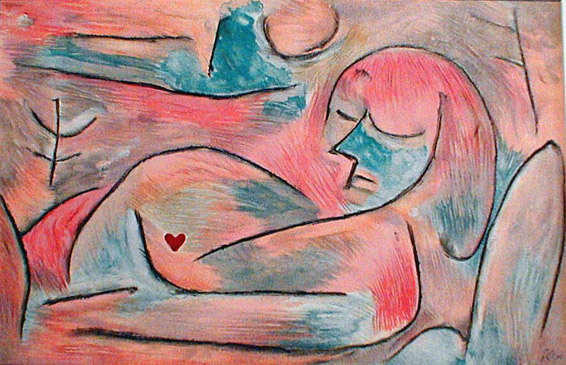
Paul Klee (Swiss, 1879-1940), Sommeil d'hiver / Winter's Dream. Original lithograph, 1938. Edition: as published in the deluxe art review Verve in 1938. Signed in the stone. On the reverse there is a black & white lithograph by Joan Miro which incorporates Klee's name and the title of the work. What an aparently very pregnant Winter dreams of is the coming of new life with the spring. Image size: 349x250mm. Price: Please call or email for current pricing information.
|
|
|
|
|
Spaightwood Galleries, Inc.
To purchase, call us at 1-800-809-3343 (1-508-529-2511 in Upton MA & vicinity) or send an email to spaightwood@gmail.com.
We accept AmericanExpress, DiscoverCard, MasterCard, and Visa.
We also accept wire transfers and paypal.
For directions and visiting information, please call. We are, of course, always available over the web and by telephone (see above for contact information). Click the following for links to past shows and artists. For a visual tour of the gallery, please click here. For information about Andy Weiner and Sonja Hansard-Weiner, please click here. For a list of special offers currently available, see Specials.
All works are sold with an unconditional guarantee of authenticity (as described in our website listing).
Copyright 2004-2017, Spaightwood Galleries, Inc.
Go back to the top of this page.
Visiting hours: Saturday 10:00 am to 5:00 pm and Sunday noon to 6:00 pm and other times by arrangement.
Please call to confirm your visit. Browsers and guests are welcome.
|
|
|
|
|
|
|
|
|
|
|
|
|
|
|
|
|
|
|
|
|
|
|
|
|
|
|
|
|
|
|
|
|
|
|
|
|
|
|
|
|
|
|
|
|
|
|
|
|
|
|
|
|

